
Table of Contents
Key Takeaways
1. Communication is a clinical skill and a business growth engine.
Poor communication drives cancellations, low case acceptance, weak reviews, malpractice risk, and operational friction, even when clinical care is excellent.
2. The most effective practices use the “5 Cs” to create consistency.
Clarity, correctness, conciseness, completeness, and cohesiveness turn communication into a predictable system that reduces anxiety, improves trust, and boosts treatment acceptance.
3. Modern patients expect partnership, transparency, and simple language.
Using visuals, consistent messaging, digital tools, and empathetic interactions, from scheduling to payment, creates a patient experience that feels trustworthy, modern, and aligned with patient values.
Introduction
If your schedule looks full but your production, reviews, or case acceptance don’t match, there’s a good chance the culprit isn’t your clinical care, it’s your dentist patient communication.
One study found that patients remember less than half of the oral health advice they receive, which shows just how easily important information gets lost.
Communication isn’t just what you say in the operatory. It’s every text reminder, front desk script, hallway conversation, post-op call, and portal message a patient receives. When your communication quality is clear, consistent, and human, your patient experience improves along with loyalty, referrals, and collections. When it isn’t, you see more no‑shows, confusion, and bad patient experience, even if your dentistry is excellent.
Strong dentist patient communication elevates:
- Patient satisfaction and trust
- Treatment acceptance and adherence
- Referrals and online reviews
- Reduced complaints and malpractice risk
- More predictable, sustainable practice growth
Let’s unpack how this actually works in a busy dental office and where to start.
Hidden Costs of Poor Communication
A. Daily Symptoms You’re Probably Normalizing
Most offices don’t wake up one day with “a communication problem.” It creeps in slowly:
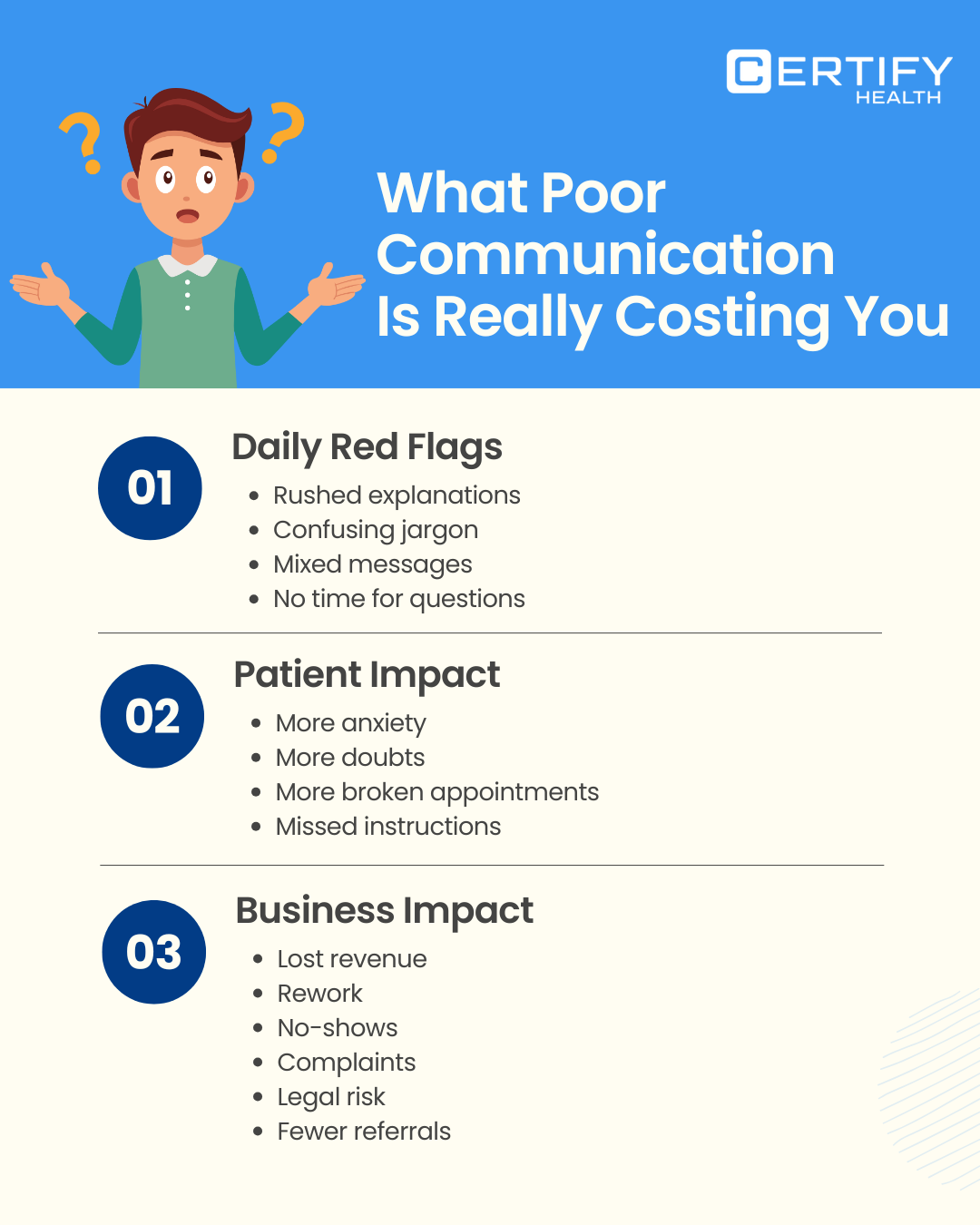
- Rushed explanations because you’re running behind
- Jargon-heavy dental communication that makes sense to clinicians—but not to patients
- Different answers from different team members about cost, coverage, or next steps
- No real time for questions, so patients just nod and leave confused
- Mixed messages between text reminders, front desk staff, and the dentist
The impact of poor communication shows up as:
- More phone calls asking, “Do I really need this?” or “What am I being charged for?”
- Staff spending extra time re-explaining treatment and financials
- Patients feeling anxious, dismissed, or “talked at” rather than talked with
This is where dentist patient interaction can either calm fears and build trust or accidentally send the signal that patients are just another slot in the schedule.
Common Question
Isn’t some confusion just part of dentistry?
No. Complex care is hard, but confusion is optional. With intentional dentist patient communication skills and better processes, you can dramatically reduce misunderstandings and callbacks.
B. How Gaps Erode Patient Experience
Dental communication outcomes are rarely neutral. It either lessens or increases anxiety.
When there are gaps in dentist patient communication, patients:
- Overestimate pain and risk because no one walked them through what to expect
- Delay or avoid needed treatment, especially high-ticket or elective cases
- Break appointments because they never emotionally “bought in”
- Ignore post-op instructions, leading to complications and avoidable emergencies
These poor communication effects build over time. You can have highly skilled clinicians and still deliver a bad patient experience simply because the message, tone, or timing is off.
Beyond experience, the impact of poor communication shows up in:
- Higher complaint volume to front desk or practice leadership
- Greater malpractice exposure when patients feel “no one told me” or “I didn’t understand”
In other words, dental communication is both a clinical safety tool and a business risk-control tool.
C. Business Impact You Can Actually Feel
Although it isn’t listed as a line item in your P&L, “communication” is ingrained in
everything:
Financial & Productivity Costs
- Lost revenue & rework: Staff redo tasks, correct mistakes, or chase patients for clarity
- Project failures: Misaligned goals derail initiatives and tech adoption
- Broken appointments: Unclear value = more no-shows and last-minute cancellations
- Treatment deferrals: Patients accept only the minimum
- Legal & compliance risks: Miscommunication increases malpractice exposure
Morale & Culture Costs
- Eroded trust: Mixed messages from leadership reduce team confidence
- Low engagement: Staff feel unheard or unclear on expectations
- Silos: Teams hoard information, leading to conflict and inefficiency
Customer & Quality Costs
- Weak patient experience: Confusion makes patients look elsewhere
- Errors & defects: Poor handoffs produce scheduling, billing, and clinical mistakes
- Lower referrals: “The dentist doesn’t explain things” kills word of mouth
When communication is inconsistent, you also see:
- Patients switching to practices that “listen better”
- Fewer 5-star reviews and more lukewarm feedback
- Lower production per visit and unpredictable schedules
Flip that script, and strong communication benefits become obvious: higher loyalty, better case acceptance, stronger word of mouth, and a more predictable schedule.
You might also like to read: 10 Proven Dental Patient Engagement Strategy to Improve Interaction & Revenue
What Today’s Dental Patients Expect
A. From “Doctor Knows Best” to Partnership
Modern patients don’t just want a clinician, they want a partner. They expect patient-centered care that:
- Includes them in decisions, not just informs them after the fact
- Respects their fears, cultural background, budget, and time constraints
- Offers options and explains trade-offs in plain language
This is where alignment with values becomes crucial. Some patients prioritize aesthetics; others fear surgery or want to minimize time off work. Dentist patient communication that connects recommendations with those values makes acceptance feel collaborative, not sales-y.
B. Qualities Patients Actually Notice
Common Question
Do patients really care how we say things?
Yes. Patients judge the entire practice based on every dentist patient interaction, from the first phone call to the final payment. The same clinical care with better communication feels safer, more modern, and more trustworthy.
The “5 Cs” Framework for Effective Communication
TL; DR:
What are the 5 “C” of Dentist-Patient Communication?
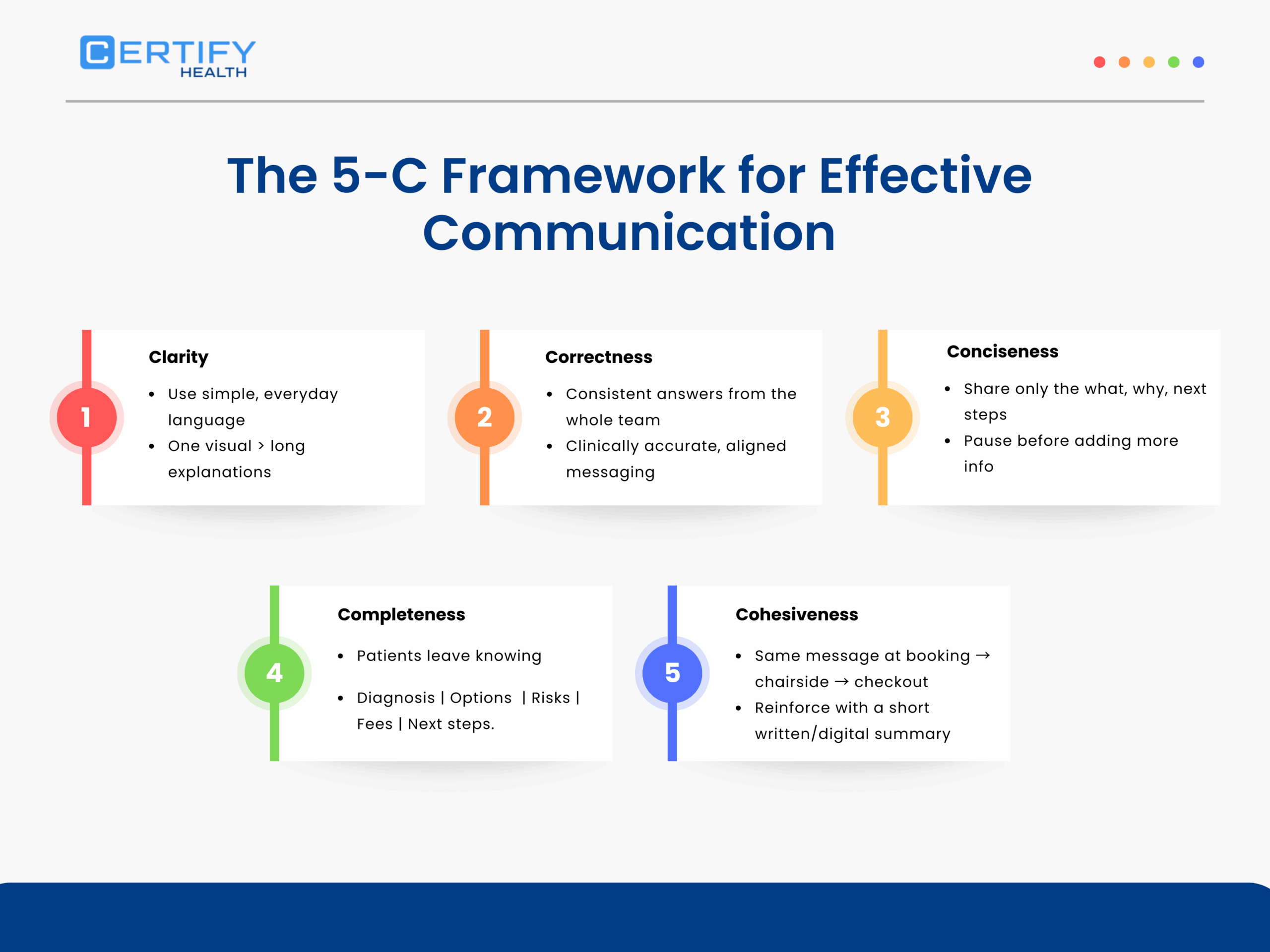
5 Cs of effective dental communication are: Clarity, Correctness, Conciseness, Completeness, Cohesiveness.
- Clarity & Correctness: Key is to make use of simple, clear, and clinically consistent communications across your team.
- Conciseness & Completeness: Provide only the needed information (what, why, and next) without going overboard.
- Cohesiveness: Consistent explanations from booking to checkout.
You already know about the 5 C of communication, but most teams never translate that into daily practice. Here’s how to put this into practice.
A. Clarity & Correctness
Clarity means your dentist patient communication is simple, visual, and free of jargon. Correctness means it’s clinically accurate and aligned across the team.
- Use everyday language first, like saying “gum infection” instead of “periodontal disease.
- Replace long lectures with short explanations and one visual.
- Verify understanding by asking, “Can you explain what we’re doing and why in your own words?”
Correctness matters too. Consistent messaging between front desk, assistants, and providers prevents patients from hearing three different explanations.
B. Conciseness & Completeness
Conciseness doesn’t mean being rushed; it means being focused. Avoid information overload by:
- Share the what, why, and next steps in simple, clear, bite-sized pieces.
- Pausing to check for questions before piling on more detail
Completeness means patients leave with the full story:
- Diagnosis and what it means in their daily life
- Options, risks, benefits, and likely outcomes
- Fees, insurance expectations, and next steps
This balance is at the heart of the 5 C of effective communication: enough information to decide, not so much they shut down.
C. Cohesiveness Across the Journey
Cohesiveness is where many practices stumble. A patient hears one thing at booking, something different chairside, and something else when paying.
To improve dentist patient communication:
- Align scripts and explanations between front desk, assistants, and providers
- Ensure consistent messaging about pricing, coverage, and timelines
- Use written or digital summaries so patients aren’t relying on memory alone
When communication and documentation support each other, the communication outcome is far more predictable.
Chairside Strategies That Improve Patient Experience
Chairside is where trust is either earned or lost. A few specific dentist patient communication skills make the difference.
- Active listening to patients
Let them talk for 30–60 seconds without interruption at the start. Ask, “What worries you most about today?” and actually wait for the answer.
- Simple language plus visual aids
Use intraoral photos, scans, or diagrams. Dental communication becomes real when patients see their own tooth, crack, or inflammation.
- Encourage questions and collaborative decisions
Say, “What questions does this bring up?” instead of “Do you have any questions?” Then move toward collaborative decisions: “Given what you’ve shared about your schedule and budget, here are two approaches that could fit.”
- Non-verbal empathy
Eye contact, sitting at eye level, open posture, and a calm tone often matter more than the words themselves.
Common Question
How do we avoid feeling rushed and still explaining enough?
Use a repeatable pattern:
- Name the problem in plain terms.
- Show it visually.
- Offer 2–3 options.
- Summarize and check understanding.
That structure keeps you concise and complete without rambling.
Dentist Patient Communication Beyond the Chair
Great dentist patient communication starts before the patient sits down and continues after they leave.
Pre-Visit Clarity
- Clear reminders with time, location, and any prep instructions
- Links to digital forms so patients don’t feel ambushed at the front desk
- Short notes about what to expect for longer or more complex visits
This reduces anxiety and no-shows, and sets expectations that your practice values patient-centered care.
Also read our blog on: Leveraging Dental Appointment Reminder Software for Practice Growth
Front Desk Script For Tough Conversations
Your front desk script is often the first and last impression. It should cover:
- How you explain coverage limits and out-of-pocket costs
- How you respond to situations like “But my insurance said…”
- What you say when someone is late, confused, or upset
Consistent messaging here protects your team, reinforces alignment with values, and keeps emotions from escalating into bad patient experience reviews.
Post-Visit Follow-Up
A simple text, email, or call that reiterates instructions, medications, or restrictions goes a long way. It also gives patients a safe channel to say, “I’m not sure I’m doing this right.”
This is where communication and documentation intersect: your documented instructions support what you said verbally, and your follow-up reinforces both.
Measuring and Improving Communication
You cannot make anything better if you cannot measure or see its impact. Don’t guess, measure.
Self-Assessment Checklist
Create a brief self-assessment checklist for dentists and staff:
- Did I invite questions more than once?
- Did I avoid medical jargon?
- Did I summarize next steps before the patient left?
- Did my message align with what front desk and assistants are saying?
Review this in team meetings. It’s a quick way to level up dentist patient interaction without huge training programs.
Patient Satisfaction Surveys
Short, focused patient satisfaction surveys reveal what your team can’t see from the chair:
- How patients rate interpersonal qualities like empathy and respect
- Whether they felt rushed or well-informed
- Whether financial conversations were clear or confusing
You’ll quickly spot patterns that point to specific communication benefits from even small changes.
Common Question
Won’t surveys just invite complaints?
They’ll surface issues that already exist, but faster and in a controlled way. That’s better than learning about a problem from a one-star review.
Role of Technology in Dental Communication
Technology doesn’t replace human connection; it amplifies it, if you use it strategically.
Modern patients experience platforms like CERTIFY Health brings you the tool to not just turn dentist patient communication into a consistent, repeatable system, but to streamline patient journey from scheduling to payment and post visit follow-up:
- Automated reminders and confirmations
- Digital intake and consent forms
- Secure messaging for quick questions
- Integrated payment and financial transparency
- Post-visit follow-ups and recall workflows
This unified approach supports consistent messaging from first contact through final payment and reduces the chance of misalignment across the team.
Common Questions
Which is a valuable communication tool for a dental practice
A valuable communication tool for a dental practice is an integrated patient communication platform like CERTIFY Health, which not only sends reminders and messages but actually closes the communication gaps that hurt production, show rates, scheduling efficiency, and patient understanding, something most generic tools fail to do.
Most platforms stop at reminders. CERTIFY Health goes further by aligning communication with operations, clinical workflows, and patient behavior.
How can dental offices improve patient communications quickly?
Dental offices can improve patient communication quickly by automating routine messages, offering multiple ways for patients to connect (text, chat, phone), and keeping all instructions clear and consistent.
Use visuals to explain treatments, set expectations upfront, and actively listen to patients. After each visit, send simple written care instructions and follow up with a quick check-in to reinforce trust.
Practical Next Steps: Map, Fix, Modernize
To turn ideas into action, start small and systematic.
- Map the patient journey
Do a simple patient journey mapping exercise, from first call or online booking to recall. Note where confusion, delays, or repeated questions pop up. Those are communication hotspots. - Identify breakdowns between people and tools
Where does communication quality slip? Between front desk and clinical team? Between what’s said and what’s documented? Between what’s texted and what’s on the website? - Align communication and documentation
Update your written materials like treatment summaries, financial policies, reminder templates, to match your verbal messaging. This tightens the communication outcome and reduces misunderstandings. - Evaluate digital tools
Look for the technology that unifies communication instead of adding more logins. CERTIFY Health is platform that centralizes messaging, intake, reminders, payments, and follow-ups can support better dentist patient communication without adding to staff workload. Book a Personalized Demo Now!
When you treat dentist patient communication as a clinical skill, a business driver, and a system you can design not just a “bedside manner”, you create a patient-centered care environment that feels aligned with values on both sides of the chair.