
Table of Contents
A national study flagged 446 hospitals at high risk of closing, especially in Medicaid-heavy markets.
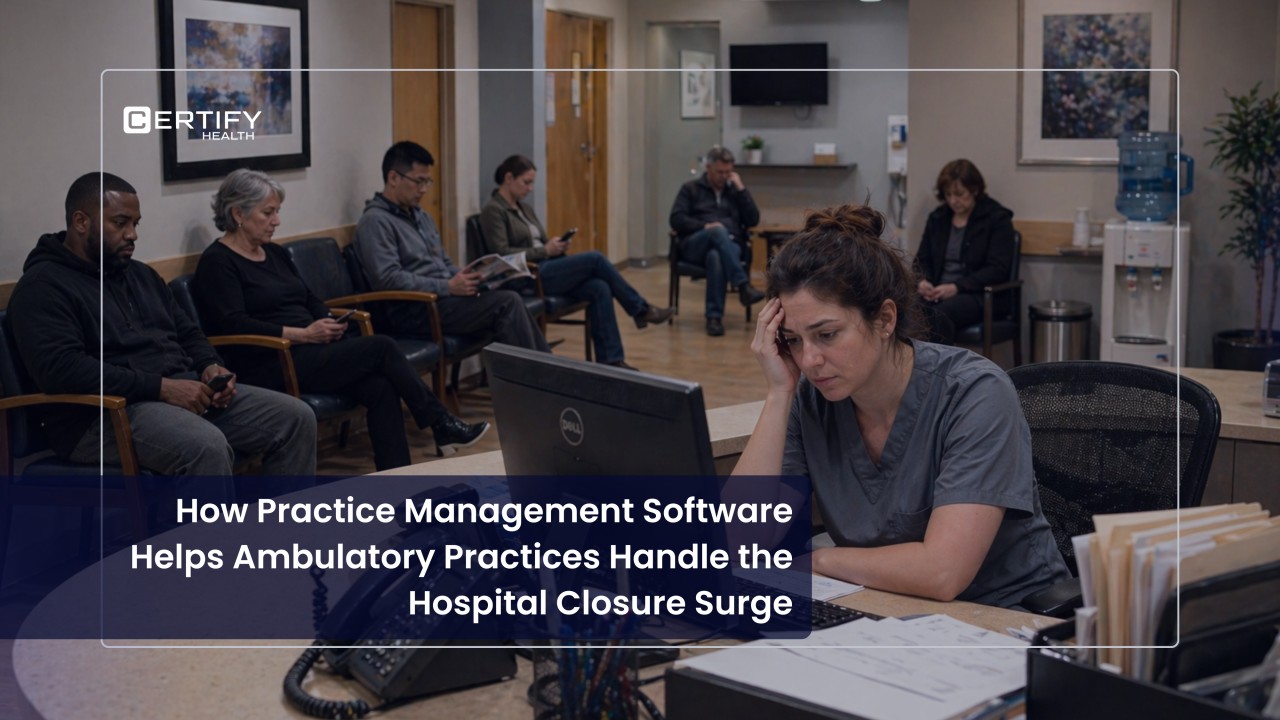
When they shut down, patients do not disappear. They shift to nearby outpatient clinics and ambulatory surgery centers, and the resulting demand can look a lot more like ED and inpatient-level pressure than routine outpatient volume. In the affected markets, that shift can create about a 27% surge in visit volume.
If you run a clinic or ASC in one of these areas, this is not a policy story. It is an operations, staffing, and revenue cycle issue that can hit all at once. We will uncover how practice management software solves it.
What Happens When a Hospital Closes
Most hospital closures do not happen overnight. The ER stops taking walk-ins, a service line winds down, referrals dry up, and patients who once went to the hospital start calling your number instead.
These are not simple cases. Many patients have chronic conditions like diabetes, COPD, and heart disease. Others need follow-up after surgery but no longer have a facility to return to. In multilocation networks, that demand rarely spreads evenly. It often concentrates in one or two sites while other locations remain underused, simply because teams do not have a live view of capacity across the whole network.
Where Operations Break
When volume spikes, the first thing to break is the schedule. Slots fill days in advance, staff squeeze in urgent visits wherever they can, and wait times grow fast. What looks manageable for a week can become a sustained bottleneck if the surge keeps building.
Intake is usually the next point of failure. New patients bring more forms, more missing information, and more time spent chasing records from the closed hospital.
The front desk also absorbs a wave of calls from stressed patients who do not know your practice, your process, or even which location to contact. That hidden call burden does not show up in the schedule, but it consumes real staff time.
In multilocation setups, the pressure is uneven. One site can become overloaded while another still has room, and without a shared view of real capacity, that imbalance is hard to correct quickly.
Staff And Billing Pressure
The strain does not stop at the front desk. Billing teams inherit messy coverage data, including lapsed Medicaid, changed plans, and patients who are unsure who their current payer is. Claims tied to coverage errors are rejected at three to four times the rate of clean claims, so even a modest increase in bad front-end data can create a long tail of rework.
As the number of new patients grows, AR days climb and cash slows. Admin work also gets heavier because staff spend more time rekeying data, chasing records, and fixing claims by hand.
That is how a volume problem turns into a staffing problem, and then into a margin problem.
Where Practices Fall Short
The practices that struggle most usually share the same weak spots. Scheduling lives in spreadsheets or systems that do not show true capacity. Intake is still paper-based. Billing requires too many handoffs between too many people.
At low volume, that structure may feel workable. At surge volume, it breaks quickly. Intake stalls, scheduling becomes reactive, and teams operate from separate lists instead of a shared workflow.
How Smart Practices Prepare
The best-prepared teams do not wait for the surge to expose the gaps. They fix them before the patient volume arrives.
Healthcare scheduling software gives you a real-time view of capacity across providers, locations, and weeks, so you can see where the pressure is building before it hits.
Digital intake lets patients complete forms before they arrive, which reduces front-desk backlog and keeps data from getting rekeyed later.
Real-time coverage checks confirm payer status before the visit, not after the claim fails.
The goal is not more tools. It is a workflow that can absorb sudden demand without forcing your staff into constant catch-up mode.
CERTIFY Health As A Standardization Layer
CERTIFY Health is a unified medical practice software built for this kind of pressure, especially in ambulatory practices with multilocation environments. Think of it as a standardization layer that connects intake, scheduling, and coverage so teams are not solving the same problem in different ways at different sites.
Its digital intake workflow replaces paper forms, so patients enter information before they arrive and that data flows cleanly into the system.
Its live scheduling view shows real capacity across sites, providers, and time periods, which makes it easier to redistribute demand when one location starts filling up faster than another.
Real-time coverage checks confirm payer status at booking, which reduces avoidable denials and helps protect the revenue cycle before the visit ever happens.
For patients with more complex payment histories, CERTIFYPAY adds structure without adding more work for staff. The point is not to layer on another system. It is to replace fragmented workflows with one consistent operating model.
Why This Matters Now
Hospital closures are not a short-term blip. Shrinking Medicaid payments, falling patient counts in rural areas, and rising fixed costs are long-term forces, and the 446 at-risk hospitals are clustered in markets where ambulatory practices and ASCs already carry a large share of the patient load. That means more volume is coming, and it will bring more billing complexity, not less.
Practices that invest now in practice management software with clean intake, live scheduling visibility, and real-time coverage checks can absorb that demand without losing quality or burning out their teams. Practices that wait will spend months reacting instead of planning, and reaction is always more expensive than preparation.
Is Your Practice Ready?
The real question is not whether demand will shift. It is whether your workflows can handle it without adding avoidable cost, delay, or turnover.
A capacity review can show where your intake, scheduling, and billing processes are likely to crack under added volume, and where you can scale without adding headcount. If you want to turn the hospital closure surge into sustainable growth, the time to prepare is before the surge hits.