
Table of Contents
Key Takeaways:
- Small operational issues compound fast: No-shows, wait times, and communication gaps quietly erode revenue and patient trust over time.
- Patient experience is a growth lever: Clear communication, easy scheduling, and financial transparency directly improve case acceptance and retention.
- Systems beat staff heroics: Automating routine tasks with CERTIFY Health reduces burnout, stabilizes teams, and delivers a more consistent dental experience.
Introduction
Nearly 73% of U.S. adults admit they’re afraid of going to the dentist, and when the experience feels rushed, confusing, or disorganized, that fear turns into missed visits and lost patients. Patients are quick to switch when the dental patient experience feels chaotic, confusing, or disrespectful of their time.
Behind the scenes, many challenges faced by dentists: staff shortages, long waits, poor communication, and billing headaches, are creating a shaky dental patient experience that patients feel at every visit. This article uses real data to expose dentistry’s biggest challenges and outlines practical steps toward a more unified patient experience.
Common Question:
Isn’t clinical quality enough?
Clinical quality is the baseline, patients expect it but what actually shapes their decision to return (or leave) is everything around the care.
- How easy was it to book?
- Did the visit start on time?
- Were costs explained clearly?
- Did anyone follow up?
When the experience feels disorganized or stressful, even great clinical care gets overshadowed. And in a world with more choices than ever, practices that focus only on clinical excellence risk losing patients before quality even has a chance to shine.
The Everyday Challenges Faced by Dentists and Patients Feel

TL; DR:
Top Dentist Challenges impacting patient experience are:
- Cancellations and no-shows → Patient access is restricted, chairs are empty, and revenue is wasted.
- Long wait times and chaotic scheduling → lead to irate patients, bad ratings, and decreased retention.
- Communication gaps → Higher anxiety, lower case acceptance, delayed treatment
- Financial friction → Denied claims, surprise bills, eroded trust
- Staffing shortages and burnout → Survival-mode teams, turnover, and inconsistent service
Challenge 1: No‑Shows & Cancellations
No-shows and last-minute cancellations are among the most expensive challenges faced by dentists because every empty chair is pure lost revenue and wasted chair time.
A review of 7,379 appointments found that adult patients had a 24% no-show rate, significantly higher than younger patients.
Each unused slot is more than a $200 hole in your day, it is an opportunity cost, staff time you still pay for, and a hit to access for patients who needed that appointment.
Frequent no-shows also ripple into the broader dental experience by making it harder to offer timely appointment access to patients who are actually trying to get in.
Quick fix:
- Reduce no-shows and cancellations by using automatic reminder systems (SMS, email, and voice), such as CERTIFY Health’s reminder & nudges, and provide patients with scheduling access so they may book, confirm, or reschedule.
- Introduce a clear no-show or late-cancellation policy, such as a small fee or deposit, and communicate it upfront with transparent, respectful messaging so patients understand expectations before they miss an appointment.
Common Question
Do automated reminders really work?
Yes. Practices already make use of digital appointment reminders tools like CERTIFY Health’s PXP software to reduce no-shows. Sending multiple reminders directly lowers missed appointments, not just one generic ping. And most importantly, patients want them as they prefer receiving reminders via text, the channel they’re most likely to read and act on.
When reminders match patient behavior and timing, they don’t feel like noise, they feel helpful. And helpful dental reminders turn into fuller schedules, fewer gaps, and more predictable revenue.
Challenge 2: Extended Wait Times and Scheduling Inefficiencies
Another major set of challenges faced by dentists is long wait times and scheduling chaos that leave patients stewing in the lobby and front-desk teams scrambling.
Industry data shows that 15.5% of patients cancel appointments, while 7.4% fail to show up, leaving staff stuck reshuffling the day. To compensate, many clinics rely on overbooking or conservative time estimates, both of which backfire.
Overbooking crowds the clinic and pushes wait times higher, while underbooking wastes valuable chair time and staff capacity.
When the dental experience becomes defined by waiting rather than care, anxiety rises, reviews suffer, and patients are far less likely to return or recommend the practice.
Quick fix:
- Implement smarter overbooking rules based on procedure length and historical no-show risk instead of “gut feel” scheduling.
- Use CERTIFY Health’s scheduling tool that offers waitlist management so patients eager for earlier appointments can fill last-minute cancellations, improve appointment access, and keeping the schedule full.
Challenge 3: Patient Anxiety & Fear
Communication gaps are quieter but equally damaging challenges faced by dentists because they feed fear, confusion, and low case acceptance.
When patients do not fully understand their diagnosis, treatment options, or out-of-pocket costs, trust erodes and they delay or decline care, harming both outcomes and the dental patient experience.
In dentistry, this often shows up as patients nodding politely in the operatory, then saying “I’ll think about it” and never scheduling needed treatment, which quietly drags down production.
Quick fix:
- Build simple communication routines with CERTIFY Health’s communication tool: pre-visit emails or texts that set expectations, during-visit chairside explanations in plain language, and post-visit recaps with next steps.
- Use clear, written summaries and visuals for treatment plans so the overall dental experience feels transparent and collaborative, not rushed or confusing.
Common Question
Is communication really a revenue issue?
Yes. A study found that 80% of Americans delay dental care due to cost, even when they know the condition could worsen and become more expensive later.
When patients do not understand the “why” behind treatment, they are more likely to cancel, no-show, or postpone care, which reduces production and long-term loyalty.
Challenge 4: Financial Barrier
Financial friction is one of the most underestimated challenges faced by dentists and a major source of stress for patients.
Confusing estimates, denied claims, and surprise balances undermine the dental patient experience and can cause patients to put off needed care or switch providers entirely.
Most of these healthcare claims are denied due to preventable issues like billing errors, missing documentation, or lack of eligibility verification, leading to significant rework and revenue loss.
A denied claim can leave patients stuck with unexpected bills for services they already received, damaging trust and increasing complaints.
Quick fix:
- Introduce real-time insurance verification at multiple touchpoints (scheduling, pre-visit, and day-of visit) using CERTIFY Health’s patient experience platform to reduce denied claims and billing surprises.
- Provide transparent estimates before treatment so the dental experience around payment feels predictable, not like a guessing game.
Challenge 5: Staffing Shortages & Turnover
Staff shortages and turnover are structural challenges in dentistry, showing up as burnout, low engagement, and inconsistent service across the front desk and operatory.
Across healthcare, 53% of clinicians and staff report burnout, while only about one-third feel highly engaged, making turnover inevitable, nearly 1 in 3 clinicians and over 4 in 10 staff leave within 2–3 years.
When dental teams are understaffed, every day feels like a fire drill: nonstop phones, growing queues, and delayed schedules.
Burnout doesn’t just affect morale; it directly drives clinician turnover, compounding workload for those who remain. Small misses then snowball into lost patients, negative reviews, and a culture stuck in survival mode rather than patient-centered care.
Quick fix:
- Use dental patient experience software systems like CERTIFY Health for automating repetitive tasks such as reminders, digital intake, and routine outreach to free staff for high-touch interactions.
- Standardize key scripts and checklists so that even with new or temporary staff, the core dental experience stays consistent from visit to visit.
How Operational Breakdowns Quietly Erode Dental Revenue
What looks like a single no-show or denied claim is often dismissed as a minor inconvenience, but the real cost builds steadily over time.
For instance, claim denials require rework and restrict cash flow, consuming staff time that could be spent on patient-facing duties. Even minor no-show rates can significantly reduce annual revenue.
Consider the following:
Pain → Impact → Revenue Hit framework.
- Billing confusion causes financial worry, which delays treatment
- Communication gaps destroy trust, lowering case acceptance
- Long wait times cause frustration and lead to negative reviews, diminishing new-patient calls.
Even if clinical dentistry is first-rate, every step erodes patient loyalty and productivity.
Also, read: Dental Revenue Cycle Management: How to Improve Your Practice’s Financial Success
Common Question
How do we quantify this in our practice?
Track metrics like no-show rate, average wait time, denial rate, and reappointment rate, then assign approximate revenue values to each missed or delayed visit to see the true financial impact.
How to Improve Patient Experience in a Dental Office
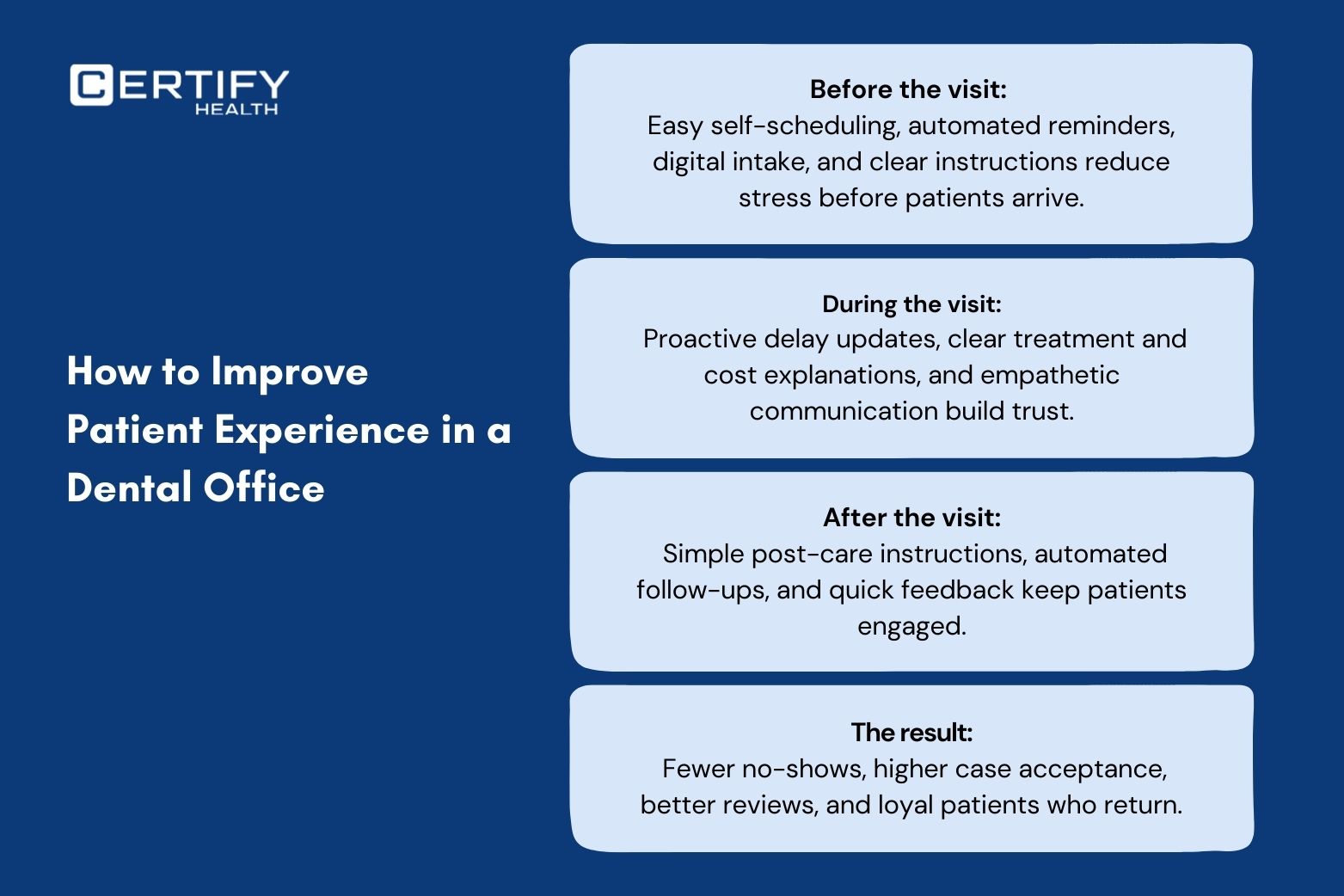
Patient experience doesn’t start when someone sits in the chair, and it doesn’t end when they walk out. It’s shaped by every interaction before, during, and after the visit. The practices that stand out remove friction early, communicate clearly, and follow through consistently. That’s where CERTIFY Health changes the game.
Before the Visit: Remove Stress Before It Starts
If booking feels hard, patients arrive frustrated. The goal is to make access feel effortless.
- Easy self-scheduling so patients book on their terms
- Instant confirmations and automated reminders to reduce uncertainty
- Digital intake forms that cut paperwork and speed up check-in
- Clear pre-visit instructions that set expectations and reduce anxiety
CERTIFY Health brings all of this into one seamless, patient-friendly flow, so visits feel organized before patients ever walk through the door.
During the Visit: Comfort, Clarity, and Connection
Small breakdowns during the visit can quickly erode trust.
- Proactive updates when delays happen, no guessing, no frustration
- Clear, simple communication around treatment and costs
- Empathetic interactions that make patients feel heard and respected
With real-time visibility and communication tools, CERTIFY Health helps teams keep patients informed and reassured, without adding extra steps for staff.
After the Visit: Follow-Up That Feels Personal
The experience doesn’t end at checkout. Follow-through is where loyalty is built.
- Clear post-care instructions patients can actually understand
- Automated follow-ups to check in and answer questions
- Easy feedback collection to catch issues early and improve continuously
CERTIFY Health turns follow-up into a consistent, personalized experience, not an afterthought.
The Payoff
- Fewer anxious patients
- Stronger trust and higher case acceptance
- Better reviews, retention, and long-term loyalty
- That’s how dental practices move from good care to care patients remember, and return.
Where to Go from Here
The core takeaway is that the most damaging challenges facing dentistry are not always clinical, they are operational and experiential.
Systematically addressing no-shows and cancellations, long wait times, communication gaps, denied claims, and staffing-driven inconsistency can help practices transform the dental patient experience and protect revenue at the same time.
The next step for any practice is to honestly audit its own dentist challenges, quantify the impact, and then experiment with a mix of manual improvements and smarter technology like CERTIFY Health to close the gaps.