
Table of Contents
We often talk about how technology should be helpful in the moments that matter most.
Today, that helpfulness is redefining the dental industry.
We are seeing a fundamental shift where the patient journey is no longer a straight line but a complex, digital-first experience.
To build a resilient practice, we must organize your digital presence to be as intuitive and accessible as possible.
Why Dental Marketing Has Fundamentally Changed
The way patients find care has evolved into a retail-centric model.
People are no longer just looking for a “dentist near me”; they are looking for a seamless end-to-end experience.
In this environment, search engines (like Google) are the new waiting room. Your digital storefront (your reviews, your search ranking, and your site speed) is the first touchpoint of clinical trust.
The fastest-growing practices understand that the goal isn’t just to fill chairs today, but to build a sustainable ecosystem where retention becomes your primary engine for growth.
- Consumer Shift: Patients prioritize convenience and digital scheduling as much as clinical expertise.
- Search Intent: High-intent keywords like “emergency dentist” or “Teeth alignment consultation” drive the highest conversion rates.
- Economic Reality: According to the U.S. Bureau of Labor Statistics, the dental services industry is projected to see an employment growth of 7% through 2032, reflecting a steady increase in demand for accessible oral healthcare.
The Modern Dental Marketing Funnel Explained
To achieve sustainable dental practice growth, we have to look beyond just the “top of the funnel.”
While awareness is the starting point, the true value is unlocked through the entire patient lifecycle.
Most practices over-invest in acquisition while neglecting the experience and reactivation phases. We view the modern funnel as a continuous loop of value.
The Patient Journey Lifecycle
| Phase | Strategic Goal | Primary Search Queries |
|---|---|---|
| Awareness | Local Visibility | Dentist [City Name], Best Dental Clinic |
| Consideration | Building Trust | Dental implants reviews, Before and after photos |
| Booking | Reducing Friction | Online dental appointment, Book dentist online |
| Experience | Patient Satisfaction | Family dentistry, Painless dental care |
| Retention | Lifetime Value | Dental cleaning membership, Preventive care |
| Advocacy | Brand Authority | Leave a Google review, Patient referrals |
The formula for scaled growth is:
Growth = (Acquisition + Experience) × (Retention + Reactivation)
This holistic approach ensures that your marketing spend isn’t just a cost, but an investment in a compounding asset.
Data from the Centers for Disease Control and Prevention (CDC) highlights the importance of this lifecycle, noting that 64.1% of adults aged 18 and over had a dental visit within the past year, representing a massive opportunity for systematic reactivation and retention.
In the context of dentistry, “accessible” means more than just a search result; it means a frictionless transition from a digital query to a clinical chair.
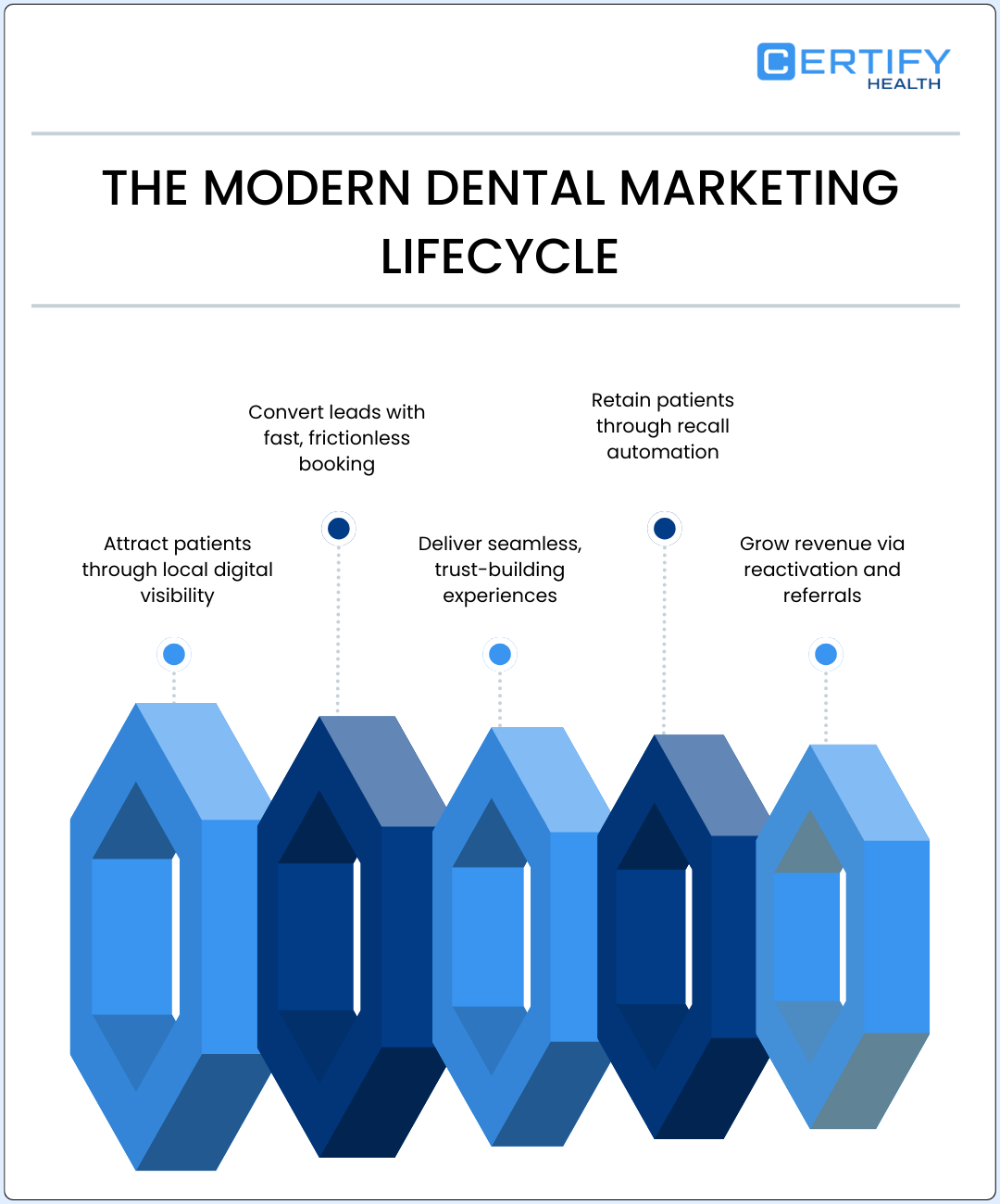
Stage 1 is about removing the barriers that prevent a patient from choosing you over the practice down the street.
Stage 1: Patient Acquisition Strategies That Actually Work
Acquisition is a game of relevance. When we look at how patients interact with search, we see that they are looking for immediate solutions to specific needs.
Your strategy should prioritize high-intent visibility to ensure you are the first choice when the “moment of need” occurs.
Local SEO (Your #1 Growth Channel)
Your Google Business Profile is often the definitive factor in a patient’s decision.
Local SEO isn’t just about keywords; it’s about proximity, prominence, and reputation.
Practices that maintain accurate business hours, high-resolution imagery, and a steady stream of authentic reviews create a “digital trust signal” that the Google algorithm prioritizes.
- Google Business Optimization: Ensure your services (like “emergency tooth extraction” or “sedation dentistry”) are explicitly listed.
- Review Velocity: Consistent, fresh reviews are more impactful than a high volume of old ones.
- Proximity Marketing: According to the U.S. Census Bureau, as of 2024, the “commute to care” remains a critical factor, and data from the Centers for Medicare & Medicaid Services (CMS) indicates that 92.1% of the U.S. population is now insured, making the local “in-network” search a primary driver for patient acquisition.
Paid Ads That Convert (Google + Meta)
Organic reach takes time, but paid acquisition provides instant scalability.
The key is intent matching. We recommend focusing your Google Ads budget on “high-intent” keywords—terms that indicate a patient is ready to book now—while using Meta for “disruptive awareness” (e.g., cosmetic dentistry or implants).
- Search Ads: Target keywords like “dentist open Saturday” or “same day crowns.”
- Meta Retargeting: Use visual storytelling for patients who visited your site but didn’t book.
Federal research on digital health habits shows that 80% of adult internet users search for health information online, but only 12% are considered proficient in interpreting complex health data, which underscores the need for simple, high-converting ad copy that speaks directly to patient outcomes.
Website Optimization for Conversions
Traffic is a vanity metric if your conversion rate is low.
A modern dental website must function like a high-end retail site.
If a patient cannot find your insurance information or book an appointment within two clicks, they will likely return to the search results.
Optimized Conversion Checklist for Dental Clinics:
| Feature | Importance | Visibility Benefit |
|---|---|---|
| Mobile-First Design | Critical | Google’s core ranking factor for 2026 |
| Online Booking | High | Reduces "phone anxiety" for Gen Z/Millennial cohorts |
| Social Proof | High | "Before and After" galleries build immediate clinical trust |
| Insurance Clarity | Essential | Addresses the #1 barrier to dental care (affordability) |
We believe that the best products are those that remove friction from the user’s life.
In your practice, that friction often exists in the “last mile.” The last mile is nothing but the gap between a patient finding you and actually sitting in the clinical chair.
We must solve for the user’s need for immediacy and clarity.
If we don’t respond at the speed of their intent, we lose the opportunity to be helpful.
Stage 2: Converting Leads into Booked Dental Appointments
The “speed-to-lead” metric is perhaps the most critical indicator of a practice’s digital health.
We see a direct correlation between response latency and conversion decay.
When a patient submits a form, they are in a high-intent state; every minute that passes without a response increases the likelihood that they will return to the search results to find a more responsive provider.
- The 5-Minute Rule: You must engage leads within the first five minutes to maintain their peak interest.
- SMS-First Strategy: Text messaging has become the preferred interface for modern consumers, offering a non-intrusive yet immediate way to confirm details.
- Automated Scheduling: Integrating direct booking into your search presence allows the “transaction” to happen while the intent is highest.
Research from the National Institutes of Health (NIH) indicates that approximately 36% of the U.S. population experiences dental anxiety or fear, which suggests that digital-first, low-pressure communication channels like SMS can significantly lower the barrier to booking for a third of your potential patient base.
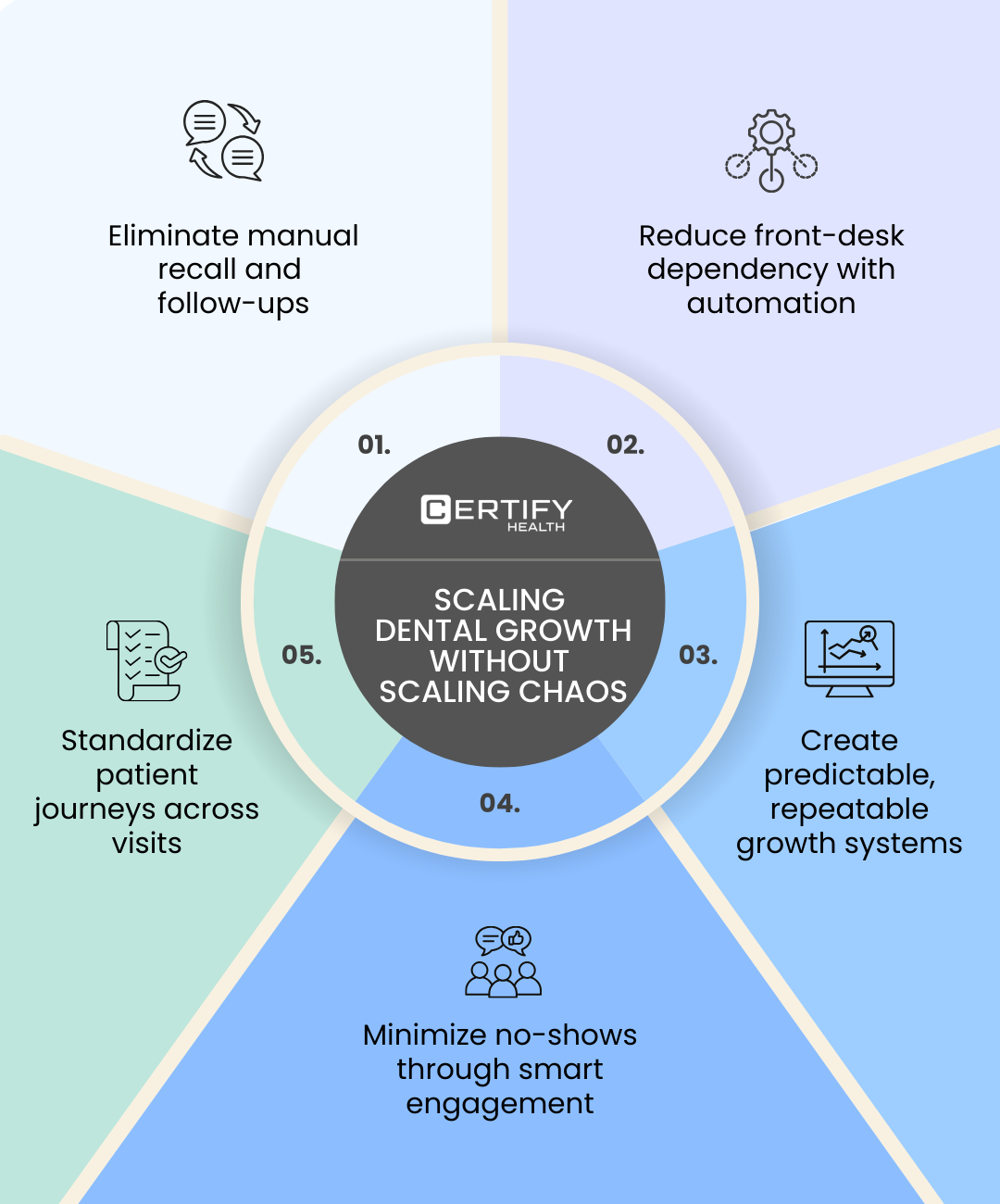
Stage 3: Delivering a High-Retention Patient Experience
Retention is the ultimate expression of trust. In our product development, we focus on “stickiness”…creating an experience so seamless that users wouldn’t dream of going elsewhere.
For a dental practice, this means moving from a transactional mindset to a relationship-based one. Retention is the total sum of every interaction, from the intake form to the post-care check-in.
- Frictionless Intake: Digital forms sent via mobile before the appointment save time and respect the patient’s schedule.
- Treatment Transparency: Using visual aids and clear digital communication helps patients understand the “why” behind their care, which is the foundation of long-term loyalty.
- Predictive Follow-ups: Proactively reaching out before a patient realizes they need their next cleaning keeps your practice top-of-mind.
- Economic Impact of Care: According to the U.S. Department of Health and Human Services (HHS), more than 1 in 4 (26%) adults in the United States have untreated tooth decay, representing a critical retention and treatment opportunity for practices that master the “Experience = Communication + Convenience + Trust” framework.
To build a sustainable future for oral healthcare, we must think of the patient database not as a static list but as a dynamic, living ecosystem. Stage 4 and Stage 5 are about creating that same momentum within your practice, ensuring that no patient is left behind and that every clinical opportunity is maximized through intelligent automation.
Stage 4: Automating Recall and Reappointment Systems
Scale is achieved when your systems work while you sleep. The most resilient dental practices treat their hygiene recall as their primary engine of recurring revenue.
By automating the “6-month nudge” across multiple channels (SMS, email, and even automated voice) you reduce the administrative burden on your front desk and provide the “proactive helpfulness” that modern patients expect.
- Omnichannel Reminders: High-performance systems use a mix of touchpoints to ensure the message is seen without being intrusive.
- Recovery Workflows: When a patient cancels or misses an appointment, an automated recovery flow should immediately trigger to reschedule, preventing the lead from “leaking” out of your funnel.
- Recall Performance: Data from the Agency for Healthcare Research and Quality (AHRQ) reveals that as of 2024, dental visit volume for primary care remained 12% lower than pre-pandemic levels, suggesting that practices with robust recall systems are capturing the market share that others are losing due to passive scheduling habits.
Stage 5: Reactivation Marketing Most Clinics Ignore
Your existing database is a goldmine of unrealized clinical need. Many patients drift away not because they are dissatisfied, but because life gets in the way.
Reactivation marketing is the process of identifying these “dormant” users and re-engaging them with relevant, educational prompts.
This is far more cost-effective than acquiring a new lead from scratch, as the baseline level of trust has already been established.
- Data Segmentation: Look for patients who haven’t visited in 6 to 24 months. These individuals often have “unscheduled treatment” in their records that can be reactivated with a simple nudge.
- Educational Nudges: Instead of a generic “we miss you” text, try a message focused on preventive health; this reminds them that small issues today prevent expensive emergencies tomorrow.
According to the Centers for Disease Control and Prevention (CDC), approximately 21% of adults aged 20 to 64 have at least one permanent tooth with untreated decay, highlighting the massive clinical and revenue potential sitting within your inactive patient files waiting for a reason to return.
When you turn a patient into an advocate, you are no longer just practicing dentistry; you are building a community. Stage 6 is about institutionalizing that advocacy, ensuring that every positive clinical outcome becomes a permanent part of your digital brand.
Stage 6: Turning Happy Patients into Referral Engines
Word-of-mouth is now a public, searchable asset. By automating the request for reviews and simplifying the referral process, you amplify the reach of your satisfied patients.
This social proof becomes a “flywheel” effect, where your current patients do the heavy lifting of acquiring your future ones.
- Automated Review Requests: Send a text-based link immediately following a successful appointment while the positive experience is fresh.
- Social Proof Amplification: Highlighting patient success stories on your social channels builds clinical authority.
- Advocacy Impact: According to the National Institute of Dental and Craniofacial Research (NIDCR), nearly 90% of U.S. adults aged 20 to 64 have had dental caries in their permanent teeth, which suggests that a single referred patient often represents an entire network of family and peers with similar clinical needs.
The Biggest Dental Marketing Mistakes to Avoid
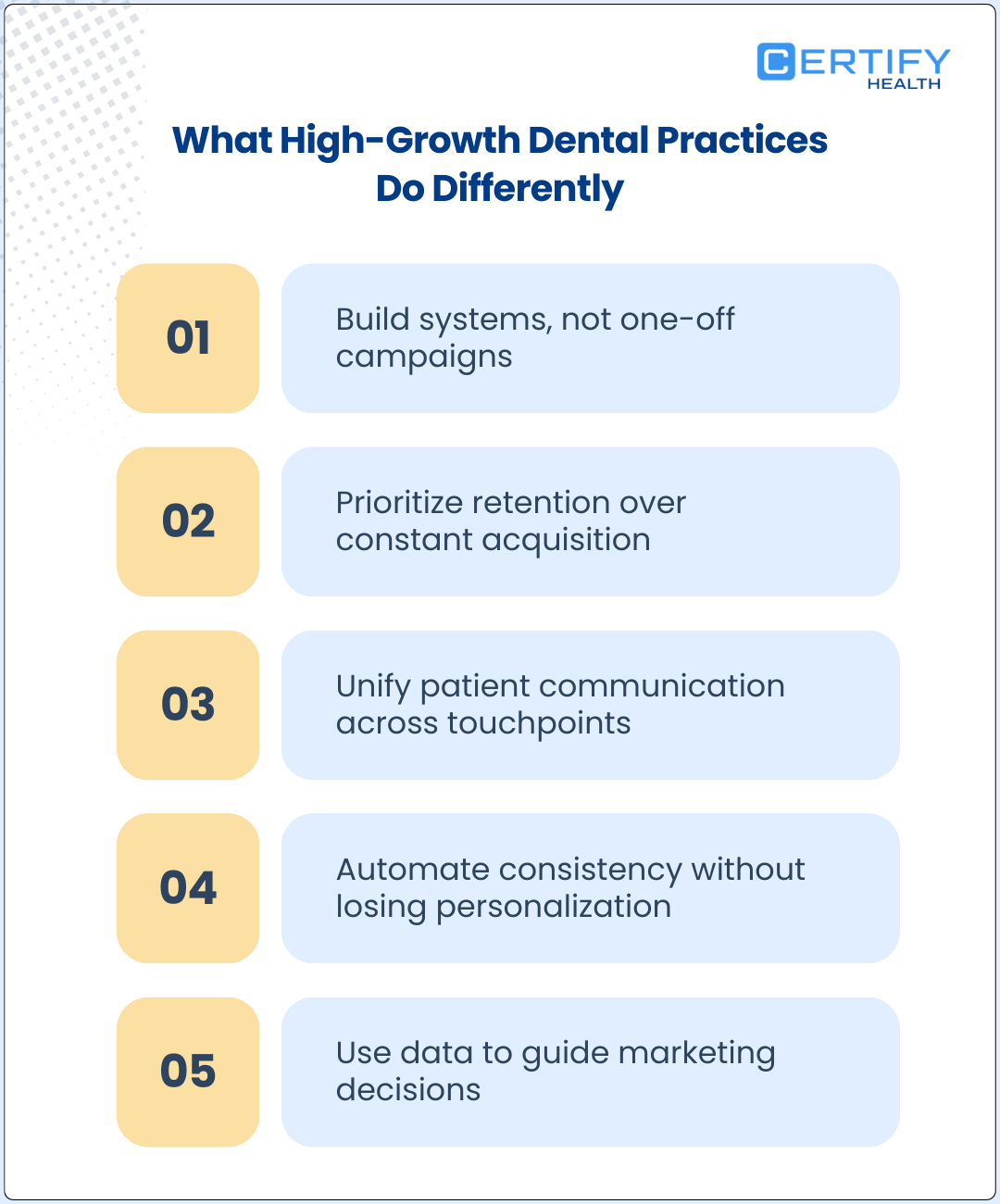
In my experience, the most common pitfall is treating marketing as a series of disconnected experiments rather than a unified system.
Many practices over-index on top-of-funnel ads while their “bucket” is leaking due to poor retention.
If your patient communication tools are fragmented and your recall workflows are manual, you are introducing friction that hurts both your staff and your patients.
- Ads Without Retention: It is inefficient to pay for a new lead if you cannot keep the patients you already have.
- Manual Friction: Human error in manual recall leads to missed opportunities and empty chairs.
- Strategic Gaps: According to the Health Resources and Services Administration (HRSA), over 76 million Americans live in dental health professional shortage areas, meaning the mistake isn’t just a lack of leads, but a failure to efficiently manage the massive existing demand through lifecycle automation.
Metrics That Define High-Growth Dental Practices
To improve something, we must first be able to measure it. We focus on these key performance indicators (KPIs) to understand the true health of a digital ecosystem.
| Metric | Why It Matters | Goal for Growth |
|---|---|---|
| CPA (Cost Per Acquisition) | Measures marketing efficiency | Lower than $150–$200 for GP |
| Lead-to-Appointment Rate | Measures front-desk and speed-to-lead efficiency | Greater than 40% |
| Patient Lifetime Value (LTV) | Measures the long-term health of the practice | Target 3x to 5x acquisition cost |
| Recall Compliance Rate | Measures the effectiveness of Stage 4 automation | Greater than 75% |
| Retention Rate | Measures patient satisfaction and Stage 5 reactivation | Greater than 85% |
The U.S. Bureau of Economic Analysis (BEA) reports that consumer spending on dental services has reached an annualized rate of over $175 billion as of early 2026, proving that the market is there for those who can measure and optimize their patient lifecycle effectively.
We’ve learned that the most transformative shifts happen when we move from fragmented tools to integrated platforms. When your data lives in silos, your patient experience feels disconnected.
To solve for the user, we must solve for the system. Transitioning to a unified growth platform is a strategic necessity to ensure that no patient intent is ever wasted.
The Shift from Tools to Dental Growth Platforms
The old model of dental management relied on a “patchwork” of isolated software: one for SEO, another for SMS, and separate tools for recall or reviews.
This fragmentation creates friction, both for your staff and for the patients who receive redundant or out-of-sync communications. The new model is the Unified Patient Growth Platform, where every touchpoint is aware of the last.
- Frictionless Integration: A single source of truth ensures that a patient who just booked online doesn’t receive an automated “we miss you” text five minutes later.
- Operational Velocity: According to the U.S. Department of Labor, the median annual wage for dental assistants and front-office staff has risen steadily, making the “human cost” of managing fragmented manual tools a significant drain on practice EBITDA.
How CERTIFY Health Helps Dental Practices Grow Across the Entire Funnel
CERTIFY Health is designed to bridge the gap between digital intent and clinical reality.
By unifying the lifecycle, we empower practices to operate with the same data-driven precision we use to optimize the world’s most helpful patient experience workflows.
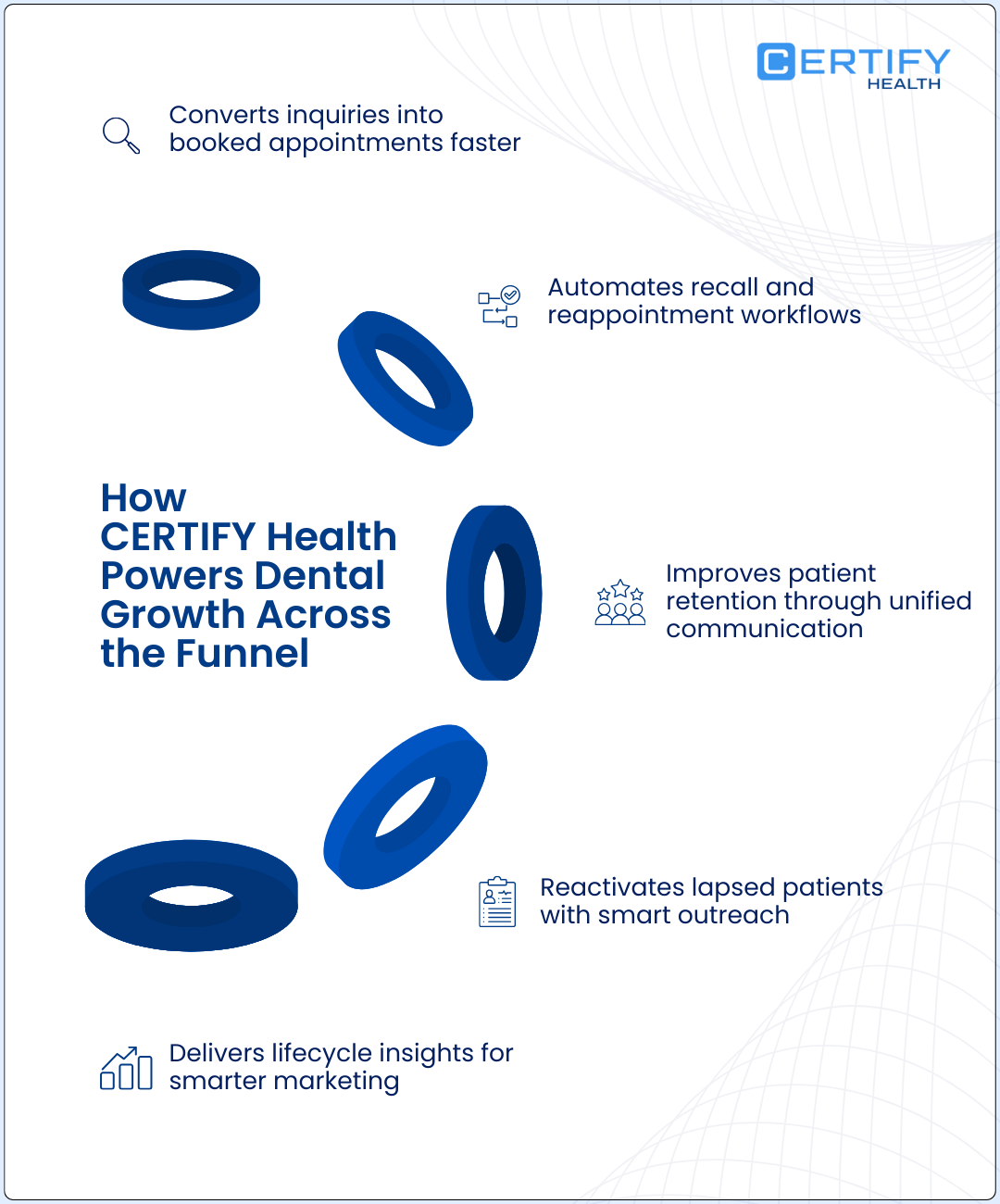
The CERTIFY Health Growth Engine
1. Acquisition → Faster Conversions
We remove the “latency gap.” By unifying communications and optimizing the booking interface, we ensure that high-intent leads are captured instantly.
- Data from the Federal Trade Commission (FTC) regarding consumer behavior in digital marketplaces suggests that 50% of consumers choose the vendor that responds first, regardless of price.
2. Experience → Seamless Patient Journeys
By consolidating intake, reminders, and messaging, we reduce the cognitive load on your patients. A seamless journey builds the clinical trust necessary for high-value treatment acceptance.
- The Agency for Healthcare Research and Quality (AHRQ) reports that effective patient-provider communication can lead to a 15% increase in adherence to preventive care schedules.
3. Retention → Automated Recall Systems
CERTIFY Health automates the “6-month nudge” across SMS and email, ensuring your hygiene chairs remain full without manual outreach.
- According to U.S. Census Bureau service annual surveys, dental offices that implement automated scheduling systems see an average revenue per establishment increase of over 9% compared to those using manual systems.
4. Reactivation → Win Back Lost Patients
Our intelligent segmentation identifies patients who haven’t visited in 12 to 24 months and triggers personalized nudges to bring them back into the fold.
- The Centers for Disease Control and Prevention (CDC) notes that 25.7% of adults aged 65 and older have total tooth loss, a statistic that underscores the critical importance of reactivation marketing to maintain oral health before conditions become irreversible.
5. Growth Intelligence → Real Marketing Insights
Finally, we provide the “Growth Intelligence” layer. You no longer must guess which channel is working; our dashboards provide a clear view of your ROI from lead to retention.
- The U.S. Small Business Administration (SBA) suggests that small businesses in the healthcare sector should allocate 7% to 8% of their revenue to marketing; CERTIFY ensures that this investment is measurable and optimized for the highest possible Lifetime Value (LTV).
In the next decade, dental growth will not be about who has the loudest marketing, but about who has the most resilient patient experience infrastructure. We are moving toward a world where AI and platform integration handle the complexity of engagement, allowing you to focus on what you do best: providing exceptional care.
Why Modern Dental Practice Marketing Is Becoming Platform-Led
The transition from a “tools-based” approach to a “platform-led” strategy is essential for scale.
When communication, lifecycle automation, and AI-assisted engagement live in a single ecosystem, you eliminate the data silos that cause patients to slip through the cracks.
This unified approach ensures that every interaction—whether it is an initial search query or a routine hygiene reminder—is personalized and frictionless.
- Communication-First Growth: Every patient touchpoint should be an opportunity to build trust.
- AI Engagement: Intelligent systems can now predict when a patient is likely to lapse and trigger a nudge before they ever leave your “active” list.
- Infrastructure over Tactics: Sustainable growth comes from systems that work consistently, not one-off ad campaigns.
- Industry Scale: According to the U.S. Bureau of Labor Statistics, the median annual wage for dental hygienists reached $94,260 in 2024, emphasizing the critical need for platforms that maximize hygienists’ time through automated, high-yield recall systems.
Conclusion: Dental Marketing Is Now Lifecycle Management
The paradigm has shifted. To be successful in today’s landscape, you must view dental marketing not as a cost center for acquisition, but as a system for lifecycle management.
Acquisition is merely the starting line.
Retention and a seamless experience are the multipliers that turn a single visit into a lifelong relationship and a sustainable revenue stream.
The Unified Growth Lifecycle
| Acquisition (Intent-based Search) |
| ↓ |
| Conversion (Instant SMS & Booking) |
| ↓ |
| Experience (Frictionless Intake) |
| ↓ |
| Retention (Automated Recall) |
| ↓ |
| Reactivation (Smart Database Win-backs) |
| ↓ |
| Advocacy (Digital Word-of-Mouth) |
The most successful practices prioritize this entire loop.
Federal data from the Health Resources and Services Administration (HRSA) as of early 2026 shows that 7,443 dental health professional shortage areas exist across the U.S., affecting over 63 million people.
This highlights a significant “utilization gap” where the demand for care is high, but the infrastructure to connect and retain patients is lacking.
Platforms like CERTIFY Health bridge this gap, ensuring that your practice remains the definitive choice for your community.