

Table of Contents
Key Takeaways:
- Patient engagement tools turn care into a true partnership, not just a visit.
- Smart technology helps reduce no-shows, save staff time, and boost satisfaction.
- Success comes from clear leadership, simple workflows, and ongoing learning.
Introduction
If you think patient engagement is only about sending reminders, then you are wrong. In healthcare, patient engagement is important since it determines how your patient feels and behaves in relation to their care. Positive engagement translates to – enhanced treatment results, improved patient satisfaction, and operational efficiency.
Hence, to keep patients truly engaged and cared for, practices are embracing digital engagement tools in today’s digital era. Because when 80% of patients trust online reviews like personal recommendations, how you engage online matters as much as how you care in person.
So, today we will uncover patient engagement 101, meaning everything from what patient engagement technology really means to how to implement patient engagement solutions to build trust, enhance patient satisfaction, and deliver better care experiences.
Let's Understand: What Is Patient Engagement Technology?
Patient engagement technology is a collective term for digital tools (automated scheduling, reminders, patient portals, surveys, etc.) that empower patients to actively participate in their healthcare beyond the clinic visit. It transforms care from a one-sided transaction into a collaborative journey.
How it works: It enables patients to have seamless access to appointment management, personalized education, and secure patient portals wherever they are. Also, it supports multi-channel communication via text, email, app notifications, phone, and portals, reaching where patients are truly present.
No more fragmented communication, forgotten appointments, or unanswered questions. Instead, an ecosystem where patients control their care, access and information, enhancing their ownership and confidence.
💡 Insight alert:
A 2025 review of 170 studies found that nearly 9 out of 10 showed digital patient engagement technology helped patients take a more active role in their care, and over 80% saw a real boost in overall engagement.
In short, these tools turn patients into partners, not just participants.
The Power of Patient Engagement in Healthcare: Why It Matters More Than Ever
TL;DR:
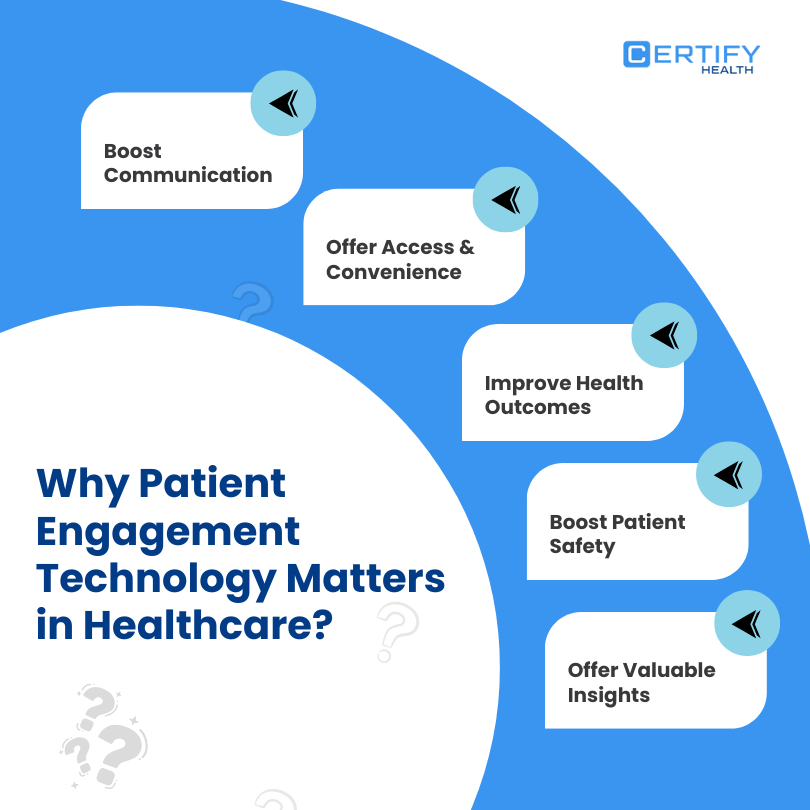
Why Patient Engagement in Healthcare Matters?
- Secure, easy patient–provider communication
- Anytime access to care and records
- Better outcomes through ongoing engagement
- Safer care with protected data
- Real feedback for smarter decisions
Why should health systems invest in patient engagement technology?
Because engaged patients do better, both for themselves and their practices.
Boost Communication
Patient engagement solutions allow practices and patients to securely communicate without risking PII (Personally Identifiable Information) or PHI (Protected Health Information).
It enables patients to request refills, ask questions, or access their medical records promptly, without having to visit the practice.
Offer Access & Convenience
Patient engagement technology provides quick access to appointments, telehealth services, medical records, reminders, and educational content for patients.
It improves convenience and supports the continuity of care for those living in remote areas, people with busy schedules, or individuals with special needs.
Improve Health Outcomes
Patient engagement technology helps you connect with patients where they are – on their phones, inboxes, and portals. It’s about keeping them involved every step of the way.
From sending personalized reminders to sharing follow-ups and helpful resources, you’re not just improving communication, you’re building trust, enhancing patient satisfaction, and driving better health outcomes.
Boost Patient Safety
Using digital engagement tools enables you to send and receive communication in a quick, convenient, and secure manner. It improves patient safety by encrypting your patients’ PII and PHI.
It also empowers patients to take an active role in their care, reviewing their medications, spotting inconsistencies, and speaking up early to prevent errors or complications.
Offer Valuable Insights
Patient engagement tools don’t just connect you with patients; they capture real feedback on gaps in care, important symptoms, and outcomes.
And that matters because real-time patient input helps you spot issues early, personalize treatment, and continuously improve the quality of care your practice delivers.
📈 The numbers tell the story:
The U.S. patient engagement solutions market is on a rapid rise, expected to triple from $7.6 million in 2024 to over $22 million by 2030. That’s a clear sign that digital engagement isn’t just a trend, it’s becoming the backbone of modern patient care.
Core Features Behind Truly Patient-Centered Experience
TL; DR:
What features make patient engagement technology indispensable?
- Stay connected through multi-channel, AI-powered communication
- Deliver personalized education to boost understanding and adherence
- Automate scheduling and reminders to cut no-shows
- Give patients 24/7 access to records and care plans via secure portals
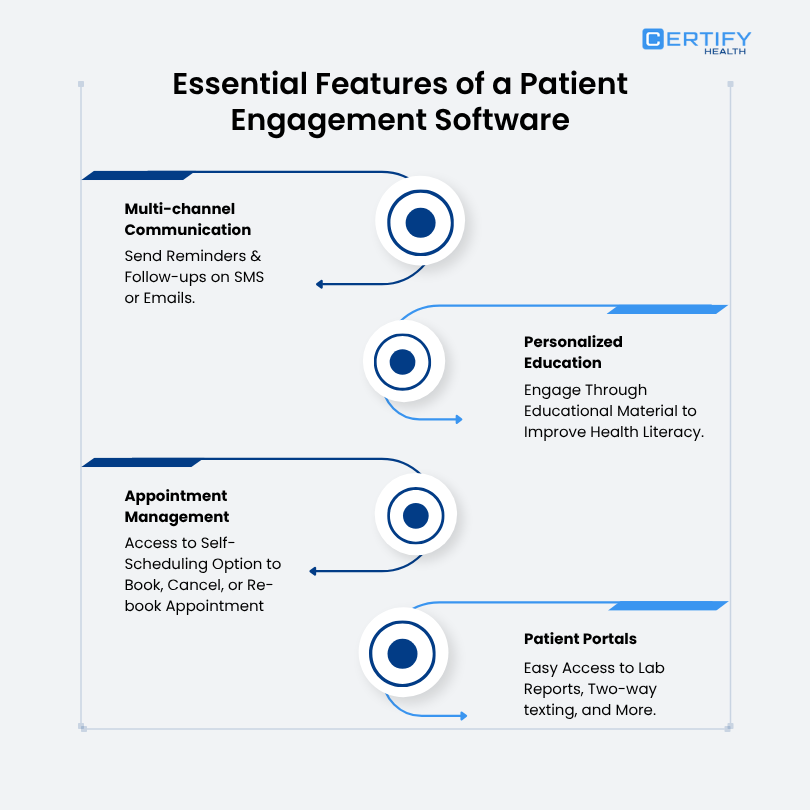
Multi-channel Communication
Look for this feature because staying in touch through texts, emails, calls, or portals builds consistent connections that keep patients engaged. Now, AI-powered tools take it further, offering voice assistants, multilingual communication, and automated reminders that anticipate what patients need before they even ask.
Personalized Education
Digital tools now personalize every interaction from treatment updates to educational tips, based on each patient’s condition. This kind of customization helps patients understand their care better, stay on track, and make confident, informed decisions alongside their providers.
Appointment Management
Automated scheduling and smart reminders make life easier for both patients and staff. This feature helps you send updates across text, email, or calls, and allows quick rescheduling; practices can cut no-shows, save admin time, and keep calendars full.
Patient Portals
This feature gives patients 24/7 access to their lab results, prescriptions, messages, and care plans, keeping them informed, reducing back-and-forth calls, and building trust through transparency.
💡 Quick Insights:
According to a study, patients using online portals report higher satisfaction with stronger care-team communication (~32%), better facility experiences (~41%), and clearer care instructions (~39%).
Digital access builds patient trust and confidence.
These capabilities remove barriers such as fragmented communication and accessibility gaps.
You might also like reading: The 10 Best Patient Engagement Strategy Ideas to Improve Practice Efficiency and Outcomes
Practical Guide to Implementing Digital Patient Engagement Technology
TL; DR:
Patient Engagement Solution Implementation Tips
- Leadership commitment drives success
- Simplify workflows so tech supports staff and patients alike
- Train both teams and patients for confident adoption
- Start small, test, and expand with real feedback
- Use data insights to refine and continuously improve your strategy
Adopting patient engagement technology requires more than just installing software; it demands a strategic approach. So, here it is:
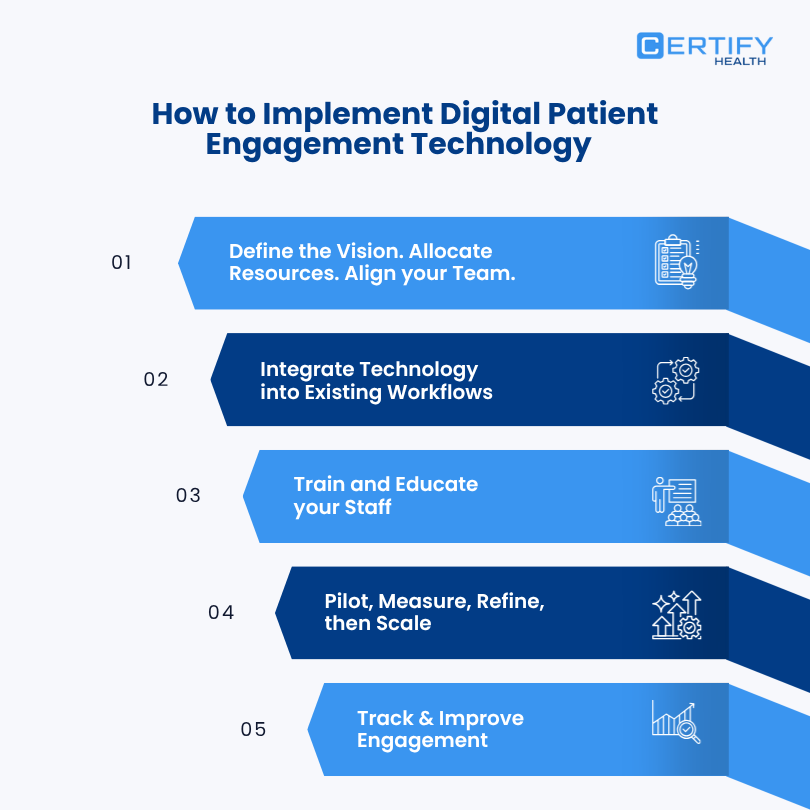
Leadership First
Change starts at the top. When leaders champion patient engagement by setting a clear vision, allocating resources, and rallying teams, it signals that improving the patient experience isn’t just a project; it’s a priority.
Workflow Redesign
Technology should make your team’s day easier, not harder. Integrate tools into existing workflows, so they actually help support staff efficiency while giving patients a smooth, intuitive experience every step of the way.
Train and Educate
Adoption only happens when everyone feels confident using the tools. Train your staff to guide patients, and show patients how engagement platforms make care simpler, faster, and more personal.
Phased Rollouts
Don’t rush it – test, learn, refine. Start small with pilot programs, gather real feedback, measure what’s working, and then expand across departments with confidence.
Use Data to Improve
Data provides insight into what is and is not functioning. Track engagement levels, clinical results, and workflow improvements, then use those insights to keep evolving. Continuous learning keeps your engagement strategy alive and effective.
CERTIFY Health’s Patient Experience Platform helps you turn every interaction into engagement, from check-in to follow-up.
Simplify workflows, empower patients, and deliver care that feels connected, convenient, and personal.
Patient Engagement Benefits and Outcomes Health Systems Can Expect
Improved clinical efficiency, operational efficiency, and enhanced reputation are all the benefits of patient engagement technology.
- Improved Clinical Outcomes: Tools that keep patients informed, involved, and monitored improve chronic illness management and adherence, which lowers hospitalizations and complications.
- Operational Efficiency: Patient flow is streamlined, staff time is maximized, and no-shows are decreased with automated appointment management and multi-channel communication.
- Enhanced Reputation: Patient loyalty and public perception are improved by smooth patient communication and easily available care, which increases competitive advantage.
- Financial Incentives: Value-based care models incentivize providers to keep their patient populations healthy. That’s why engagement technology plays a key role; it helps meet performance goals, boost reimbursements, and minimize penalties.
Moving Forward
If your health system wants to grow sustainably and put patients first, leveraging patient engagement technology is a must.
When you invest in tools that actually understand what patients need, not just what looks good on paper, then everything changes. Satisfaction goes up, outcomes get better, and your financial health strengthens along the way.
Read Next: 10 Best Patient Engagement Software for Healthcare Practices to Explore