

Table of Contents
Introduction
Stop me if you’ve heard this one before: A 500-bed hospital processes 5,000 claims monthly, and loses $25 million annually due to claim denial. Sounds like a bad joke, right? Unfortunately, it’s a harsh reality faced by healthcare practices across America.
Here’s the kicker – most of these devastating losses stem from something that happens before the stethoscope even touches the patient. Patient eligibility verification mistakes are silently bleeding revenue from practices nationwide, turning what should be routine administrative tasks into financial nightmares.
But here’s the worst part: These losses are completely preventable.
The truth is, patient eligibility verification isn’t just admin work, it’s the financial backbone of your entire practice, and when it breaks down, everything else crumbles with it.
Today, we will be looking into the seven most common patient eligibility verification mistakes that are secretly sabotaging your claims – and more importantly, how to stop them before they destroy your bottom line.
Understanding Patient Eligibility Verification
Patient Eligibility verification isn’t just some back-office checkbox—it’s the financial firewall that stands between your practice and thousands of dollars lost to claim denials. You can have the best doctors, the smoothest workflow, and still end up chasing payments—if you don’t verify eligibility upfront.
So, what is patient eligibility verification in RCM exactly? Here’s eligibility verification definition:
It is a process to verify patient’s insurance coverage, plan specifics, and payment obligations prior to providing care. Or as we like to call it—your revenue cycle management (RCM) backbone.
Because in the world of RCM, this is step one. Miss it, and you risk:
- Unpaid claims
- Delayed reimbursements
- Angry, blindsided patients
- Endless administrative back-and-forth
Let’s break it down. Real eligibility verification means confirming:
- The patient has active insurance coverage
- What’s actually covered under their plan
- Their copays, deductibles, and coinsurance
- If you are even in-network
- Whether prior authorization is needed
- Any coverage limits or sneaky exclusions
It’s not just about the patient. You need accurate patient AND provider information. Mess up either one, and you are in for a world of denials, resubmissions, and RCM nightmares.
Patient Eligibility Verification Mistakes & Its Impact on Claims
TL; DR:
What are the common eligibility verification mistakes?
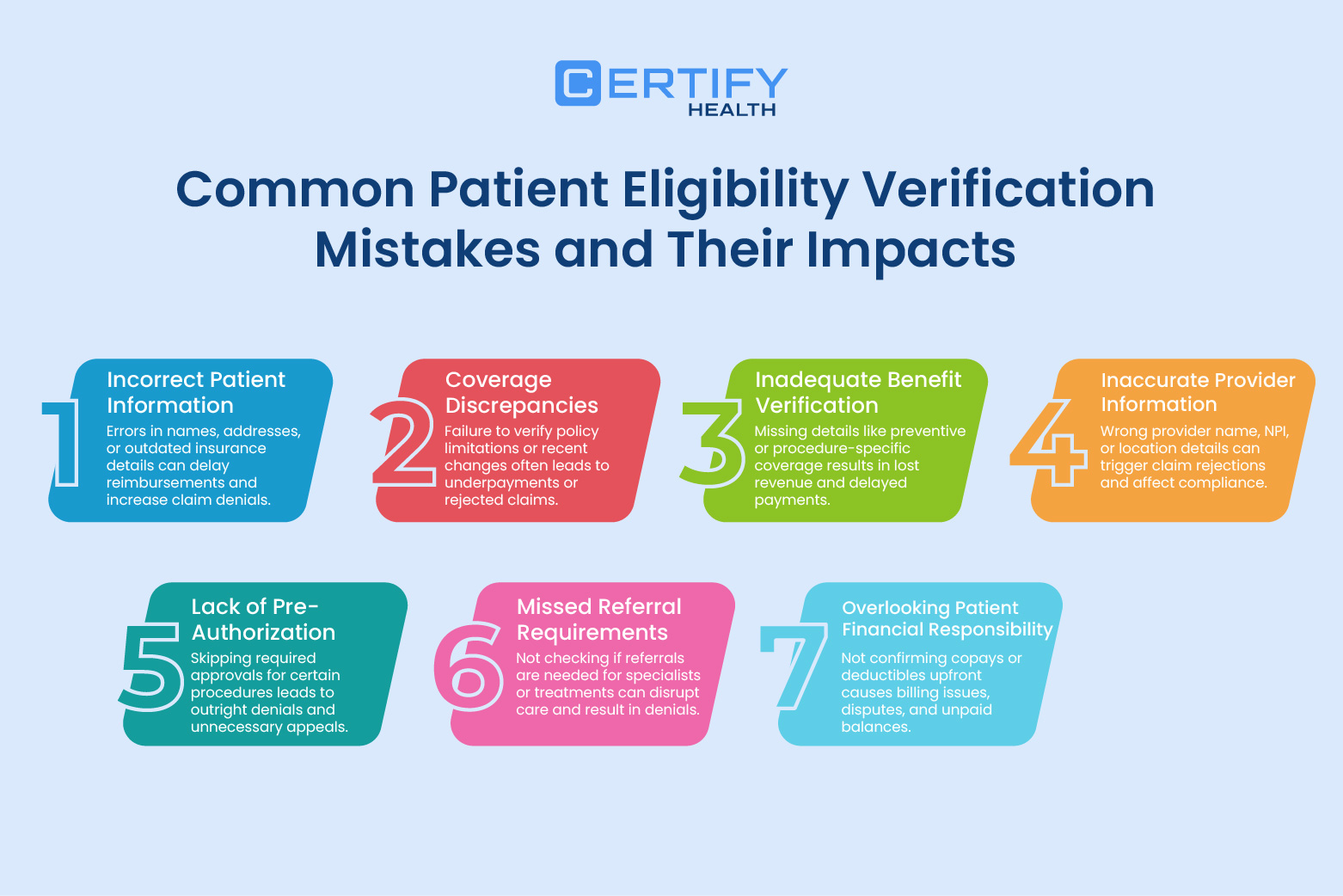
These are the common patient eligibility verification mistakes that can derail your claims:
- Wrong Info = Fast Denial: One typo or old insurance? Claim denied, cash delayed.
- Missed Coverage = Surprise Hit: Patients switch plans—miss it, lose money.
- Skipped Benefits = Lost $$$: Overlook details? Say goodbye to revenue.
- Bad Provider Info = Blocked Claim: One wrong NPI? Rejected. Every detail counts.
- No Pre-Auth = No Pay: Missed approval? You eat the cost.
- No Referral = Big Drain: Missed referral = denial + upset patient.
- No Cost Clarity = Lost Trust: Didn’t confirm copay? Expect billing drama.
1. Incorrect Patient Information
The Mistake: Inaccurate information like patient names, addresses, or outdated insurance information or delays in updating data. Even something as small as a misspelled name can result in claim denial.
The Impact: One incorrect detail in a patient’s file—just one—can cause claim denials, delay payments for weeks (or months), and trigger a whole mess of back-and-forth with the insurance company.
The Financial Reality: Studies show that 20% of claims contain eligibility errors. For that 500-bed hospital we mentioned earlier, submitting 5,000 claims monthly with a 15% denial rate translates to approximately $25 million lost annually. That’s not just a number that’s equipment upgrades, staff bonuses, and patient care improvements going down the drain.
2. Coverage Discrepancies
The Mistake: Incomplete or inaccurate verification of what services are covered, policy limitations, or recent changes in coverage. Your staff assumes coverage exists without confirming the specifics.
The Impact: This results in partial reimbursement, underpayment, or lengthy disputes with payers, undermining your practice’s financial sustainability. When you discover mid-treatment that a procedure isn’t covered, you are left holding the bag – and an angry patient.
Here’s the kicker – as per a research, 15.6% of Medicaid patients switched coverage one or more times within one year. You are not just verifying once. You are chasing a moving target.
If your team isn’t on top of it constantly, you will miss those changes—and that means denied claims, delayed payments, and frustrated patients.
3. Inadequate Benefit Verification
The Mistake: Overlooking nuanced coverage details, such as prescription, preventive, or procedure-specific benefits. Your team checks for basic coverage but misses the fine print.
The Impact: Missed billing opportunities for covered services and protracted reimbursement chases, causing revenue leakage. You are essentially leaving money on the table because you didn’t dig deep enough into the benefits structure.
4. Inaccurate Provider Information
The Mistake: Even an incorrect NPI number or misspelled provider name can direct your claim to the denial city. If the payer can’t match your information with their records? Claim rejected. Out-of-network status? That’s a reimbursement killer. Expired credentials? Now you are dealing with compliance issues, too.
The Impact: Inaccurate information of providers leads to delayed payments, rework for your staff, and a frustrated patient who thought everything was covered. Moral of the story? Provider data needs to be just as accurate and up-to-date as patient data—because when it’s wrong, everyone pays the price.
5. Lack of Pre-Authorization
The Mistake: Failing to obtain required pre-approvals for certain procedures, devices, or medications. This happens when verification processes don’t flag authorization requirements.
The Impact: Outright claim denials increased administrative burden for appeals, and potential revenue loss for services already rendered. You have already provided care, used resources, and invested time – but you won’t see any financial benefits.
The Staggering Statistics: According to KFF analysis, 9% of all in-network denials were due to lack of prior authorization or referrals.
In Texas specifically, 22% of all denied claims by Blue Cross and Blue Shield of Texas were due to missing prior authorization. That’s not a small oversight – that’s a systematic problem costing practices millions.
6. Failure to Verify Referral Requirements
The Mistake: Your front desk didn’t check if a referral was required—and the patient got booked anyway. Easy to miss, right? But here’s the thing: what seems like a small oversight on your end turns into a massive billing mess later.
The moment the claim enters the payer’s system, it’s flagged with ‘no referral’ and gets rejected. Now you are chasing down paperwork after the fact, scrambling to fix a preventable error, and explaining to an irritated patient why they are suddenly stuck with a bill.
The Impact: Lost revenue. Extra admin hours. A hit to your reputation. And let’s not forget the patient’s trust—you just told them, without saying a word, that your systems don’t have their back.
The Revenue Hemorrhage: $78–$97 million lost annually per 100 providers due to referral leakage, often caused by poor communication or lack of insurance verification. When you factor in that $210 per missed referral occurs when referrals weren’t pre-approved or verified, the numbers become staggering.
7. Overlooking Patient Financial Responsibility
The Mistake: Not informing or incorrectly assessing patient copays, deductibles, and out-of-pocket expenses at the point of service is another patient eligibility verification mistake. Your staff assumes the insurance will cover everything without calculating patient responsibility.
The Impact: Leads to billing discrepancies, disputes, increased bad debt, and administrative workload for collections. When patients receive unexpected bills, trust erodes quickly.
The Trust Crisis: Nearly half of insured patients receive unexpected bills (45%), undermining the patient-provider relationship and creating collection nightmares. When patients don’t understand their financial obligations upfront, they are more likely to delay or avoid payment entirely.
The Broader Financial and Operational Impact on Practices
TL; DR:
What are the Best Practices to Prevent Eligibility Verification Mistakes?
- Build a standardized verification checklist and aim for 90%+ completion.
- Use real-time automation tools to reduce manual errors and save time.
- Train staff regularly to stay updated on insurance policies and protocols.
- Promote consistent accuracy and personal responsibility in everyday processes.
- Track denial trends and audit verification performance continuously.
Let’s address the most pressing issue: the impending revenue loss caused by accumulated patient eligibility verification failures. This isn’t just about individual claim denials; it’s about systemic financial hemorrhaging that threatens your practice’s survival.
The Administrative Burden: When eligibility verification fails, your staff spends more time on appeals, resubmissions, and follow-ups, diverting resources from core functions and increasing operational costs. This creates a vicious cycle where administrative burdens grow exponentially with each verification mistake.
Compliance and Contractual Risks: Mistakes don’t just cost money – they can lead to non-compliance penalties and strained payer relationships. Insurance companies track provider accuracy rates, and poor performance can result in increased scrutiny or even contract termination.
Financial Impact on Practices: As per a study:
- The cost to US healthcare providers of claim adjudication alone was an astounding $25.7 billion.
- And here’s the kicker: 70% of denied claims did get paid—but only after multiple rounds of time-consuming and expensive follow-up.
- Fighting denials isn’t cheap — it costs between $44 to $57 per claim just to correct what should have been done right the first time.
- More denials, longer delays: 67% are stuck waiting to get paid.
These financial impacts aren’t just abstract numbers—they directly influence a practice’s bottom line, resource allocation, and future planning.
The trend is clear: Eligibility verification mistakes are becoming more expensive and more common.
See It in Action
Tired of claim rejections and slow reimbursements?
CERTIFY Health’s real-time insurance verification slashes eligibility errors and helps your practice collect faster—without adding more to your team’s plate.
Book a quick demo to see how seamlessly it fits into your workflow.
Best Practices to Prevent Eligibility Verification Mistakes
A. Implement Robust Verification Processes
If your team is still scrambling for insurance info 10 minutes before the appointment, you have got a problem. You need to standardize your workflows like your revenue depends on it—because it does.
Build a checklist. Stick to it like gospel. From verifying patient and provider details to confirming every last coverage code, nothing slips through the cracks. The industry gold standard? A 90%+ verification rate. Anything less is like trying to plug a leaky boat with duct tape.
B. Leverage Technology and Automation
Real-time verification systems like CERTIFY Health’s insurance verification software verified patient eligibility in real-time and plug directly into your EHR and billing tools—so insurance info flows in fast, clean, and accurate. No more guesswork. No more rejections because someone typed in one wrong digit.
Here’s the kicker: automated eligibility verification can cut claim denials by up to 30%. That’s not just cleaner data—it’s faster payments and fewer financial headaches.
Automation = Time Saved. And time is money (literally).
Manual verification takes 12 minutes on average. Automation slashes that to just one. That’s 11 minutes back per patient—and $3.59 saved on every claim. Multiply that by your daily patient load, and the ROI speaks for itself.
With automated reminders, you will never forget a pre-auth again. The system nudges your team before a referral gets missed—so patients aren’t delayed and you are not denied.
The integration of these tools with EHR and billing systems ensures seamless data flow, minimizes manual errors, and accelerates revenue cycles.
CERTIFY Health’s integrated platform combines automation, smart alerts, and real-time coverage checks—all in one seamless dashboard. Let us walk you through it.
C. Staff Training and Accountability
Let’s be real—insurance requirements change more often than your front desk changes pens.
That’s why regular training programs for your front-office and billing teams aren’t a “nice to have”—they’re your secret weapon. Weekly updates. Refresher sessions. Micro-trainings. Whatever works, just keep it consistent.
Because here’s the thing: if your staff isn’t up to date on the latest compliance requirements, it’s not just a missed checkbox—it’s a missed payment.
Now combine that with an accuracy-focused culture.
No more rushing through intake. No more “I’ll double-check it later.” You create a mindset where double-checking isn’t an extra step—it is the step. When that mindset takes hold? You reduce eligibility errors, clean up claim submissions, and stop revenue leaks before they start.
Train often. Verify thoroughly. And always, always treat accuracy like your bottom line depends on it—because it does.
D. Continuous Monitoring and Auditing
Run root cause analysis on denied claims like a detective on a mission. Look for patterns, repeat offenders, and the little mistakes that keep turning into big money losses.
Analytics isn’t just a dashboard—it’s your playbook. Use it to track how efficient your eligibility verification really is and how much cash you are bleeding from preventable errors.
And don’t stop there. Track:
- What’s your verification completion rate?
- Which error types are causing the most denials?
- How long does it take to get paid?
Guessing isn’t a strategy. Tracking is. When you track, you see problems before they explode. And more importantly—you fix them before they cost you.
The Future—Self-Service and Digital Solutions
The healthcare industry is rapidly embracing self-service eligibility verification applications like CERTIFY Health’s Insurance Verification Software that empower practices to automate and streamline checks in real-time. These digital solutions offer:
- Reduced Administrative Costs: Eliminate manual phone calls and paperwork
- Faster Billing Cycles: Real-time verification accelerates the entire revenue cycle
- Improved Accuracy: No manual steps mean fewer mistakes and a more consistent workflow.
Leverage Automation strategically by evaluating digital tools that fit your workflow and scale. The future belongs to practices that can verify eligibility instantly, accurately, and automatically.
Conclusion
Let’s be clear—Patient Eligibility Verification isn’t just a compliance requirement. It’s the gatekeeper to your revenue. Get it wrong, and the fallout is brutal: denied claims, delayed payments, overworked staff, and frustrated patients.
Want sustainable growth? It starts here.
Accurate verification means smoother claims, better cash flow, and fewer headaches for everyone. That’s the real ROI.
So what now?
- Leverage technology to automate the boring stuff
- Train your team to catch issues before they snowball
- Use continuous monitoring to fix gaps before they hurt your bottom line
Don’t let simple mistakes cost you thousands. It’s time to protect revenue with smarter systems and better processes—because in today’s healthcare, you can’t afford to play catch-up.
Start by exploring: 7 Top Insurance Verification Software Transforming Healthcare in 2025
Correcting eligibility issues early isn’t just a smart operational move—it’s a critical revenue strategy.
Stop Losing Revenue to Preventable Errors
Denied claims, delayed verifications, and billing backlogs are eating into your bottom line.
With CERTIFY Health, practices cut denials, verify eligibility in seconds, and get paid faster—all without overloading your staff.
Get a Personalized Walkthrough of CERTIFY Health’s RCM and insurance automation tools.
Frequently Asked Questions
What are the problems with insurance verification?
Insurance verification problems typically include:
- Inaccurate patient information
- Outdated patient information
- Missing prior authorizations
- Incorrect insurance details
- Miscommunication between front-office staff and payers
And guess what happens next?
- Claims get denied
- Payments get delayed
- Patients get blindsided by surprise bills
How can technology reduce patient eligibility verification mistakes?
Technology reduces patient eligibility verification mistakes by:
- Real-time automation checks patient insurance, benefits, and prior authorizations instantly—no more guessing or waiting on hold.
- Integrated tools sync with your EHR and billing systems, cutting out manual data entry (aka error central).
- Payer rules? Already built in. The system knows what’s required and flags issues before you submit the claim.
This means – fewer denials, faster payments, and a smoother revenue cycle—without your staff drowning in paperwork.
What should a practice do after a claim denial due to eligibility errors?
After a denial caused by eligibility issues, the first step is – don’t just resubmit and hope for the best. That’s how mistakes get repeated.
Step 1: Dig into the denial. Was it due to inactive coverage? Missing referral? Wrong insurance ID? Get clarity.
Step 2: Call the patient and the payer. Confirm the correct info. (Yes, both—you need the full picture.)
Step 3: Fix the claim and resubmit it—ASAP. Time is revenue.
Now the real fix begins:
- Do a quick reality check—was this slip-up caused at the front desk? A missed verification step?
- Retrain the team if needed.
- Update your patient eligibility verification process so this doesn’t happen again.
What is the difference between verifying eligibility status and verifying insurance benefits?
Eligibility status verification simply checks if a patient’s insurance is active on the day they receive care.
Insurance benefits verification, on the other hand, digs deeper—it checks what services are covered, co-pays, deductibles, coinsurance, network participation, and prior authorization requirements.
How long does insurance verification take?
How long does insurance verification take? Depends on whether you’re stuck in 1999 or not.
Manual verification: Get ready to waste 10 to 30 minutes per patient—sitting on hold, navigating payer phone trees, or waiting on faxed responses (yes, still a thing).
Automated verification: Done in under a minute. Seriously. Real-time insurance verification tools check active coverage, benefits, copays, and more while your front desk is still greeting the patient.