
Table of Contents
Key Takeaways:
- Patient feedback isn’t just chatter — it’s your secret weapon for loyalty, repeat visits, and steady revenue.
- Continuous feedback spots pain points before they snowball, keeping patients happy and care top-notch.
- SMS, email, apps, portals, kiosks — short, anonymous, and staff-backed surveys get real, honest insights.
- Digital platforms centralize feedback and turn raw responses into smart, actionable improvements.
- Integrate with EHR/PMS, track trends with dashboards, and expand effortlessly as your practice grows.
Introduction
Think patient complaints are just noise? Think again.
They’re your secret roadmap to growth. For small and mid-size practices, patient feedback software doesn’t just capture complaints — it turns them into actionable insights that improve care and fuel practice growth.
With patient expectations rising and competition heating up, listening and responding isn’t optional; it’s how you keep patients happy, loyal, and coming back for more.
Studies from peer-reviewed journals highlight that practices using digital patient feedback systems see significant improvements in care quality as well as up to 68% positive feedback sentiment in patient comments.
Mini FAQ:
Q: Can patient feedback software really impact financial growth?
A: Let’s be real, when patients feel heard, they come back. Listening to feedback isn’t just good manners; it’s good business. Acting on patient feedback drives loyalty, repeat visits, and yes — steadier revenue.
Understanding Patient Feedback & Its Importance
What is Patient Feedback?
Patient feedback is any commentary, rating, or suggestion made after a healthcare encounter – whether praise, complaint, or suggestion for improvement.
What is Patient Experience Feedback?
Patient experience feedback delves deeper, capturing the emotional and practical aspects of a patient’s journey. High-quality practices use these insights to align clinical services with patient expectations, leading to ongoing quality improvement.
Continuous patient feedback collection strengthens a practice’s reputation, improves patient trust, enhances patient satisfaction, and supports more effective operational changes and patient safety.
The importance of patient feedback in healthcare is clear:
- It aligns care delivery with actual patient needs to improve satisfaction
- Drives service refinement by identifying service gaps
- And builds loyalty through actively participating in their care
- Helps design care plans that are patient-centered
- Improving brand reputation through continuous improvement based on feedback.
Mini FAQ:
Q: Why does continuous feedback matter?
A: Patients won’t always tell you what’s wrong — unless you ask, often. Regular feedback helps you uncover pain points early, fix them fast, and keep your reputation shining.
Methods to Gather Feedback from Patients
TL; DR:
- How to collect patient feedback?
- Here’s how your practice can collect patient feedbacks effectively:
- Direct conversations – ask questions and get detailed insights.
- Reach patients everywhere — SMS, email, portals, apps, or kiosks.
- Keep surveys short, direct, and anonymous for honest feedback.
- Train staff to guide patients and make giving feedback effortless.
Direct Methods
The best way to really understand your patients? Talk to them. Face-to-face. Ask questions. Listen. Dive into their experiences. Sure, it gives rich, detailed insights and yes, you can follow up on anything that needs clarity. But here’s the catch: it’s time-consuming, often buried under admin tasks, and easy to skip.
Technology Based Methods
Collect Feedback Everywhere
Why limit yourself to one channel? Modern patient feedback platforms let you reach patients wherever they are — SMS, email, portals, app prompts, or even onsite kiosks. Every patient touchpoint becomes a chance to listen.
Make It Honest and Effortless
Short, direct, and anonymous wins every time. Keep surveys quick and simple — patients of all ages respond more genuinely when it’s easy and safe to share their thoughts.
Front-Desk and Clinical Teams: Your Secret Weapon
Patients respond best when someone they trust invites them. Train staff to guide patients through the process and make giving feedback seamless — it’s not just helpful, it’s essential for capturing real insights.
What is Patient Feedback Software and How Does It Work?
Patient feedback software is a digital solution that streamlines all aspects of collecting, storing, and analyzing feedback from multiple sources. It automates survey deployment, aggregates responses, and utilizes data analytics to surface real-time insights. Top features include:
- Automated feedback collection across all channels for maximum reach
- Real-time insights for immediate action on patient concerns
- Centralized data storage eliminates silos, ensuring all teams have access
- Response management tools to close the loop with timely, personalized follow-ups
Technology-driven feedback collection trumps traditional paper surveys by providing structured, accessible data that is instantly actionable for leadership and frontline teams.
Using Patient Feedback for Quality Improvement

Patient feedback software empowers teams to analyze and interpret data, making it easier to spot trends and service gaps.
A systematic review of 59 studies encompassing 88,069 complaints found that:
- 33.7% of complaint issues relate to safety and quality of clinical care
- 35.1% relate to the management of healthcare organizations
- 29.1% relate to patient-staff relationships including patient communication challenges.
These insights reveal common pain points that, when you address pain points, it significantly enhances care quality and improve communication.
Best practice: Always close the feedback loop, thank patients for their input, communicate improvements, and track satisfaction after changes.
Mini FAQ:
Q: How fast can feedback lead to real change?
A: When feedback becomes data, everything changes. Within weeks, practices see measurable gains in communication, efficiency, and improve patient experience — proof that small insights can drive big improvements
You might also like to read: 11 Tips to Enhance Patient Experience
Patient Feedback Software Benefits for Practices
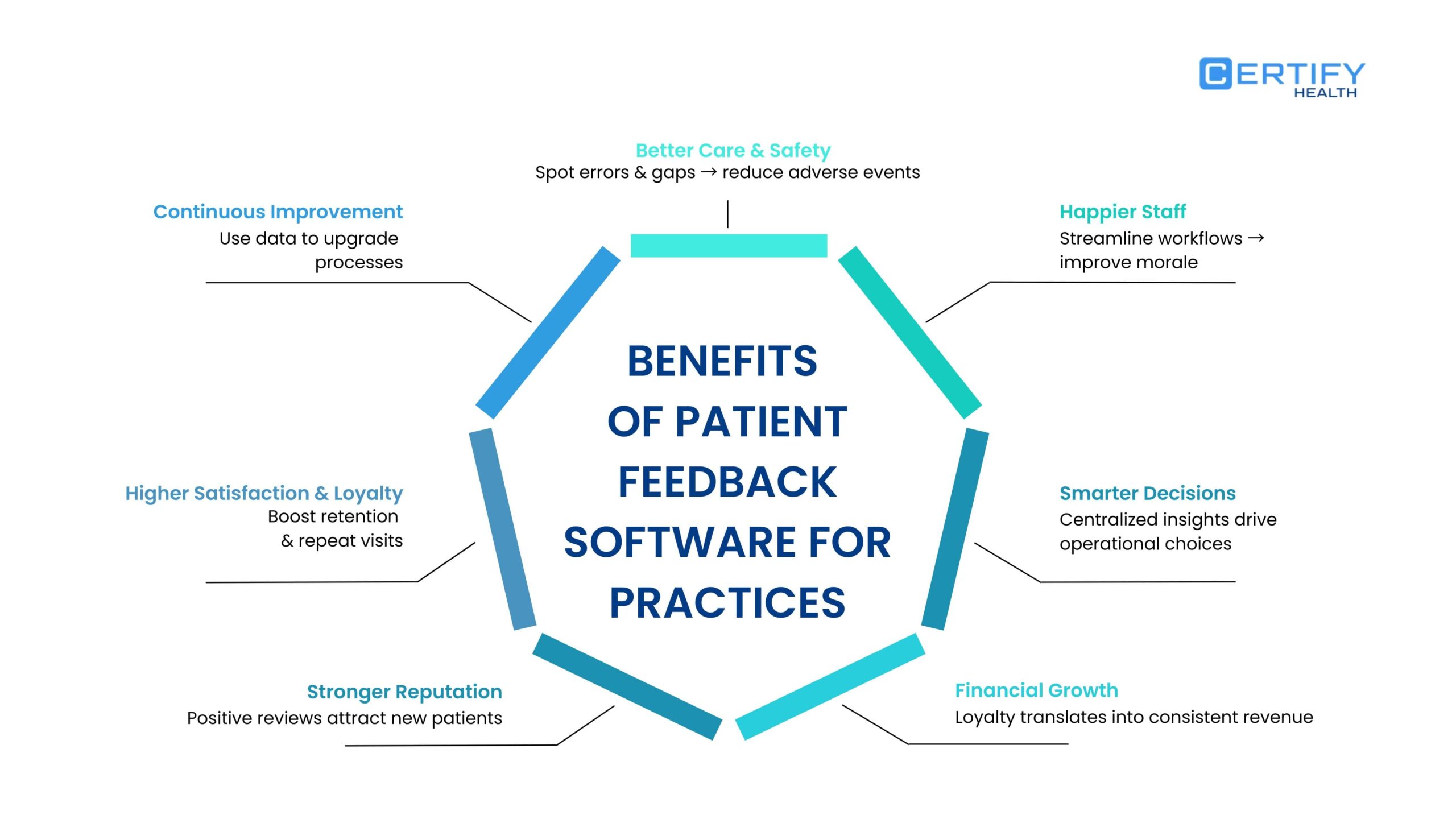
| Benefit | Impact |
|---|---|
| Better care & safety | Identifies errors and gaps, reducing adverse events |
| Continuous improvement | Enables data-driven upgrades in processes |
| Higher satisfaction & loyalty | Boosts retention and repeat visits |
| Stronger reputation | Positive reviews attract new patients |
| Happier staff | Streamlines workflows, improving morale |
| Smarter decisions | Centralized insights fuel smart operational choices |
| Financial growth | Loyalty translates to consistent revenue |
Additional Benefits
Proactive issue management: Handles negative feedback before it escalates, keeping patients happy and protecting your reputation.
Regulatory compliance made easy: Demonstrates commitment to patient experience while meeting requirements for accreditations, designations, and reimbursement programs.
Aligned care teams: Feedback helps staff stay on the same page, ensuring patients’ needs and expectations are met consistently.
A well-implemented patient feedback system leads to fewer unresolved complaints, faster issue response, and upgrades that patients actually notice.
Tips for Choosing the Right Patient Feedback Software
TL; DR:
What are the tips to choose the right patient feedback software?
Here are 5 essential tips to choose patient feedback software:
- Easy Setup: Start collecting feedback immediately with intuitive, no-fuss platforms.
- Integrations: Connect seamlessly with EHR, PMS, and workflows for actionable insights.
- Custom Dashboards: Visualize trends and KPIs to make data-driven improvements.
- Anonymity & Accessibility: Encourage honest feedback across all devices.
- Scalability: Grow with your practice using multi-location support and flexible reporting.
1. Ease of Use and Quick Setup
A feedback platform should be simple enough for any team member to use — no lengthy training, no complicated setup. The goal is to start collecting feedback immediately, not weeks later. Look for intuitive interfaces, guided onboarding, and ready-to-use templates so staff can focus on patients, not technology.
2. Seamless Integration with Core Systems
Feedback shouldn’t live in isolation. Choose a platform that integrates with your EHR, Practice Management System (PMS), and other workflow tools. This ensures patient feedback is automatically linked to visits, encounters, or service lines — making it easier to identify patterns, improve care coordination, and address workflow inefficiencies in real time.
3. Customization and Insightful Dashboards
Every healthcare organization has unique goals and KPIs. The right patient feedback system should let you customize surveys, rating scales, and reporting views. A clean, visual analytics dashboard helps leadership quickly spot trends, track performance, and turn raw responses into actionable insights that drive measurable improvement.
4. Support for Anonymity and Accessibility
Patients are more honest when they know their voices are heard safely. Ensure the platform allows anonymous responses to encourage open, transparent feedback. Accessibility across mobile, desktop, and kiosk devices keeps the system truly patient-centric, giving every individual — regardless of age or tech comfort — an equal voice.
5. Scalability and Flexible Reporting
As your practice grows, your feedback solution should grow with you. Look for platforms that offer multi-location support, custom report filters, and role-based access. Scalable systems make it easier to compare performance across departments, identify location-specific bottlenecks, and maintain consistent improvement in patient experience metrics.
6. Security & Compliance
HIPAA compliance isn’t optional—it’s essential. Why? Because patient feedback often includes sensitive health information. Without encryption, access controls, and proper safeguards, you risk privacy breaches, fines, and lost trust. The right software keeps feedback secure, protects your patients, and shows you take confidentiality seriously.
7. Multi-Channel Feedback
Patients communicate in different ways—some reply to emails, some prefer texts, others respond on your website or in-person kiosks. The right software meets them where they are, capturing feedback from every touchpoint so you get the full picture.
You might also like to read: What is Patient Experience Software?
Mini FAQ:
Q: Can feedback software grow with a practice?
A: Scaling shouldn’t be stressful. With modern patient feedback platforms, adding a new provider or location is literally a settings tweak — not an IT project. Everything stays synced, centralized, and ready for smarter decisions.
Conclusion
Patient feedback software is no longer just a compliance tool; it is a competitive advantage for small and mid-sized practices.
By transforming patient complaints into growth opportunities, practices can deliver high-quality care, maintain continuous improvement, and empower teams with real-time insights for smarter decisions and financial growth.
To stay ahead, practices should act now to optimize their patient feedback collection and close the loop on quality improvement, building patient loyalty, stronger reputations, and happier staff.