
Table of Contents
TL;DR: Reducing Missed Appointments in OB-GYN Clinics
Missed OB-GYN appointments, which can range from 19% to 64%, are a critical barrier to women’s health and prenatal care.
Each missed visit limits early detection, disrupts continuity of care, and leads to significant financial losses for clinics.
The main causes include forgetfulness, transportation challenges, financial constraints, childcare responsibilities, and limited appointment availability.
Studies show that using automated reminders, digital scheduling systems, and integrated EMR tools can lower no-show rates by up to 25%.
Effective strategies to reduce missed OB-GYN appointments:
- Automate appointment reminders through text, email, or phone.
- Implement digital engagement and self-scheduling platforms.
- Offer flexible scheduling and transportation assistance.
- Use predictive analytics to identify patients at higher risk of no-shows.
- Monitor attendance rates and benchmark performance against national standards.
Reducing missed appointments strengthens patient trust, improves maternal and infant outcomes, and enhances the overall efficiency of OB-GYN practices.
Introduction: The Hidden Cost of Missed OB-GYN Appointments
Missed appointments in OB-GYN care are more than scheduling problems. They are indicators of deeper issues in maternal and infant health.
Missed Appointments: A Major Threat to Women's Health and Prenatal Care
- Across the United States, missed visits account for as much as 30% of lost clinical capacity, straining resources and limiting access to timely care.
- In OB-GYN clinics, the problem is widespread. Gynecology no-show rates range from 19% to 64%, while obstetric visits miss between 22% and 64%.
- Among women with high-risk pregnancies, the no-show rate rises to 20% to 34%, surpassing general OB-GYN averages.
Each missed appointment represents more than an empty slot. It is a lost opportunity for early detection and intervention.
The impact is national in scope. NBC News reported a 0.1% increase in mothers receiving no prenatal care between 2022 and 2023.
That seemingly small number represents thousands of women and infants exposed to preventable complications. Mothers without consistent prenatal care are five times more likely to experience adverse outcomes for their babies, and missing prenatal appointment visits triples the risk of premature birth, which is top factor causing rise in infant morbidity in the United States.
Direct Revenue Losses and Operational Strain
For small and mid-sized OB-GYN practices, average revenue losses can shoot up to $150K in yearly losses from no-shows.
This loss triggers staff reductions, workflow disruptions, and lower care quality, creating a cycle that undermines both health outcomes and financial stability.
The solution lies in connected, patient-centered systems that keep patients engaged and informed.
Automated reminders, digital follow-ups, and integrated scheduling tools help reduce no-shows and protect both lives and livelihoods.
In modern maternal care, every appointment kept is a step toward healthier mothers, stronger infants, and a more resilient healthcare system.
Evidence-Based Causes of Missed Appointments in OB-GYN
Missed OB-GYN appointments arise from both patient-level and system-level barriers.
At the patient level, factors such as rural location, limited transportation, lack of insurance, and community circumstances make it difficult to attend scheduled visits.
At the system level, issues include absence of automated patient management systems, shortages of qualified OB-GYN practitioners, and inefficient scheduling processes.
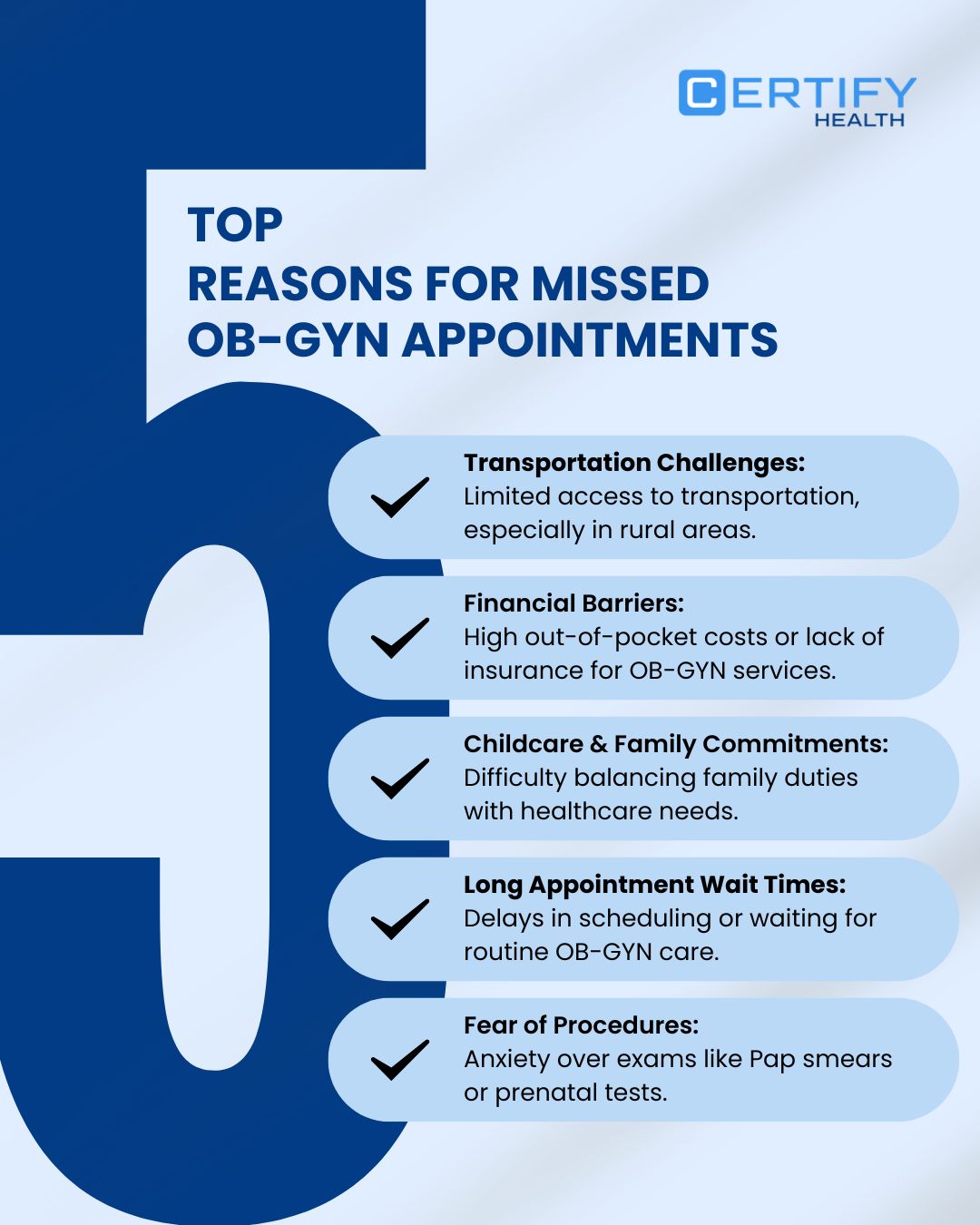
Together, these gaps reduce access, increase no-shows, and weaken continuity of care. The table below outlines these barriers for a clear overview.
| Cause | Evidence |
|---|---|
| Forgetting Appointment | 36% of missed appointments were because patients simply forgot the appointment |
| Transportation Barriers | 24% of Black birthing people in Los Angeles County reported transportation problems affecting maternal care |
| Childcare Responsibilities | 10% of women at a US safety-net hospital missed OB-GYN visits due to lack of childcare |
| Work/School Conflicts | 17% of missed OB-GYN appointments were due to work-related scheduling issues |
| Insurance/Financial Barriers | 20% of uninsured or publicly insured US women reported missing prenatal visits due to inability to pay |
| Extended Travel/Public Transit | 30% of pregnant women using public transit faced excessive travel times contributing to missed visits (NYC study) |
| Scheduling Delays | 16% of missed appointments linked to inability to get same-day or next-day OB-GYN appointments in US clinics |
| Absence of Reminder Systems | Appointment reminders reduced missed rates by 20–30% in randomized US studies |
| Low Perceived Importance | 15% prioritized other activities over their OB-GYN visit or felt non-urgent, contributing to no-shows |
Research-Backed Solutions to Reduce Missed Appointments in OB-GYN Clinics Across the US
What are the proven methods for specialty practices to significantly decrease no-show rates using automated communication tools?
1. Automated Appointment Reminders
Modern patient management software plays a crucial role in reducing missed appointments. These systems automate HIPAA-compliant appointment reminders through SMS, email, phone calls, or app notifications, keeping patients informed and engaged.
Automated reminders can reduce no-shows by 5% to as much as 44%, even in small-scale studies. While limited in scope, these findings clearly demonstrate the measurable impact of reminder systems on attendance rates.
A DovePress review further found that no-show rates decline even more when reminder systems analyze patient data and send multiple reminders (such as two text messages or additional calls) based on a patient’s history of missed visits.
Within this landscape, Certify Health has helped partner practices reduce no-shows by 30% through configurable communication tools.
These solutions enable multi-touch sequences, personalized messages, and scheduling customization by visit type, specialty, or patient profile. Such automation strengthens patient engagement, improves continuity of care, and protects clinical efficiency.
2. Digital Engagement
After COVID-19, digitizing OB-GYN workflows became essential for sustaining care delivery. Transitioning patients to digital intake forms, self-scheduling systems, EMR-integrated workflows, and online outreach or wellness programs marked a turning point in operational efficiency.
According to the CDC’s 2024 EHR Survey, clinics that adopted these digital tools saw a clear improvement in patient engagement and attendance. Missed appointment rates declined from 21% for in-person scheduling to nearly 15% when digital engagement systems were fully integrated.
This shift highlights how technology not only improves convenience but also strengthens adherence, communication, and overall continuity of maternal care. Digital adoption is no longer an option for OB-GYN practices; it is a proven strategy for reducing no-shows and improving outcomes.
3. Socio-Economic Barriers
Transportation remains one of the most significant and overlooked causes of missed OB-GYN appointments. While some no-shows result from personal choice or lack of motivation, many are linked directly to accessibility challenges.
Reports from the CDC and NBC News show that when an OB-GYN provider is located more than 30 miles from a patient’s residence, the likelihood of a missed prenatal appointment increases by over 30%.
Distance and unreliable transportation continue to be leading contributors to missed care, especially for expectant mothers in rural areas.
Encouragingly, a 2025 research study found that hospital systems offering the following significantly improve attendance and care continuity.
– Travel assistance
– Flexible scheduling
– Automated reminder programs
These practical interventions reduce no-shows, improve prenatal monitoring, and promote better maternal outcomes.
4. Integration of Reminders into EMR and Predictive Outreach
Platforms that integrate automated reminders directly with Electronic Medical Record (EMR) scheduling systems have been shown to improve patient adherence and reduce the need for repeated follow-ups. When reminders, scheduling, and patient data operate within a unified system, clinics maintain better coordination and patients are less likely to miss appointments.
Clinical reviews indicate that analyzing patient patterns through data algorithms helps identify high-risk individuals and apply predictive outreach methods, resulting in a 25% reduction in no-shows.
This approach forms the foundation of risk stratification, a method that uses predictive data to pinpoint patients who need targeted reminders and engagement strategies to stay on track with their care.
5. Risk Stratification
Risk stratification is one of the most effective data-driven tools in modern healthcare. It enables providers to categorize patients based on their likelihood of specific risks, such as missing appointments.
By tailoring engagement strategies and communication methods to each patient’s risk profile, clinics can deliver more personalized and effective outreach.
How Risk Stratification in OB-GYN Clinics Works
- Categorizes and predicts patients prone to miss visits, allowing staff to act early.
- Streamlines workflows, improves continuity of care, and makes better use of limited clinical resources.
- When risk scores show a low likelihood of no-show, clinics can confidently overbook to maintain full capacity.
- When the risk is high, schedules can be adjusted, slots freed for other patients, or staff time reallocated to critical needs.
- Research confirms risk stratification as a valuable strategic asset in patient management.
- Serves as a real-time signal to identify patients who may need additional reminders, flexibility, or support to keep appointments.
Measuring Success: US Benchmarks and OB-GYN Clinic Outcomes
NBC News reports that the CDC has established a national benchmark for prenatal care participation, recognizing its direct impact on infant morbidity. As of 2025, about 77.7% of U.S. women receive adequate prenatal care. Current projections suggest it may take another three years for this figure to surpass 80%.
Consistent prenatal attendance plays a vital role in preventing premature births and reducing Neonatal Intensive Care Unit (NICU) admissions, particularly among high-risk pregnancies.
The NICU provides specialized medical care for newborns who are critically ill or born prematurely, making early intervention and regular monitoring essential.
Clinics that have implemented Certify Health’s multi-channel automated reminder system have reported a 30% reduction in no-show rates across the United States.
This demonstrates the platform’s reliability and effectiveness in improving patient adherence, care coordination, and overall OB-GYN practice performance.
Conclusion: Action Checklist for US OB-GYN Clinics
Did you know?
Up to 36% of missed OB-GYN appointments occur simply because patients forget their scheduled visits. Research shows that text message reminders can reduce no-shows by nearly one-third.
Did you know?
In major U.S. cities, one in four Black birthing individuals cite transportation barriers as a key reason for missing OB-GYN appointments, underscoring the critical role of access and mobility in ensuring consistent prenatal care.
These barriers (forgetfulness, transportation challenges, and fragmented communication) can all be minimized through unified healthcare management platforms that connect every step of the patient’s journey. Integrated systems streamline scheduling, automate reminders, and ensure equal care opportunities for all patient populations.
Certify Health offers a comprehensive suite of tools designed to achieve exactly this. Its connected workflows, automated reminders, and data-driven insights help practices reduce no-shows, strengthen engagement, and enhance patient experience across the OB-GYN care spectrum.
The table below provides a simple checklist to help you identify the next steps for implementation and measure the potential benefits for your practice.
| Action Step | Why It Works | How Certify Health Enables This |
|---|---|---|
| Automate Multi-Channel Reminders |
Two-touch, multi-modality reminders reduce missed OB-GYN visits by up to 30% |
CERTIFY Health automates SMS & phone call reminders, customizable for multiple touchpoints per patient. |
| Integrate EMR with Scheduling, Reminders & Post-visit patient engagement |
Seamless EMR integration ensures timely reminders and patient outreach, lowering appointment no-shows |
CERTIFY Health’s unified platform connects EMR, scheduling, automated reminders, and post-visit engagement campaigns. |
| Offer Flexible Appointment Hours & Transportation Assistance |
Flexibility and digital outreach solve up to 24–30% of missed visits in OB-GYN (transport, after-hours, outskirts) |
CERTIFY Health’s tool features support customization and enables visit offers beyond standard hours. |
| Predictive Analytics for High-Risk Patient Outreach |
Targeting highest-risk no-show groups with reminders and resources improves equity and attendance |
CERTIFY Health analytics can be used to flag uninsured, rural/urban, and chronic no-show patients for proactive outreach. |
| Track Missed Rates & Benchmark to CDC Standards |
Benchmarking against CDC goals (>80.5% early prenatal care, <20% no-shows) is proven to improve health outcomes |
CERTIFY Health dashboards allow clinics to monitor missed visit rates and early prenatal care enrollments monthly |
| Patient Education & Engagement at Registration |
Digital engagement increases awareness; 15% of visits missed due to lack of perceived importance by patients |
CERTIFY Health provides digital check-in, reminders opt-in, and targeted education resources on device |
Ready to Elevate Your Therapy Practice?
Book a demo with CERTIFY Health and discover how we can transform your practice with measurable ROI and streamline patient management.
FAQs
What are the consequences of not going to the doctor while pregnant?
Missing prenatal visits can delay detection of conditions like preeclampsia, gestational diabetes, or fetal growth issues, increasing risks of complications for both mother and baby. It can also raise the likelihood of preterm birth and low birth weight due to lack of early monitoring and treatment.
What are the top strategies for engaging expectant mothers through automation?
Effective strategies include automated appointment reminders, digital intake and self-scheduling, personalized follow-ups based on patient history, and predictive outreach for high-risk patients. These tools improve engagement and can reduce missed appointments when integrated with clinical workflows.
Are there platforms that offer coordinated outreach efforts to reduce patient no-show rates?
Yes. Modern patient engagement platforms combine automated reminders, digital intake, scheduling tools, and EMR integration to coordinate outreach. These systems enable targeted messaging and multi-touch communication that helps practices reduce missed visits and improve patient adherence.
Can you get in trouble for not going to prenatal appointments?
In most cases, missing prenatal appointments does not lead to legal trouble. However, healthcare providers strongly encourage consistent visits because prenatal care helps monitor maternal and fetal health and prevent complications during pregnancy.
What is a prenatal appointment?
A prenatal appointment is a routine medical visit during pregnancy where healthcare providers monitor the mother’s health and the baby’s development through exams, tests, and guidance on nutrition, lifestyle, and pregnancy care.