
Table of Contents
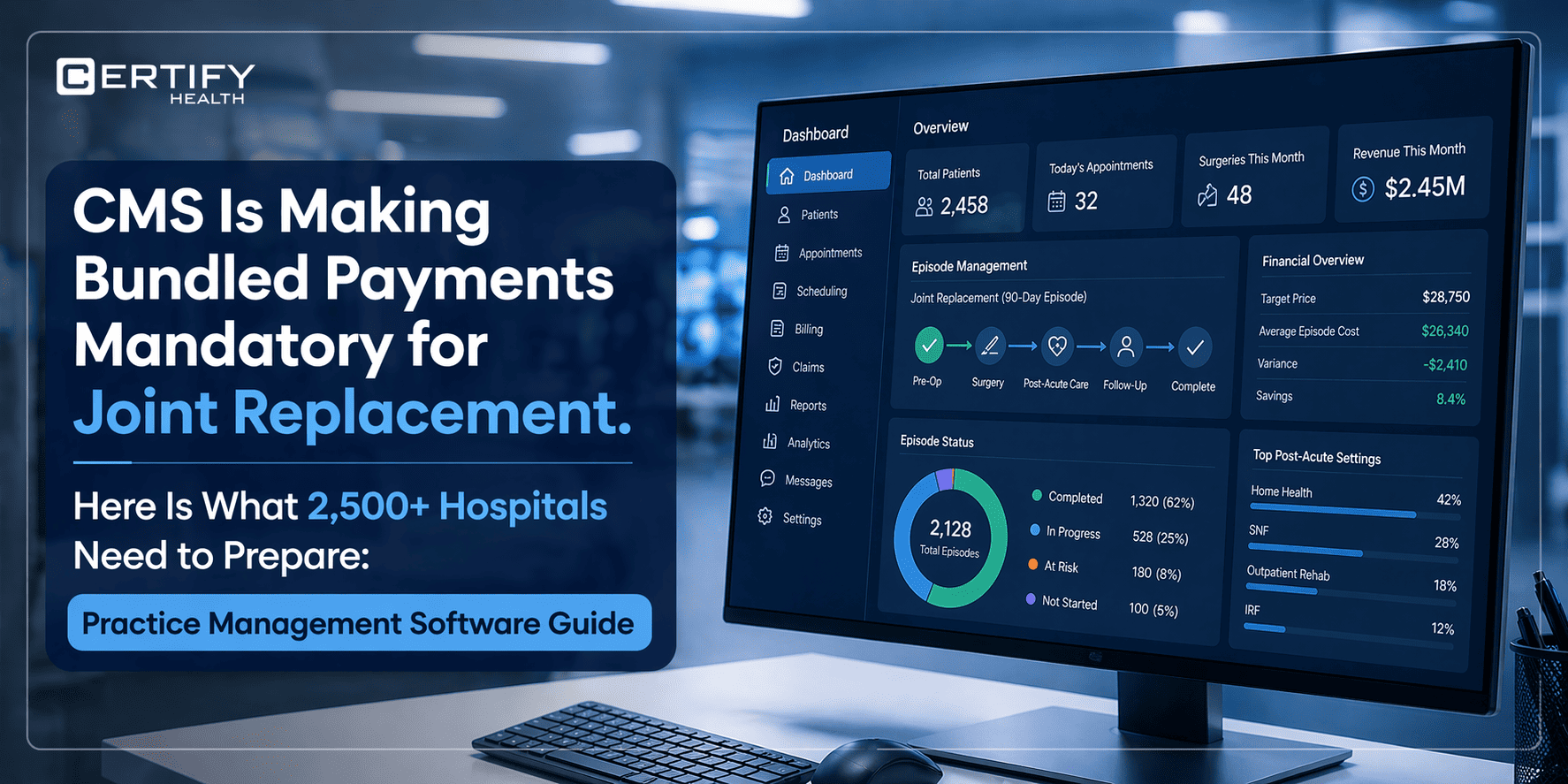
You’re staring at an email from CMS. It says your hospital’s now in the CJR-X model. Bundled payments for joint replacements are mandatory. No opt-out. Your ops team feels the heat: schedules are packed, discharges drag, and revenue worries keep you up at night.
It’s not panic time. CJR-X builds on the 2016 model you have seen before. But with 2,500+ hospitals locked in starting October 2027, you need a clear plan.
This guide breaks down the operational shifts, financial risks, and fixes to make before go-live. We’ll focus on what practice management software can do to smooth it all out.
What CJR-X Changes
CMS dropped the news – 2027 IPPS proposed rule. They want mandatory participation for over 2,500 hospitals in select metro areas. That’s a big jump from voluntary days.
Key shifts hit hard:
- Mandatory participation: No more picking and choosing. If you’re in a CJR-X area, you’re in. CMS targets high-volume joint replacement spots to push value-based care.
- 90-day episode accountability: Every hip or knee replacement triggers a 90-day bundle. You own costs from surgery through recovery, post-acute care included.
- Downside financial risk: Hospitals face real penalties if episodes exceed benchmarks. CMS sets targets based on your historical data. Beat them, earn shared savings. Miss, and you pay back up to 20% of excess costs.
It’s evolution, not revolution. CJR since 2016 tested this. Now it’s scaled up. Your goal? Coordinate care to hit those targets without dropping quality.
Operational Impact of CJR-X model
This is where it gets real. Bundled payments flip your daily flow. Fee-for-service let you bill per service. Now, one price covers the episode. Mess up coordination, and profits vanish.
Let’s break it into bites.
Scheduling & Case Flow
Your Operating Room (OR) schedule just got tighter. CJR-X demands efficient case flow to avoid backups. Delays mean longer stays, higher costs.
Let’s understand this: A knee patient waits extra days for a slot. That bumps bundle costs. Practice management software fixes this. It syncs OR blocks with surgeon prefs and patient needs. Tools like healthcare scheduling software within PMS predict no-shows and slot fillers fast.
Hospitals using smart scheduling cut episode times by 15-20%. You can too, without adding staff.
Care Coordination Across Settings
Handovers break bundles. Surgery goes smooth, but rehab lags. Who tracks the patient post-discharge?
CJR-X holds you accountable for the full 90 days. That means tight links with SNFs, home health, and outpatient. One gap, and costs leak.
Teams that nail this use shared dashboards. They spot readmits early. No more phone tag between departments.
Post-Acute Network Management
Your post-acute partners matter now. CMS tracks where patients go after discharge. Send to high-cost SNFs? Your bundle suffers.
Build a vetted network. Track outcomes per provider. Good practice management software maps this, flags risky discharges in real time.
Bundled programs often cut post-acute spend by 10–15% when you build strong preferred networks. It’s doable if you start mapping now.
Data Tracking & Reporting
CMS wants proof. You’ll submit episode data quarterly. Miss a code, face audits.
Manual spreadsheets won’t cut it. You need real-time visibility into every patient touchpoint. That’s where integrated tracking shines, pulls data from EHR, claims, and post-acute feeds.
Revenue Cycle Impact
Fee-for-service padded errors. Bundles punish them.
Swapping to one payment changes everything. No more billing every bandage. Instead, you get a target payment. Underdeliver, keep the surplus. Overdeliver, eat the loss.
Big risks loom:
- Leakage: Services slip outside the bundle. Think unrelated ER visits. They hit your bottom line.
- Denials: Payers scrutinize harder. One missed modifier, and claims bounce.
- Missed documentation: Forgot to code that PT session? Benchmarks tank.
Revenue cycle management software plugs these holes. It flags bundle-eligible cases early, auto-codes episodes, and reconciles payments. Hospitals report 25% fewer denials with automation.
Without it, expect 5-10% revenue dips in year one. With it, you stabilize fast.
What Hospitals Need to Build Now
October 2027 feels far. But prep starts today. Over 2,500 facilities face this. Late starters scramble.
Here’s your actionable checklist. Focus on systems, workflows, and visibility.
- Upgrade your core tech stack: Pick practice management software that handles bundles. It should integrate scheduling, patient tracking, and revenue tools. Look for healthcare scheduling software with OR optimization and episode timers.
- Modernize patient intake workflows: Implement a digital intake system that captures insurance, medical history, and consents before surgery, then syncs them into your practice management software and EHR. This reduces day‑of‑surgery hiccups and bundles fewer surprise cost drivers.
- Map workflows end-to-end: Redesign discharge protocols. Train staff on 90-day handoffs. Test with mock episodes.
- Build post-acute partnerships: Vet 5-10 SNFs and home health groups. Set shared KPIs like readmit rates under 5%.
- Automate revenue cycle: Roll out revenue cycle management software. It catches leaks, speeds claims, and forecasts risks.
- Invest in data visibility: Dashboards for every leader. Ops sees case flow. Finance tracks variances. Compliance preps reports.
- Train your team: Run workshops on CJR-X rules. Role-play tough discharges.
- Pilot test: Launch a voluntary bundle now. Tweak before mandatory hits.
CERTIFY Health’s unified medical practice software makes this painless.
Their practice management software unifies care coordination: scheduling, intake, verification, tracking, and post-acute links in one view.
Pair it with CERTIFY Pay for revenue cycle management software that auto-handles bundle recon.
No rip-and-replace.
It plugs into your EHR, cuts manual work by 40%, and gives episode-level insights.
We’ve seen hospitals shave 12% off joint costs in pilots.
Start small. Build visibility. You’ll hit benchmarks.
Ready for CJR-X?
CJR-X isn’t a crisis. It’s a nudge to coordinate better. With mandatory bundles for 2,500+ hospitals, the smart move is prep now. Nail scheduling, care handoffs, and revenue with solid practice management software. Financial risks shrink. Ops run smoother.
Your team can do this. Talk To Our Team at CERTIFY Health about care coordination for bundled payment episodes.