

Table of Contents
Executive Summary
Functional medicine practices grapple with data overload from GI-MAP and hormone panels, interoperability gaps limiting real-time decisions, clinician time lost to EHR burdens (one-third to half of workdays), complex cash-pay billing causing revenue leaks, compliance risks from fragmented data, and siloed tech stacks stalling efficiency.
CERTIFY Health’s unified functional medicine software resolves these by centralizing lab data, automating workflows and RCM, delivering clinical decision support, and enabling seamless integration, reclaiming 80% admin time, cutting no-shows 25%, boosting revenue 20%, and ensuring zero fines across practice sizes.
CERTIFY Health’s functional medicine software empowers your practice to operate efficiently, integrate lab data seamlessly, and focus on patient outcomes rather than administrative chaos. With a unified system, fragmented workflows, inefficient communication practices, and siloed GI-MAP or hormone panels are replaced by a single, streamlined platform for functional medicine practice management.
By combining healthcare workflow automation, clinical decision support software, and biomarker data management, CERTIFY Health ensures your team spends less time on paperwork and more on transforming patient lives.
Functional Medicine Tech Challenges
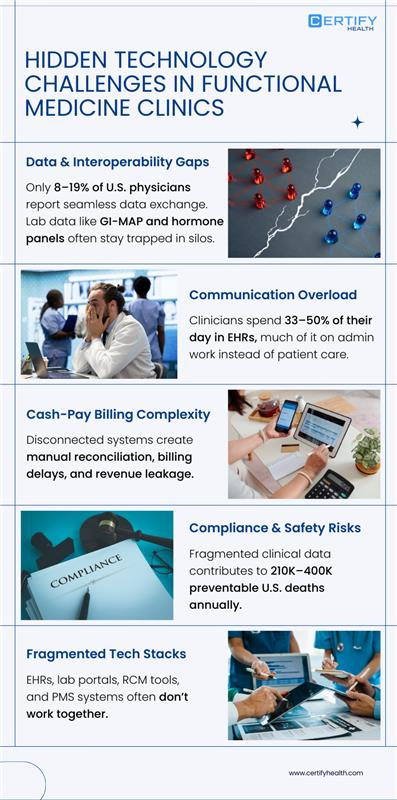
Functional medicine practices face unique operational hurdles:
Data Overload & Interoperability Gaps
Across U.S. healthcare, ideal interoperability remains elusive, with only 8–19% of primary care physicians reporting truly seamless data exchange for key clinical information.
That means most practices still struggle to access GI‑MAP results, hormone panels, and patient labs quickly and reliably across systems, limiting real‑time decision‑making and care continuity.
Inefficient Communication Drains Clinical Time
Electronic systems intended to streamline care often backfire. In the U.S., clinicians now spend an estimated one‑third to one‑half of their workday interacting with electronic records, much of it on documentation, reconciliation, and administrative tasks rather than patient care. These burdens directly amplify inefficient communication practices across teams and tools.
Cash‑Pay Billing Is Costly & Complex
Though U.S. journals focus less commonly on cash‑pay models, research consistently shows that non‑interoperable systems contribute to redundant administrative work and billing inefficiency. Fragmented EHRs and disconnected billing stacks force multiple manual reconciliations, a major contributor to billing cycle delays and revenue leakage for practices without solid functional medicine PMS and automation.
Compliance & Patient Safety Risks
Continued failure to overcome interoperability challenges undermines safe care delivery. In the U.S., preventable healthcare errors, often linked to incomplete or fragmented clinical data, may contribute to 210,000–400,000 of deaths annually. This highlights the compliance burden faced by practices trying to track complex protocols like 5R or longevity programs while ensuring data integrity.
Fragmented Tech Stacks Stall Efficiency
Despite nearly universal adoption of electronic health records across U.S. hospitals, the promise of seamless data sharing hasn’t materialized. Fewer than half of hospitals engaged in all domains of interoperability as recently as 2018, underscoring that fragmented EHRs, lab portals, standalone RCM tools, and separate PMS systems still create bottlenecks for coordinated care and lab data flow.
Solution: CERTIFY Health provides functional health solutions that unify lab data, automate workflows, and offer clinical decision support, reclaiming up to 80% of admin time.
Get a Live walkthrough Today to Reduce Admin Overload and Claim 30+ Hours Per Month.
ICP-Tailored Adoption Framework
Not all functional medical practices are the same. CERTIFY Health’s adoption framework aligns with your:
- Practice Type: Gut, hormones, autoimmune, longevity, or hybrid specialties.
- Team: charting leads and operations leads.
- Maturity Stage: Startup practices vs. multi-site established centers.
This phased, practice readiness assessment ensures the platform addresses bottlenecks like inefficient communication and lab interoperability gaps without overwhelming your team.
Step-by-Step Adoption Roadmap
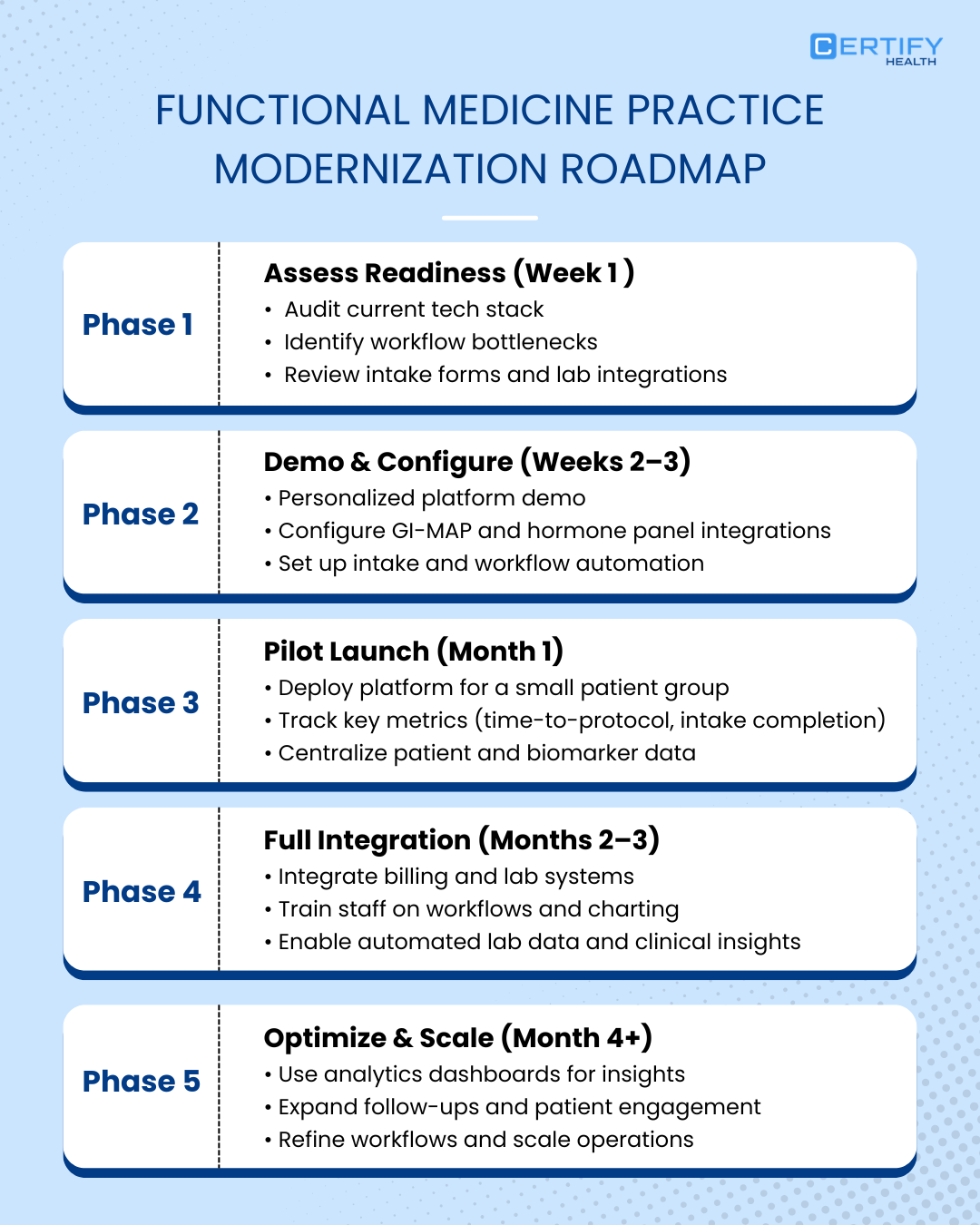
1. Assess Readiness (Week 1)
- Map current systems and identify workflow bottlenecks.
- Audit scheduling errors, billing delays, and no-shows.
- Highlight gaps in functional medicine intake forms, GI-MAP and hormone panel integration.
2. Demo & Customize (Weeks 2-3)
- Personalized demo tailored to your specialty.
- Sync GI-MAP or hormone panels based on your practice needs.
- Customize healthcare workflow automation for lab and intake processes.
3. Pilot Phase (Month 1)
- Launch PXP and functional medicine PMS for a subset of patients.
- Track KPIs: time-to-protocol, patient completion of patient health questionnaires.
- Observe inefficient communication practices dissolve as biomarker data management centralizes information.
4. Full Integration (Months 2-3)
- Add RCM and full lab interoperability.
- Train staff on EHR implementation best practices, authorizations, and charting.
- Enable lab data automation and clinical decision support for seamless operations.
5. Optimize & Scale (Month 4+)
- Leverage healthcare analytics dashboard for PROs and adherence insights.
- Expand follow-ups, refine workflows, and apply healthcare change management strategy for lasting improvements.
Platform Adoption Roadmap Tailored by Size
| Practice Size | Phase | Timeline | Key Focus Areas & Wins |
|---|---|---|---|
| Solo/Small Functional Medicine Practice | Phase 1 – Core Wins | Months 1–2 | - Implement auto-intake, flexible booking, functional medicine intake forms - Cut no-shows by 25% - Automate patient health questionnaires |
| Phase 2 – Scale Up | Months 3–4 | - Introduce group scheduling - Enable RCM automation - Integrate GI-MAP and hormone panels | |
| Phase 3 – Full ROI | Month 5+ | - Deploy dashboards for patient reported outcomes - Optimize healthcare workflow automation - Implement clinical decision support software | |
| Mid-Size Functional Medicine Practice (Autoimmune/Longevity Focus) | Phase 1 – Core Wins | Months 1–2 | - Automate intake for multiple providers - Standardize functional medicine PMS workflows - Ensure lab interoperability |
| Phase 2 – Scale Up | Months 3–4 | - Enable group scheduling - Perform eligibility checks - lab integration- Track patient health questionnaires across providers | |
| Phase 3 – Full ROI | Month 5+ | - Enterprise dashboards for adherence insights - Deploy clinical decision support software across all providers - Ensure compliance with functional medicine insurance policies | |
| Multi-Site Functional Medicine Practice (Hybrid/Enterprise) | Phase 1 – Core Wins | Months 1–2 | - Centralize functional medicine intake forms - Automate biomarker data management and lab data automation (Patient management) - Standardize workflows across sites |
| Phase 2 – Scale Up | Months 3–4 | - Deploy unified PXP + PMS - Integrate RCM and lab interoperability across locations - Train staff using healthcare change management strategy | |
| Phase 3 – Full ROI | Month 5+ | - Enterprise dashboards with patient reported outcomes - Full compliance tracking - Zero fines - Optimize clinical decision support software workflows at scale |
Outcomes Achieved on Successful Adoption of CERTIFY Health’s Unified Platform
Solo/Small Practices (Gut/Hormone Focus)
- Reduced no-shows by 25%
- Cut administrative workload by 40%
- Accelerated diagnoses by 30%
- Achieved ~$50K in annual savings
Mid-Size Practices (Autoimmune/Longevity)
- Increased patient retention by 18%
- Grew revenue by 20%
Reduced functional medicine - insurance errors by 40%
Improved cross-site workflow efficiency
Multi-Site Practices (Hybrid/Enterprise)
- Achieved 20% overall efficiency gains
- Ensured full compliance with zero fines
- Standardized operations across multiple locations
Implementation Best Practices
- Change Management: Train Detectives on charting first, Architects on RCM dashboards.
- Vendor Selection: Prioritize lab integration, functional medicine PMS, and scalable functional health solutions.
- Metrics Tracking: Weekly: no-shows, AR; Monthly: patient reported outcomes, doctor time via healthcare analytics dashboard.
- Pitfalls to Avoid: Avoid over-customization, skip staff buy-in, or ignore EHR implementation best practices.
Next Steps
Adopting CERTIFY Health’s functional medicine software eliminates workflow friction, automates intake, integrates lab data, and supports clinical decision support, scaling your functional medical practice without chaos.
Run a practice readiness assessment and Book a Demo to see how functional health solutions streamline your operations in minutes, not months.