
Table of Contents
Introduction
Care has already moved into the home. Your workflows have not. Congress extended the hospital-at-home waiver through 2030, and programs are already scaling. The model works. The money works.
The rules are in place, and the same model is now moving into post-acute care. A group of lawmakers from both parties is writing the Post-Acute Recovery at Home Act. The bill would create a five-year CMS waiver for skilled nursing care at home. It is based on the same idea: patients who need recovery care do not always need a building to get it.
The case is hard to argue against. More than 500 nursing homes have closed since the pandemic. The ones still open are not full. Patients want to heal at home when they can. Private payers already cover this model in many markets. Medicare is catching up, not testing something new.
For post-acute care teams, the question is simple. Home-based skilled nursing is coming. Can your systems handle it?
Why Facility Workflows Do Not Work at Home
A skilled nursing facility runs around the building. The patient has a bed. Nurses are on the floor. Therapy happens in a shared gym. Meds follow a set schedule. Charts, vitals, and care plans are tracked at stations wired to the network.
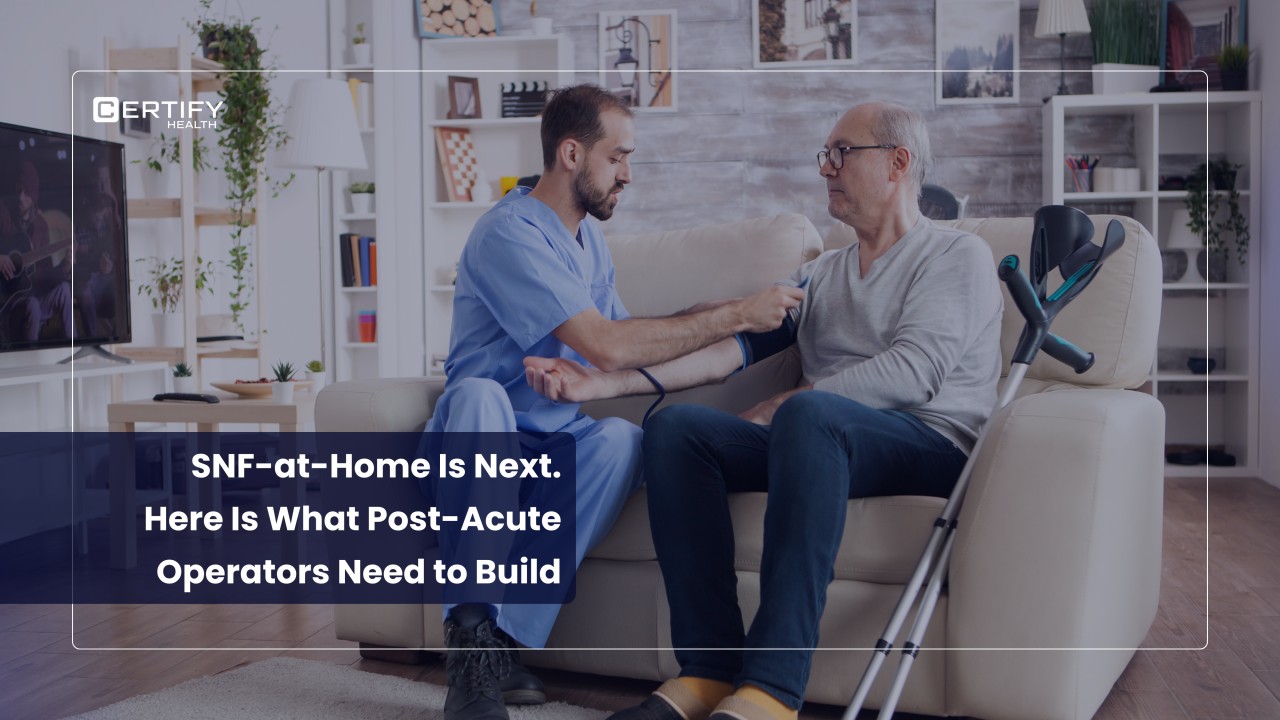
SNF-at-home takes away the building. The patient is on their couch. Nurses drive between homes. Therapy means travel time across town. Meds depend on the patient and family, not staff. Notes are typed on a phone over a cell signal, not a wired system.
Every step that relied on everyone being in one place needs to be rebuilt. At small scale, you can patch the gaps. At forty patients spread across a county, patches break.
The Three Workflows That Break First
Scheduling across locations. Inside a facility, you assign a therapist to Room 204 at 10 AM. At home, you have a therapist driving to four houses across 30 miles. A nurse needs to show up after the therapist leaves. A doctor does a video check-in later that day. A lab tech draws blood the same morning. Each visit depends on the others. A scheduling tool built for one-site time slots cannot handle this.
Data collection from the home. In a facility, intake happens once at the door. Once care moves home, data flows all day, every day. Vitals. Med tracking. Wound checks. Pain scores. Fall risk. Progress notes. All of it needs to move from the patient’s home to the care record in real time. Digital intake on the patient’s own phone is not a nice feature here. It is the only way data gets captured.
Talking to patients and families. In a facility, the nurse is 30 feet away. In the patient’s home, the main support person may be at work all day. You need a system that sends med reminders, confirms visits, checks on symptoms, and flags problems. Automated messages do what a hallway nurse station used to do. One person texting twenty patients by hand does not scale.
What Private Payer Programs Have Proven
This model is not new. Private payers cover it in many markets already. Those programs have real data.
Patients who heal at home get readmitted less often. They report higher scores. They recover faster. Costs are lower because there is no building to maintain. And the care team is more flexible because staff can serve a wider area than a single facility.
The programs also show where things go wrong. The ones that grew well had one thing in common: they set up a single platform for scheduling, intake, messaging, and care tracking before they added volume. The ones that tried to run home care with the same patchwork of tools from the facility stalled at twenty to forty patients.
Build the System Before the Waiver Arrives
Right now, the bill is being written. The waiver is not live. Medicare is not paying for this yet. But private payer programs are running, and the evidence is stacking up.
Teams that build their home-care systems now, while volume is low and mistakes are cheap, will be ready when Medicare opens up. Teams that wait will have to build under pressure with no room for error.
What you need is not some new kind of software. It is a single platform that ties scheduling, intake, messaging, and care tracking together for care that happens outside a building. CERTIFY Health already runs these workflows for outpatient care.
The same system works in the home.
The setting changes. The workflows do not.
Four Questions to Ask Now
Can your scheduling system handle visits from multiple providers at multiple homes for one patient over a full recovery? If it manages room numbers today, it needs to manage routes and locations before volume grows.
Does your data collection work on the patient’s phone? If any part of intake or tracking needs a facility visit, it will not work at home.
What breaks when you reach twenty home patients? If a person is texting each one by hand, you will need to hire more people before you can grow.
Are you doing home-based care for private payers today? If yes, use those lessons to get ready for Medicare. If not, start a small program now. It is the safest way to learn before the waiver goes live.
Looking at SNF-at-home for your team? Talk to us about how CERTIFY Health handles scheduling, intake, and messaging for home-based care.