Table of Contents
Introduction
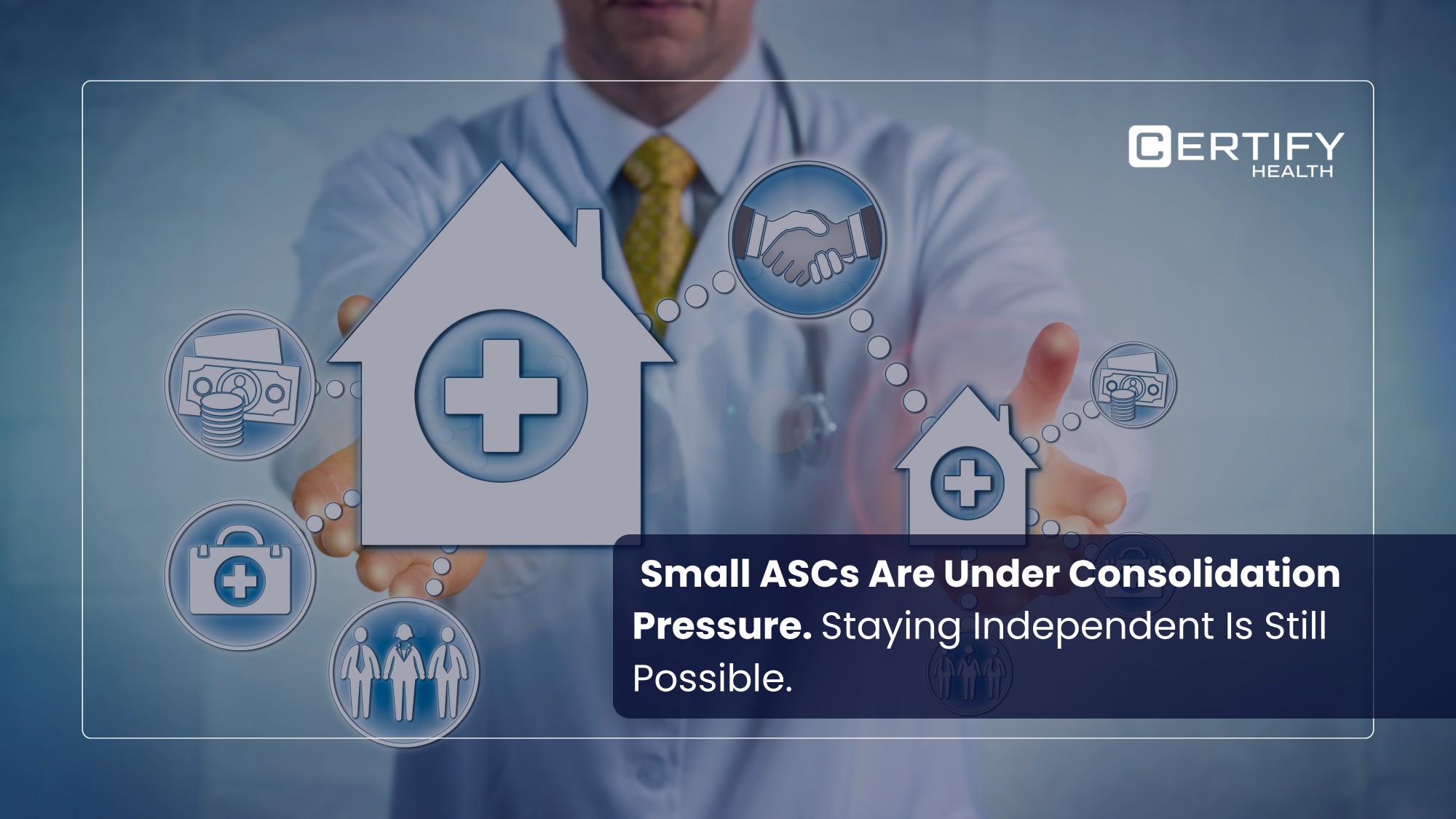
If you own a small surgery center, you know the pressure is real.
PE firms are calling. Health systems want to talk. You are asking yourself: is staying on your own still worth it?
That is a fair question. It deserves a real answer.
Selling is one way to deal with the burden. Other strategies can help relieve the strain.
Before you decide anything, it helps to know what is driving the pressure. And whether that pressure can be reduced without giving up your center.
Comparing Patient Identity Verification Options?
CERTIFY Health helps outpatient practices address manual identity checks, duplicate records, fraud risk, and slower check-in so teams can strengthen patient identity checks without slowing the visit.
Why Small ASCs Are Being Targeted Right Now
The push toward mergers in the ASC space is not random. It is built into how the market works right now.
About 68 percent of ASCs remained independent as of 2023, according to Becker’s ASC Review. But that share keeps shrinking. Health systems, PE-backed groups, and large management firms are buying up smaller centers.
According to VMG Health valuation data, ASC valuation multiples have recently hovered around 7–8x EBITDA. Buyers are paying serious money for well-run centers.
The team at Regent Surgical Health noted in its 2026 outlook that small centers with one or two ORs are under growing financial pressure. Labor costs are up. Medicare and commercial reimbursement rates remain tight. Compliance demands keep growing.
Staffing pressure is making things harder for small ASCs. Many centers are working with smaller teams while struggling to hire nurses and surgical techs. At the same time, staff are also handling more administrative work in addition to patient care responsibilities.
That matches what many owners say when you ask them. Clinical care is usually not what creates the strain. It is everything around the surgery that has become too hard to manage alone.
What Is Actually Causing the Pain
Before you take any meeting with a buyer, it helps to name what is really causing the strain. In most cases, the pressure comes from three core issues.
1. Admin Work
Think intake, scheduling, insurance checks, prior approvals, and chart records. Each task needs staff time or outside vendor spend.
A small center does not have enough volume to staff a big admin team. But it faces the same rules and requirements as a large one. For small centers, that difference can become a serious expense.
2. Payer Issues
Payment rates are not keeping up with costs. Payer rules are getting harder to follow. Prior authorization denials are increasing.
Without a full billing team, many small centers outsource revenue cycle management. That means one more contract, one more monthly cost, and one more vendor relationship to manage.
3. Too Many Tools
Most small ASCs run on multiple disconnected systems. A basic EHR. A separate scheduling tool. A third-party billing vendor. Maybe a patient messaging app.
None of them share data well. Staff end up entering the same information twice and chasing records across systems. This goes beyond inefficient software. It drains time every single day.
When buyers come calling, these are the pain points they are targeting. They offer shared services, centralized billing, and vendor leverage that smaller centers often cannot access on their own.
That is real value. The question is: do you have to sell to get it?
That is real value. The question is: do you have to sell to get it?
Let’s be honest. Merging with a larger partner has real benefits.
A strong partner brings billing teams, compliance support, staffing resources, and operational systems you may not be able to build independently.
For some owners, especially those nearing retirement or already burned out, that trade makes sense.
But there are real costs too.
You lose control over your own center. Scheduling policies. Staffing decisions. Vendor relationships. Those decisions move up the chain.
You may stay on as a clinician, but the center is no longer fully yours to run.
VMG Health industry research indicates that many ASC owners prefer partnership models over giving up full ownership. Most are not trying to exit completely. They want operational pressure off their plate without giving up independence entirely.
That is the key point. If the burden can come down, staying independent becomes a much more realistic option.
Other Ways ASCs Reduce Pressure Without Fully Selling
Technology is not the only way independent ASCs reduce pressure.
Some centers work with MSOs to get help with billing, payer contracts, staffing, and operations while still keeping ownership of the center.
Others join GPOs or ASC networks to lower supply costs and improve buying power.
Some owners choose partnership models where they sell only a small stake instead of giving up full control.
Succession planning also matters. Some physician owners bring in younger surgeons over time instead of selling the center completely.
These strategies can help reduce financial and operational stress. For many ASCs, technology is just one part of a larger plan to stay independent.
Download
Revenue Leakage & Patient Payment Workflow Audit
Use this worksheet to review where payment delays start: eligibility, patient responsibility, reminders, payment plans, Text-to-Pay, and follow-up workflows.
The Other Path: Cutting the Burden With Better Tools
So ask yourself this before any deal goes further: how much of the admin pressure can be reduced with better technology?
This is where many small ASCs find a different path.
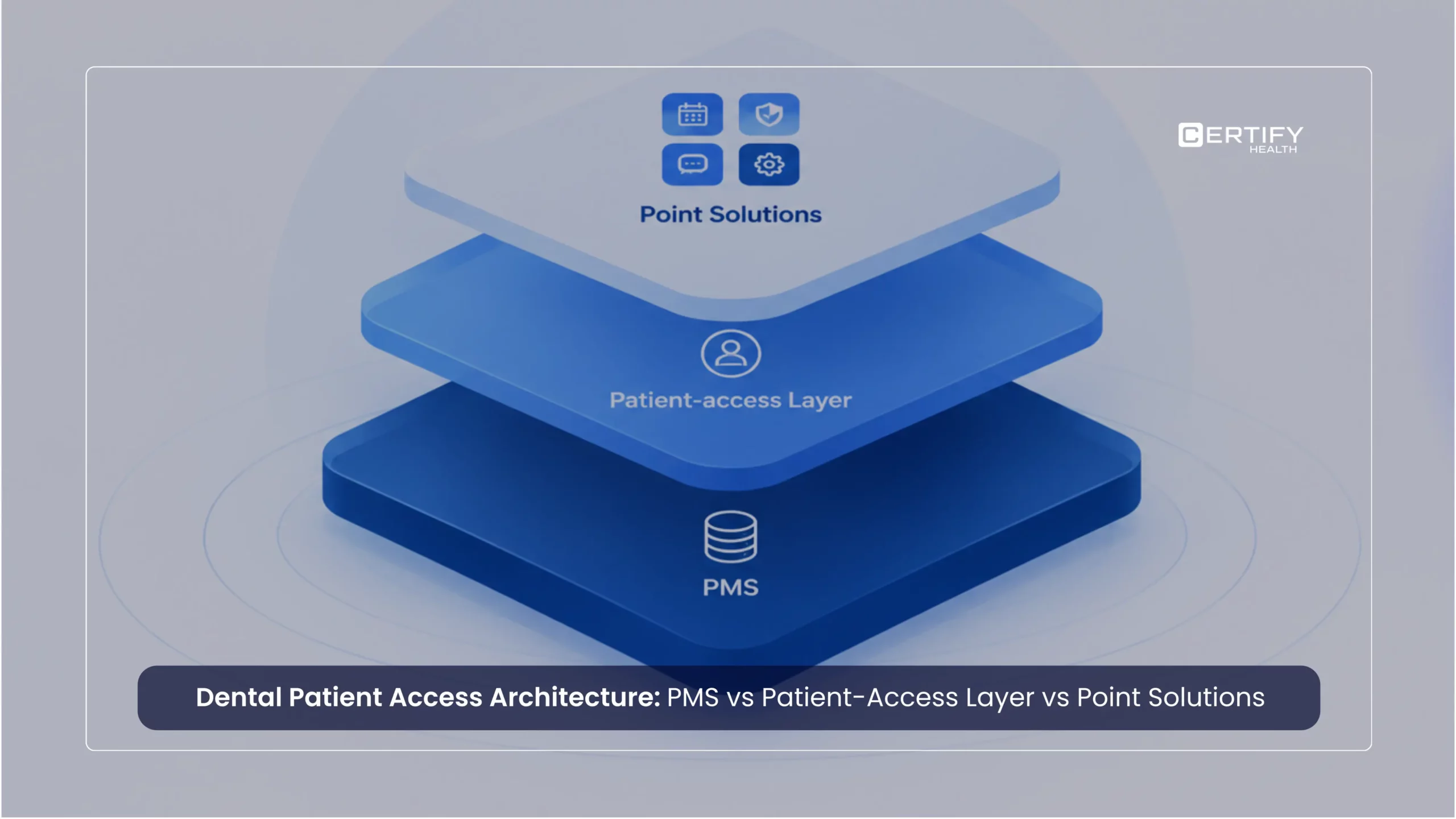
Good practice management software for ASCs can help reduce a large share of the administrative work that makes independence feel impossible. Not by adding more tools, but by replacing disconnected systems with one platform that handles intake, scheduling, records, and billing together.
Healthcare scheduling software connected to intake and insurance workflows can help prior authorizations start sooner. Front desk work becomes easier to manage. Staff spend less time chasing missing information.
Digital patient intake replaces paper forms. Patients complete forms before arrival. Staff spend less time on manual check-in tasks. Care teams can move faster once patients arrive.
When billing is integrated into the same platform, revenue cycle management becomes easier to oversee. Teams work from the same data instead of juggling separate vendors and disconnected systems.
Many centers that move from fragmented systems to unified practice management software report smoother workflows, fewer billing issues, and clearer operational visibility without significantly increasing headcount.
But software cannot fix every problem for small ASCs. Low payments, staff shortages, hiring doctors, and growth costs can still create pressure. Some centers still need outside help or business partnerships. For many ASCs, better software is only part of the solution.
See Where CERTIFY Health Fits in the Revenue Journey
CERTIFY Health helps ASC teams connect patient payments, communication, and revenue cycle workflows to reduce avoidable revenue leakage.
CERTIFY Health: Enterprise Capabilities at Independent Economics
This is where CERTIFY Health fits in.
CERTIFY Health’s practice management software platform is built for surgery centers. It combines patient intake, healthcare scheduling, chart records, and Billing RCM Ops into one connected system.
For a small center with one or two ORs, that can look like this:
CERTIFY Health (CH) manages scheduling, intake, and records in one place. Patients complete digital forms ahead of their visit. Insurance eligibility checks can run automatically. Scheduling workflows become easier to coordinate. Records are captured faster, helping reduce after-hours administrative work for clinical staff.
CERTIFYPAY (CP) supports billing workflows within the same platform. For some centers, that can reduce dependence on separate outsourced billing vendors. Claims management becomes easier to track. Financial reporting stays in one place instead of across multiple systems and vendors.
The result can be lower operational overhead, fewer disconnected tools, and better visibility into how the center is performing.
For many independent ASCs, reducing operational burden is what makes independence financially sustainable again.
A Simple Framework to Evaluate Your Decision
If you are weighing a deal against staying independent, here is a practical way to work through it.
Step 1: Add up your real admin costs
Look at staff time spent on intake, insurance checks, scheduling, billing, and vendor coordination.
What does that cost each month? What does it cost per case?
Step 2: Find the root cause
Is the problem too many staff hours? Billing inefficiencies? Fragmented systems?
The root cause points to the right solution.
If disconnected tools and billing overhead are the main issue, a unified practice management software platform may solve much of the problem.
If the bigger issue is payer leverage or contracting power, a partnership strategy may still make sense.
Step 3: Run the numbers on a technology switch
What would your costs look like if one platform replaced your current mix of vendors and systems?
That is where a platform evaluation becomes important.
Step 4: Revisit any deal conversation from a position of strength
When the administrative burden is more manageable, you are no longer negotiating from exhaustion or urgency.
You are negotiating with options.
That changes the conversation completely.
The Question Isn’t “Should We Sell.” It’s “Can We Reduce the Burden?”
Consolidation is not going away. The pressure on small centers is real. For some owners, a partnership or sale will still be the right move.
But for the centers that want to stay independent, the answer is not simply resisting change.
It is removing the operational pressures that made selling feel like the only option in the first place.
Rising costs. Administrative overload. Too many disconnected systems. Billing complexity.
These are real problems. But many of them are manageable with the right operational foundation in place.
With stronger practice management software, a small ASC can operate leaner, simplify workflows, and make independence more sustainable over the long term.
The centers that last are not necessarily the ones that avoid change. They are the ones that build systems strong enough to support independence as the market evolves.
See how CERTIFY Health gives small ASCs enterprise capabilities without enterprise overhead.