
Table of Contents
Key Takeaways:
- Revenue cycle management best practices now focus on preventing denials before claims are submitted.
- Clinical documentation improvement, cleaner intake workflows, and real time insurance eligibility verification help reduce costly claim errors.
- Healthcare workflow automation and predictive analytics in healthcare help teams improve collections, reduce manual work, and spot revenue risks faster.
Introduction: 2026 Is a Tipping Point
Running a hospital or medical practice is tough in 2026. Denials are rising. Costs keep climbing. Payers add more rules. Patients now pay more of their own bills than before.
The numbers show how serious the problem has become. A recent study in JAMA Network found that nearly 18% of insured adults in the U.S. said a health insurance claim was denied. Another JAMA article warned that rising prior authorization denials and healthcare claim denials are creating more waste. They are also putting more pressure on providers.
The money lost is huge. A 2026 industry report found that hospitals lost more than $48 billion in 2025 from denied claims and unpaid patient bills. Rising denials and higher patient costs caused most of that loss.
The 2024 Change Healthcare cyberattack hurt claims processing all across the country. At the same time, rising Medicare Advantage denials added more admin work and contract fights for providers.
On top of all that, healthcare staffing shortages make the work even harder. Revenue cycle teams spend more time fixing errors, redoing claims, and chasing payments.
The good news is that modern revenue cycle management best practices can help providers fight back. Smart organizations no longer just react to denials. They focus on stopping problems before claims are ever sent out.
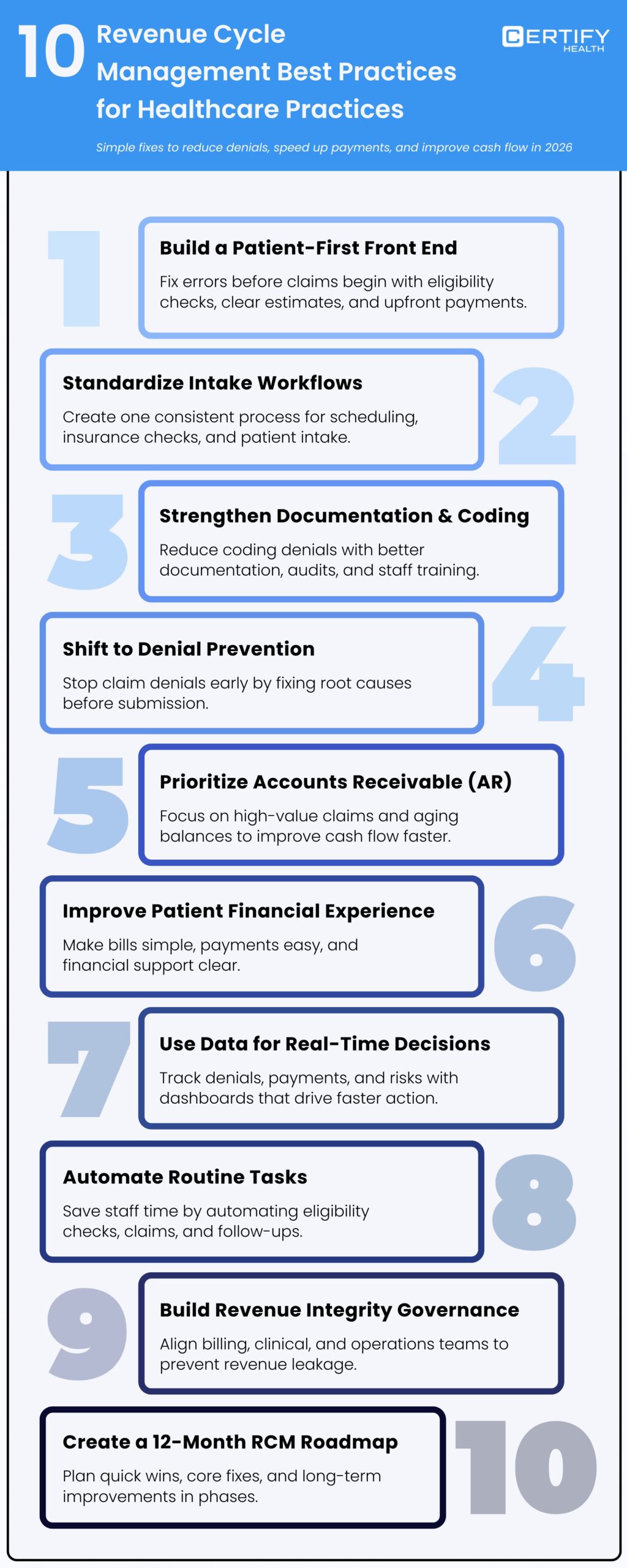
This guide shares 10 revenue cycle management best practices for 2026.
These 10 Revenue Cycle Management Best Practices Offer a Clear Fix.
Best Practice 1: Build a Patient-First Front End
Goal: Fix issues before claims start.
Front desk errors cause many denials. A study by KFF found that 25% of in-network claim denials in 2024 were for admin reasons.
What to do:
- Real-time insurance eligibility verification: Check coverage fast before patients arrive. Spot lapsed plans early. Catching a bad insurance record before the visit stops a denial before it even starts.
- Accurate estimates and upfront payments: Use a patient payment estimator. Share costs clearly with the patient. Collect point of service collections in healthcare so money is gathered before the patient leaves.
- Standard registration and counseling: Use the same scripts and steps at every location. Screen patients for charity care. Set up healthcare payment plans on site so patients always have a way to pay.
💰 Financial Impact
Fixing front-end errors cuts admin denials — often the single largest denial group. Each avoided denial saves rework time, speeds up payment, and cuts write-offs. Clean intake alone can raise first-pass yield by several percentage points. That means more claims get paid the first time they are sent, without any extra work.
Track These KPIs
| KPI | Target |
|---|---|
| Registration errors | Under 2 per 100 |
| Estimate accuracy | Close to final bill |
| Point-of-service collections | Dollars collected at visit |
Best Practice 2: Standardize Intake Workflows
Goal: Cut rework with consistency.
Revenue cycle management strategies start here. One clinic’s prior authorization process can be totally different from another clinic’s. That gap leaks cash. When the process is not the same everywhere, errors happen more often and money gets lost.
What to do:
- Same steps for all: Match data whether a patient calls in, books online, or walks in. No matter how a patient registers, the same information should be collected every time.
- Pre-visit checklist: Check authorization, insurance, updates, and balances before the patient arrives. Use a pre-visit checklist so staff never skips a step.
- Clinician docs: Share denial data with clinical staff. Set clear chart rules to reduce documentation gaps. When doctors and nurses know what triggers a denial, they can write better notes.
CMS Prior Authorization Final Rule (2026):
New CMS rules require faster prior authorization decisions. Standard requests must be done within 7 days. Urgent requests must be done within 72 hours. Providers that still use manual workflows may face more delays and compliance risks. Moving to electronic tools helps teams meet these new deadlines and stay compliant.
💰 Financial Impact
Faster prior auth turnarounds mean fewer delayed procedures and fewer prior authorization denials. Hospitals that automate PA tracking see 20–30% faster approval cycles. That directly shortens AR days. Shorter AR days mean money comes in sooner and cash flow stays healthy.
Track These KPIs
| KPI | Target |
|---|---|
| Authorization denial rate | Trending down |
| No-shows/cancellations | Baseline + trend |
| Claim rework rate | Trending down |
Best Practice 3: Strengthen Documentation and Coding Integrity
Goal: Fix coding at the source to reduce coding denials.
Coding claim denials are rising fast. One source found that denial amounts jumped 126% in 2024. And 85% of providers say that complex coding rules lead to more billing errors and denied claims. These numbers are hard to ignore.
Modern coding tools do more than just flag missing info. They can suggest codes in real time, find documentation gaps before claims are sent out, predict denial risk, and even draft appeal letters. These tools make the coding process faster and more accurate.
New ICD-10 and CPT updates for 2026 make coding oversight even more important. The OIG is also watching areas like telehealth, infusion therapy, and E/M coding more closely than before. Providers need to make sure their coding practices are up to date.
What to do:
- Run CDI reviews: Check charts for clinical documentation improvement before claims go out. If a chart does not have the right details, fix it before the claim is sent.
- Audit coding often: Review denied claims and train staff on common coding mistakes. Regular audits help catch patterns and stop the same errors from repeating.
- Use specialty-specific coding rules: Different specialties need different coding workflows and training. A cardiology claim is not the same as an orthopedic claim. Each area needs its own set of rules.
- Keep coders updated: Share payer rule changes and coding updates often. Payers change their rules all the time. If coders do not know the new rules, they will keep making the same mistakes.
- Use coding automation tools: Automated coding tools can catch missing details before submission. These tools act like a safety net that catches errors before they become denials.
💰 Financial Impact
Cutting coding denials by just 5% can recover hundreds of thousands of dollars each year for a mid-size hospital. AI coding tools also cut coder time per chart. That lowers labor cost per clean claim and frees up staff to handle other work.
Track These KPIs
| KPI | Target |
|---|---|
| Coding denial rate | Trending down |
| Audit variance | Below 3% |
| Case mix index trend | Stable or improving |
Best Practice 4: Shift to Denial Prevention
Goal: Stop denials before they hit. Use healthcare revenue cycle optimization.
Clean claims are harder to submit now. Payer rules, coding needs, and prior authorization checks keep growing in complexity. Strong teams focus on stopping denials early instead of spending time and money appealing them later. Prevention is always cheaper than correction.
Medicare Advantage plans deny claims far more often than traditional Medicare. Because of this, providers need payer-specific denial tracking. Some health systems have even ended MA contracts because the appeal workload became too heavy to manage.
Automated tools can now predict denials before claims are ever sent out. They use payer data, diagnosis codes, and authorization info to catch problems early. This helps teams cut preventable denials before they cost the organization money.
What to do:
- Track denial types: Sort denials by type — eligibility, coding, and more. Find the root cause of each type. You cannot fix a problem you do not understand.
- Team reviews: Meet weekly with all staff involved in the revenue cycle. When everyone is in the same room, problems get found and fixed faster.
- Fix the front end: Link denial data back to intake changes. If a denial keeps happening because of a front-end error, fix that error at the source. Do not just appeal the same denial over and over.
💰 Financial Impact
A 1% improvement in first-pass yield can recover $1M+ per year at a 200-bed hospital. Stopping denials costs less than appealing them after the fact. Appeals alone can cost $25–$118 per claim just in staff time. Multiply that by hundreds of denials per month and the savings become very clear.
Track These KPIs
| KPI | Target |
|---|---|
| First-pass yield | Over 95% |
| Denial rate by type | Trending down per category |
| Preventable denial rate | Trending toward zero |
Best Practice 5: Prioritize Account Receivable (AR) with Queues
Goal: Turn claims into cash fast.
Random AR work loses money. When staff work claims in no particular order, big-dollar claims can sit too long while small ones get worked first. Use queues sorted by payer, balance, and age to make sure the most important work gets done first.
What to do:
- Smart queues: Work big balances first. Batch claims by payer so staff can stay in one workflow and move faster.
- Set follow-up intervals: Match follow-up timing to payer-specific rules and timely filing limits. Missing a filing deadline means losing the claim forever.
- Segment work: Give newer staff simpler tasks. Route complex or high-dollar claims to more experienced collectors. Matching the right staff to the right work speeds up results.
- Underpayment Recovery: Underpayments are often just as costly as denials but much harder to see. They happen because of fee schedule mismatches, grouper issues, and manual errors. Using contract variance detection in AR workflows can recover 1–3% of net revenue at a very low cost. Many organizations leave this money on the table simply because they are not looking for it.
💰 Financial Impact
Getting AR days below 40 helps cash flow right away. For a hospital with $100 million in revenue, even one fewer AR day can improve cash flow by a large amount. Cutting AR over 90 days lowers bad debt and reduces the chance of write-offs. Every day a claim sits unpaid is a day that money is not in your account.
Track These KPIs
| KPI | Target |
|---|---|
| Days in AR | Under 40 |
| AR over 90 days | Under 15–20% |
| Bad debt % | Baseline + trending down |
| Underpayment recovery rate | Increasing month over month |
Best Practice 6: Elevate Patient Financial Experience
Goal: Boost collections on patient financial responsibility.
Patients now pay more of their healthcare bills than ever before. But at the same time, providers are collecting less of that money. Clear bills and simple payment options can go a long way toward improving patient collections and reducing what gets written off.
Under the No Surprises Act, providers must give Good Faith Estimates to self-pay and uninsured patients before any scheduled care. These estimates are required by law. Not following the rules can lead to real penalties. Adding GFE workflows into the scheduling process also raises upfront payment rates, since patients know what they owe before they even walk through the door.
Self-pay strategy now needs more than soft reminder letters. Payment prediction tools help staff figure out which accounts need follow-up first. Automated charity screening and structured healthcare payment plans can also cut bad debt and help more patients get the care they need without falling behind on payments.
What to do:
- Create clear bills: Use plain language. Show exactly what insurance paid and what the patient owes. A confusing bill leads to no payment at all.
- Easy payments: Offer portals, apps, and text-to-pay options. Patients pay faster when paying is easy and does not require a phone call.
- Plans and financial aid: Screen for financial need early. Offer healthcare payment plans that patients can actually stick to. A smaller payment made consistently is better than a large balance that never gets paid.
- Propensity-to-pay scoring: Use data to find which patients are most likely to pay. Focus outreach efforts on those patients first to get the best return on staff time.
Track These KPIs
| KPI | Target |
|---|---|
| Patient collection rate | Improving trend |
| GFE compliance rate | 100% |
| Charity screening rate at intake | >90% |
| Billing satisfaction score | Improving |
Best Practice 7: Use Data for Real-Time Decisions
Goal: Act daily with predictive analytics in healthcare.
Dashboards beat monthly reports. Monthly reports often arrive too late to help. By the time the report lands on a manager’s desk, denials have piled up and cash flow problems have already gotten worse. Daily data keeps teams ahead of problems instead of behind them.
- What to do:
- Core views: Put denials, AR, cash, and payer data all in one view. Staff should be able to see the full picture without logging into five different systems.
- Regular checks: Have teams check the data weekly. Leaders review monthly for bigger trends. The goal is to catch small problems before they become big ones.
- Predict risks: Use tools that flag bad claims early. If a claim looks like it might be denied, the system should catch it before it ever goes out.
- Summarization: New AI tools can now summarize denial trends, detect payer problems, and auto-generate appeal letters. These tools cut down on manual reporting work by a large amount. Staff spend less time building reports and more time fixing problems.
💰 Financial Impact
Real-time denial dashboards let teams act in days, not weeks. Organizations that move from monthly to daily denial tracking report faster denial overturn rates and shorter AR cycles. Catching a denial trend on day three is far better than catching it on day thirty.
Track These KPIs
| KPI | Target |
|---|---|
| First-pass yield trend | Improving week over week |
| Cost-to-collect | Under 3% |
| Denial overturn rate | Improving |
Best Practice 8: Automate Routine Tasks
Goal: Fight healthcare staffing shortages with healthcare RCM automation and healthcare workflow automation.
Automate high-volume, repeat tasks to cut manual work, speed up claims, lower billing errors, and help revenue cycle teams handle growing workloads with fewer staff. When people are not stuck doing the same task over and over, they can focus on work that actually needs a human brain.
New technology can do much more than simple computer tasks. It can help with medical coding, spot problems before claims are denied, manage appeals, and pull key information from documents. This helps staff finish their work faster and with fewer mistakes.
What to do:
- Top automation uses: Eligibility checks, claim scrubbing, payment posting, simple denial routing, and PA tracking are all great places to start with automation. These tasks happen hundreds of times a day and do not need a person to do them one by one.
- Automated coding and appeals: Use tools that suggest codes and draft appeal letters for common denial types. This cuts the time coders and billers spend on these tasks and lets them handle more complex work.
- Manage exceptions: Train staff to review and act on what automation flags. Automation handles the routine work. People handle the hard stuff that needs judgment and experience.
- Use linked tools: Connect all automation steps so nothing falls through the cracks. If one tool does eligibility and another does claim scrubbing, they should talk to each other so no step gets missed.
💰 Financial Impact
Automation lowers cost-to-collect — the gold standard efficiency metric in revenue cycle management. Organizations that automate eligibility checks, follow-up, and payment posting report lower labor cost per claim. That savings goes straight to margin and helps offset the rising cost of healthcare staffing shortages.
Track These KPIs
| KPI | Target |
|---|---|
| Staff productivity (claims per FTE) | Improving |
| Claim turnaround time | Decreasing |
| Automation error rate | Under 1% |
| Cost-to-collect | Under 3% |
Best Practice 9: Build Revenue Integrity Governance
Goal: Make revenue cycle strategies a team effort.
Managing payments in healthcare takes teamwork. Doctors, front-desk staff, billing teams, IT, and compliance teams all need to work together. A small mistake in one area can slow down payments or cause lost money. No single team can fix revenue cycle problems alone.
What to do:
- Revenue integrity committee: This group meets often, owns fixes, and drives accountability. When one team owns a problem, it actually gets solved.
- Reviews: Regularly check the Charge Description Master (CDM), payer contracts, and documentation standards. These are the building blocks of accurate billing, and they need to be checked often.
- Clear escalation paths: Know who handles what when problems come up. When an issue surfaces, everyone should know exactly who to go to and how fast to act.
Healthcare providers sometimes miss charges for services they actually gave to patients. This can happen in treatment rooms, emergency care, or surgery when the information is not written down correctly. Missing charges can mean losing money that the provider has every right to collect.
Payer underpayments should also be tracked closely through contract variance review. Setting up active recovery workflows for underpayments can improve net revenue by a meaningful amount. Many hospitals lose money here simply because they are not checking.
As healthcare changes, teams need to track how money is earned and shared across different payment models. This helps doctors and billing teams stay on the same page and work together toward better patient care and stronger margins.
After recent healthcare payment problems, including the Change Healthcare attack, many organizations are working much harder to protect their systems. They are also building backup plans so payments can still happen if key systems go down. Having a downtime plan is no longer optional — it is a standard part of running a safe revenue cycle.
💰 Financial Impact
Revenue integrity governance is where the biggest long-term margin gains live. Charge capture recovery, underpayment recovery, CDM accuracy, and contract optimization together can add 2–5% back to net patient revenue at a typical hospital. That is a very large dollar amount that most organizations are currently leaving behind.
Track These KPIs
| KPI | Target |
|---|---|
| Revenue leakage recovered | Trending up |
| CDM accuracy | >98% |
| Underpayment recovery | New KPI — track vs. baseline |
| Charge capture variance | Under 1% |
Best Practice 10: Create a 12-Month RCM Roadmap
Goal: Plan revenue cycle management best practices in phases.
Trying to fix everything at once does not work. A phased roadmap helps teams build on small wins, stay focused, and make lasting changes over time. Start with the quick fixes, then build out the harder work in later phases.
Phase 1 (0–90 Days): Quick Wins
- Build a denial list sorted by type and root cause. You need to know what you are fighting before you can fight it.
- Standardize front-desk intake and registration scripts at every location.
- Launch real-time dashboards for denials and AR. Get the data in front of the right people now.
- Assign ownership for top denial categories. When no one owns it, no one fixes it.
- Begin a GFE compliance workflow review to make sure the team meets No Surprises Act rules.
Phase 2 (3–9 Months): Build the Core
- Set up ePA (electronic prior authorization) for CMS 2026 compliance. Manual PA workflows will not cut it under the new rules.
- Pilot AI-assisted coding in high-denial specialties. Start small, learn fast, and expand.
- Launch CDI reviews for key service lines. Better documentation means better coding and fewer denials.
- Build AR smart queues and start underpayment tracking. Get the right claims in front of the right staff.
- Train staff on documentation standards. People cannot follow rules they do not know.
Phase 3 (9–12+ Months): Advanced Operations
- Use predictive denial scoring and AI-driven appeal generation. Let the tools do the heavy lifting on repeat work.
- Run full CDM and payer contract audits. Find out where money is leaking and close those gaps.
- Set up a revenue integrity governance committee. Give the team a formal place to meet, review, and fix problems.
- Finish the automation and tool integration review. Make sure all systems are talking to each other the right way.
- Activate clearinghouse backup and downtime workflows. Be ready before the next disruption hits.
Workforce Strategy (Ongoing)
Build clear onboarding, upskilling programs, and RCM career paths for staff. Find the right mix of onshore and offshore staff for routine tasks. This reduces turnover-driven AR backlogs and stops avoidable denials. When staff know there is a path to grow, they stay longer and get better at their jobs. That directly helps the revenue cycle perform at a higher level.
Clinical + Billing Governance Updates
Update coding rules for post-PHE telehealth billing changes and growing behavioral health parity enforcement. Both are active audit focus areas for 2026. Teams that stay ahead of these changes will avoid penalties and audit findings that can cost a lot to fix.
What Top Performers Do in 2026
Top revenue cycle teams hit strong results every single year. They do not get there by luck. They follow clear processes, use the right tools, and hold everyone accountable.
Here is what the best teams consistently do:
- First-pass yield above 95%
- Days in AR under 40
- Cost-to-collect under 3%
- Falling denial rates across all payer types
- Strong patient collections backed by digital payment options
- Clearinghouse backup with tested downtime plans
- Active use of automation for coding, denial prediction, and appeals
- Monthly revenue integrity governance reviews
They do not just react to denials. They stop them from happening in the first place. That is the difference between a team that is always putting out fires and a team that rarely has fires to put out.
Conclusion
The best healthcare teams do not just fix problems — they stop them before they start. That shift in thinking is what separates high-performing revenue cycle teams from those that are always behind.
Strong teams:
- Check insurance before visits so problems do not slip through at registration
- Catch billing errors early before claims ever go out the door
- Automate repeat tasks so staff can focus on work that actually needs a human
- Track denials and cash flow in real time so nothing hides until it is too late
- Make it easy for patients to pay by offering clear bills and flexible options
- Connect front-desk, billing, and back-office work so every step flows into the next
The results speak for themselves: faster payments, fewer denied claims, and a better experience for patients from start to finish.
Why CERTIFY Health
CERTIFY Health is a medical software platform that puts billing and revenue tools in one place — no more juggling separate systems or switching back and forth between tools. It supports the full RCM lifecycle, from patient intake all the way to final payment.
With CERTIFY Health, your practice can:
- Check insurance coverage right away at the point of scheduling, so problems get caught before the visit
- Automate billing, claims, and follow-up reminders so staff spend less time on manual tasks
- Track denials and payment trends in real time with dashboards that show what matters most
- Collect patient payments via text, app, or structured healthcare payment plans that patients can actually keep
- Generate Good Faith Estimates and manage all price transparency compliance in one place
- Cut manual work and reduce cost-to-collect so the team can do more with less
Everything connects — from patient check-in to final payment — so nothing falls through the cracks and every dollar that is owed gets collected.
Ready to Improve Your Revenue Cycle?