

Table of Contents
Executive Summary
Physical therapy practices are struggling with tight margins, high insurance denials (12.9%), frequent no-shows (15–31%), therapist burnout (16% annual turnover), and disconnected systems. CERTIFY Health’s 12-week unified platform roadmap helps solve this with PXP, PMS, RCM, interoperability, and FaceCheck.
It’s tailored for:
- Solo clinics (1–5 therapists): can lift revenue by ~$50K
- Mid-size ortho/sports clinics (6–20 therapists): increase throughput by 25%
- Enterprise networks (20+ therapists): free up ~$200K in working capital
Phased adoption reduces admin work by 40%, cuts AR days 15–20%, and ensures HIPAA/MIPS compliance. Start with a Week 0 assessment, streamline workflows, and move from surviving to scalable growth.
Running a physical therapy practice today means facing tough choices amid shrinking budgets and rising demands, whether you’re a solo sports therapy clinic, a multi-site orthopedic group, or a pediatric specialty center.
This guide breaks down a practical path to streamline operations, cut waste, and improve patient care for practices of all sizes and focuses.
Why Modernize Your Physical Therapy Practice
Physical therapy practices across specialties, from orthopedic and sports rehab to pediatric and geriatric care, are under pressure from industry shifts that hit small startups and large chains alike.
A guide to physical therapy practice digital transformation starts with recognizing core pressures and building scalable systems that work for your team’s size and patient mix.
Modernizing helps solo practitioners save hours weekly, while multi-location groups gain oversight without added staff.
Core PT Practice Challenges
Margin Compression Challenges
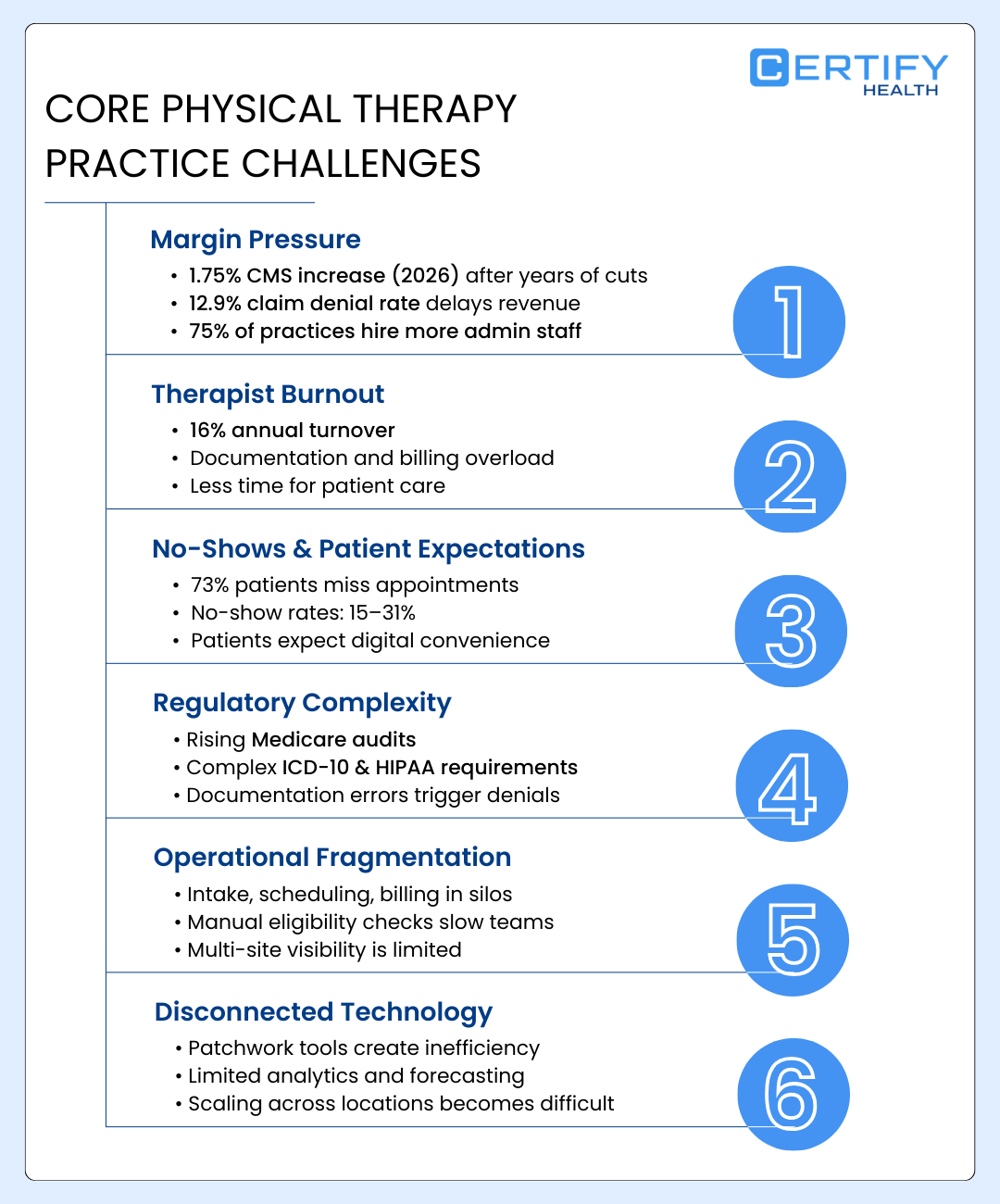
After five consecutive years of cuts, CMS finalized just an 1.75% average reimbursement increases for physical therapists in 2026, offering slight relief, but not enough to offset years of payment compression.
Meanwhile, the economics of care remains demanding. In the U.S., a single physical therapy session typically costs $80–$120, meaning a standard 4–6-week treatment plan can total $640 to $2,160 before insurance adjustments. That puts pressure on both patients and providers to ensure every claim is processed accurately and paid on time.
Operational costs only add to the strain. Nearly 75% of practices report hiring additional administrative staff to manage evolving payer requirements, diverting resources away from direct patient care.
The impact compounds when claims are denied. Physical therapy practices report an average claim denial rate of 12.9%, and nearly three-quarters of providers must appeal those denials, with roughly half ultimately overturned. This recurring cycle, consistent from 2018 through 2025, reflects costly administrative rework that delays revenue and strains staff resources.
For small practices, that means shrinking margins. For larger organizations, it means scaled revenue leakage across locations.
Workforce Burnout Realities
Physical therapy practices face intense job strain and administrative pressure: about 16% of therapists change jobs each year, and more than half report work-related pain linked to job demands.
Burnout is often driven by heavy documentation requirements, manual scheduling, insurance follow-ups, billing complexity, and repeated claim corrections, all of which pull therapists away from patient care.
The right physical therapy software and physical therapy practice management software directly address these stress points.
Modern pt practice management software streamlines physical therapy scheduling software, automated reminders, physical therapy billing software, and integrated documentation tools, reducing administrative workload and giving clinicians more time for hands-on treatment.
Retention and Competition Pressures
Competition isn’t just coming from the clinic down the street anymore.
Patients now compare their experience to everything, from boutique wellness studios to large hospital-affiliated PT groups, and they expect care to feel seamless, digital, and convenient.
At the same time, no-shows quietly drain revenue. Studies suggest 73% of patients miss at least one appointment, and specialty no-show rates can range from 15–31%. That’s lost time, lost income, and disrupted schedules.
This is where strong patient client management physical therapy tools make a difference.
Easy scheduling, reminders, and streamlined communication help patients stay engaged. When the experience feels simple and connected, orthopedic patients return consistently, and pediatric practices build long-term loyalty with families.
Regulatory Complexity Hurdles
Regulatory pressure isn’t easing up.
Medicare audits are increasing, ICD-10 coding requirements remain complex, and HIPAA compliance expectations continue to tighten, with 2026 standards placing even greater emphasis on accurate, defensible documentation.
When documentation falls short, denials follow.
That puts added strain on physical therapy billing software and revenue workflows. A single compliance gap can delay payments or trigger costly rework.
For small practices, the risk is financial penalties and disrupted cash flow. For multi-location groups, the challenge is maintaining consistent, audit-ready documentation across every site.
Strong systems and standardized processes aren’t just helpful anymore, they’re critical for staying compliant and protecting revenue.
Operational Fragmentation Issues
When intake, billing, and scheduling operate in silos, things fall through the cracks. Without clear visibility from a centralized pt practice management software, teams end up chasing information instead of focusing on patients.
Manual eligibility checks and disconnected workflows slow down small neuro clinics, while multi-site sports groups struggle to track performance metrics and KPIs across locations. What should be simple coordination turns into daily friction.
That’s where physio practice management software changes the game. By bringing intake, scheduling, billing, and reporting into one unified system, practices gain real-time visibility and the foundation needed for scalable, sustainable growth.
Costs of Fragmented Technology
Patchwork physical therapy software doesn’t just create extra work, it limits how far a practice can grow. When systems aren’t connected, leadership lacks clear performance insights, forecasting becomes guesswork, and scaling to new providers or locations gets complicated fast.
Small pediatric practices feel stuck in daily operations instead of planning ahead. Expanding orthopedic groups struggle to standardize processes across sites.
A physical therapy office software platform creates operational clarity through unification of all tasks from scheduling to post payment engagement, etc.
The Inflection Point: From Survival to System Design
Most physical therapy practices don’t struggle because they lack effort. They struggle because they’re solving systemic problems with incremental fixes, adding another tool, hiring another admin, patching another workflow.
But today’s pressures aren’t temporary. Margin compression, regulatory complexity, workforce strain, and rising patient expectations are structural shifts.
That means the response must also be structural.
Modernization isn’t about replacing one software tool. It’s about redesigning how scheduling, documentation, billing, compliance, and patient engagement work together as a single system.
Without a unified foundation, every improvement creates new friction elsewhere. With the right foundation, efficiency compounds. That’s where a phased, intentional adoption model becomes critical.
CERTIFY Health: Your Unified PT Platform
CERTIFY Health bring patient experience, practice management, RCM & billing, patient management, interoperability, and FaceCheck together in one unified stack. Whether your guide to physical therapy practice focuses on boutique neuro care or enterprise-scale wellness networks, the platform aligns workflows across clinical, financial, and operational layers.
This isn’t about adding more tools. It’s about replacing fragmentation with control.
Practices using a unified physical therapy software approach report faster reimbursements, fewer denials, and stronger operational visibility. The result: measurable performance improvement without operational disruption.
CERTIFY Health 12-Week Unified Platform Roadmap for Physical Therapy Practices
1. Solo & Small Practices
| Weeks | Module Focus | Implementation Actions | Adoption Criteria / Metrics | ROI Impact |
|---|---|---|---|---|
| 0 | Assessment | Workflow audit; team kickoff; baseline KPIs (no-shows, AR days) | Risks ID'd; SMART goals set | Prep for 20% efficiency gain |
| 1–2 | PXP/PMS | Digitize intake (OCR/e-consents); map scheduling w/ 1-hr training | ≥90% digital forms; bottlenecks ↓30% | Front desk time -40% |
| 3–4 | RCM/Patient Management | Copay automation/denials; reminders + HEP self-scheduling | No-shows ↓20%; consents ≥95% | AR days ↓15 |
| 5–7 | PMS/RCM Opt. | Dynamic waitlists; billing + MIPS alerts w/ training | Throughput ↑15%; idle time ↓ | Revenue +$30K/yr |
| 8–9 | Interoperability | EHR/billing/PXP dashboards | Errors ≤5%; unified KPIs live | Compliance readiness ↑ |
| 10–12 | Analytics/Auth | KPI dashboards; FaceCheck rollout; refine w/ feedback | Full adoption; NPS ↑25% | $50K+ net revenue lift |
2. Mid-Size Ortho & Sports Clinics
| Weeks | Module Focus | Implementation Actions | Adoption Criteria / Metrics | ROI Impact |
|---|---|---|---|---|
| 0 | Assessment | Multi-provider audit; baseline across sites; champions assigned | Bottlenecks mapped; KPIs baselined | Scale prep for 25% throughput |
| 1–2 | PXP/PMS | Standardize intake (OCR/e-consents); provider scheduling w/ training | ≥90% digital; consistent workflows | Admin -35% |
| 3–4 | RCM/Patient Management | Copay/claim templates; reminders + injury self-scheduling | First-pass claims ≥85%; no-shows ↓ | AR ↓20 days |
| 5–7 | PMS/RCM Opt. | Peak-hour waitlists; billing integration w/ training | Utilization ↑20%; leakage minimized | Revenue +$100K/yr |
| 8–9 | Interoperability | Multi-provider EHR/PXP dashboards | Errors ≤5%; visibility live | Multi-therapist sync |
| 10–12 | Analytics/Auth | KPI refinement; FaceCheck; feedback loops | Dashboards accurate; adoption 100% | NPS ↑30%; MIPS bonuses |
3. Multi-Site / Enterprise Networks
| Weeks | Module Focus | Implementation Actions | Adoption Criteria / Metrics | ROI Impact |
|---|---|---|---|---|
| 0 | Assessment | Enterprise audit; cross-site baselines; exec alignment | Gaps standardized; KPIs captured | Enterprise-scale foundation |
| 1–2 | PXP/PMS | Location intake audit; e-consents/scheduling w/ training | Consistent processes; bottlenecks ID'd | Ops uniformity +25% |
| 3–4 | RCM/Patient Management | Enterprise copays/denials; site reminders + caregiver flows | No-shows ↓; comms ≥95% | AR acceleration |
| 5–7 | PMS/RCM/Auth | Dynamic cross-site scheduling; billing + FaceCheck training | Throughput ↑20%; audit-ready ≥95% | $200K+ working capital |
| 8–9 | Interoperability | Unified EHR/billing/exec dashboards | Errors ≤5%; exec KPIs live | Cross-site efficiency |
| 10–12 | Analytics | Workflow refinement; Q2 planning; full optimization | KPIs stable; 100% integrated | Revenue +15%; zero fines |
Proven Results & Next Steps
Small PT practices achieve $50K+ annual revenue lift through faster collections and no-show reductions, while enterprise networks unlock $200K+ working capital via unified compliance.
Audit your workflows today, start with CERTIFY Health’s 12-week roadmap for predictable growth and operational clarity.