
Table of Contents
Introduction
For years, ambulatory surgery centers (ASCs) have operated without the same level of public scrutiny that hospitals face. That is changing fast.
Two major changes are now approaching:
- The Leapfrog Group’s expansion of public ASC quality ratings in July 2026.
- CMS’s ASC Quality Reporting (ASCQR) program rules, which will affect 2027 Medicare payments.
These changes are pushing ASC administrators to act. The question is no longer whether to upgrade their technology. It is whether they have enough time to do it right.
But first, you need to understand why so many ASCs still run on paper and stitched‑together software.
Comparing Medical Practice Software for ASC Operations?
Disconnected scheduling, intake, check-in, communication, and payment tools can create hidden friction long before a procedure begins. See how CERTIFY Health helps ASC teams connect front-office workflows without replacing their existing systems.
The Technology Gap Is Real
Here is a key number to remember: only 31% of ambulatory surgery centers had adopted electronic health records by 2016. The difference has gotten smaller, but it still exists.
Many ASCs today still rely on paper intake forms, manual scheduling, fragmented billing software, and notes that live in different systems. Walk into a busy ASC on a procedure‑heavy morning and you might still see staff pulling charts, calling insurers, and manually reconciling payment records at the end of the day.
This is not a story of ASCs being behind the times. It is a story of technology not keeping up with ASCs.
Generic practice management software was built for physician offices. It was designed around simple appointment scheduling, basic intake forms, standard billing, and simple documentation. That works well for a primary care clinic seeing thirty patients a day.
But it is not suited for ASC environments where each case includes anesthesia planning, procedure‑specific prior approvals, specialized supply coordination, implant management, and detailed notes tied to quality reporting. The workflows are different. Generic tools create gaps. Those gaps became the status quo.
What Generic Systems Cannot Do for an ASC
This is where the technology gap becomes operational. The capabilities that matter most for ASC workflows are exactly the ones that generic practice management software handles poorly, or not at all.
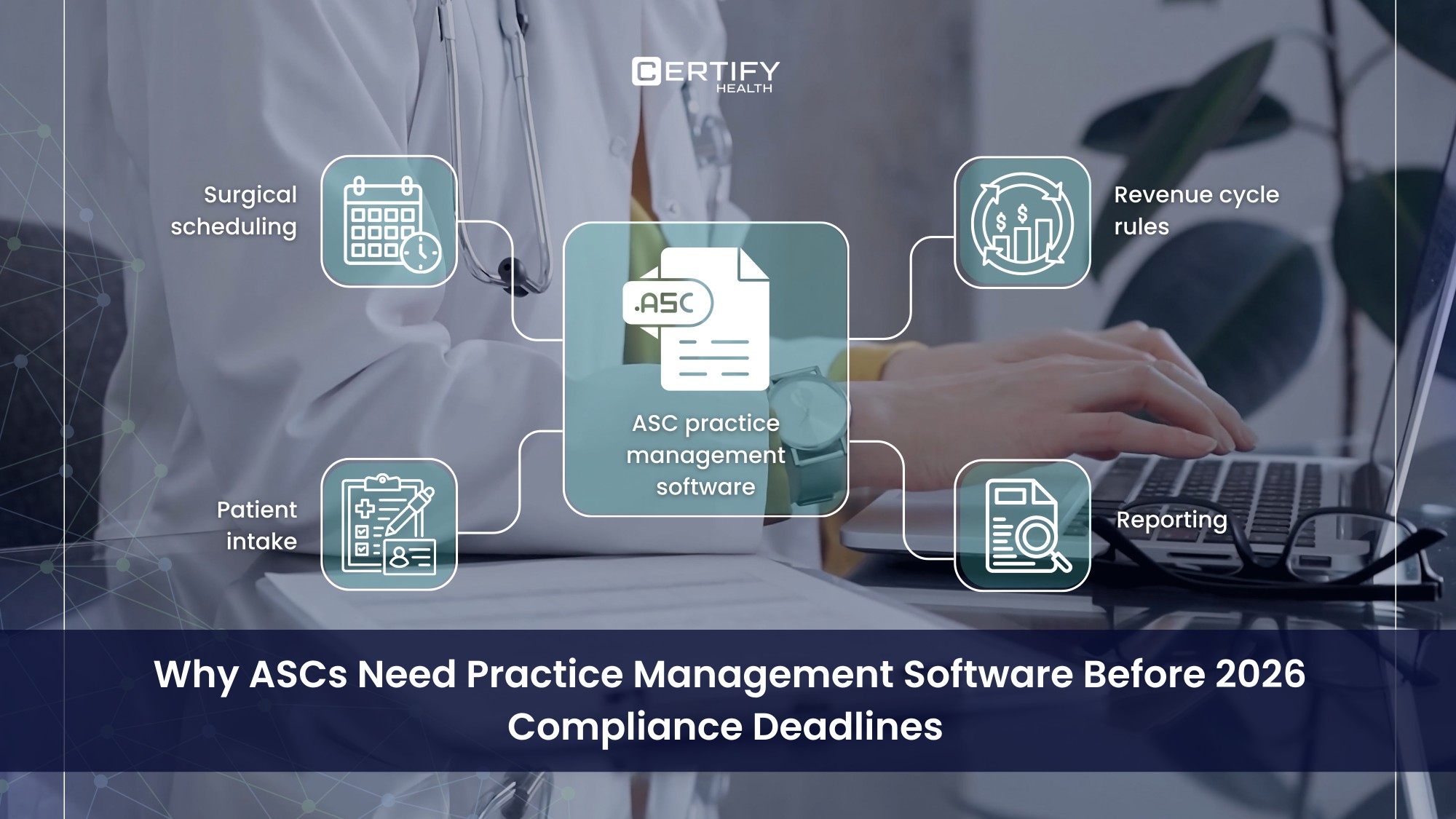
1. Surgical scheduling that captures what matters
Scheduling a surgery is not the same as booking an appointment. An ASC scheduler needs to capture anesthesia type, authorization status, supply and equipment requests, and procedure‑specific needs—all at the time of booking.
Generic healthcare scheduling software was not built for this. It captures only a time slot and a patient name. What gets missed is everything the clinical and billing teams need before the patient arrives. Errors discovered on the day of surgery are not small problems. They cause case delays, cancellations, and rework that costs time and revenue.
2. Patient intake designed for a surgical setting
Paper intake forms are slow and error‑prone. A patient filling out a paper form in a pre‑op bay is not giving you structured, usable data. They are giving you handwriting that someone has to decode and manually enter.
Patient check‑in software designed for ASCs does more than digitize the form. It captures structured clinical data:
- Allergies
- Medications
- Health history
These data flow directly into notes and quality reporting. It can flag missing authorizations before the patient reaches the pre‑op suite. And it reduces the clerical burden on front desk and nursing staff at the same time.
Generic patient check‑in software does not carry surgical‑specific intake logic. An ASC bolting a generic intake tool onto its workflow still ends up with staff bridging gaps manually.
3. Billing rules that match how ASCs get paid
ASC billing is not the same as standard medical billing. ASCs use special rules like multi‑procedure discounts, payment indicators, implant charge capture, and bundled payment logic. A billing system built for physician office coding will produce errors in an ASC, and those errors hit the revenue cycle directly.
This is among the most critical capability gaps. An ASC running on generic practice management software or a disconnected billing vendor is likely leaving money on the table and creating rework that takes staff hours every week.
4. Quality data capture tied to ASCQR reporting
The ASC Quality Reporting program pays based on reporting compliance. This means ASCs earn their full Medicare payment update only if they report correctly. ASCs that do not comply may see a 2‑percentage‑point cut in their Medicare payment update. That carries a direct financial impact.
Reporting accurately requires data to be captured correctly during care delivery. If your clinical notes do not produce structured, reportable data, your staff ends up doing manual abstraction at the end of a reporting period—and manual abstraction produces errors.
Two Compliance Deadlines That Are Forcing the Decision
These four capability gaps have existed for years. So why act now?
Because two external events are making the cost of inaction very visible and very public.
Leapfrog Public Ratings: July 2026
In April 2026, the Leapfrog Group revealed a major expansion of its ambulatory surgery center public reporting program. Starting in late July 2026, Leapfrog will publish public safety and quality ratings for nearly 4,000 ambulatory surgery centers across the United States.
This has not happened before at this scale. Leapfrog has rated hospitals for years. ASCs have largely stayed out of that process. That changes this summer.
The ratings will include performance on 13 CMS quality measures:
- Unplanned hospital visits
- Falls
- Wrong‑site procedures
- And more — alongside measures from accreditation bodies and the Leapfrog ASC Survey 2.0
All ambulatory surgery centers that bill Medicare will receive a performance score. ASCs that completed the Survey 2.0 by the June 30 deadline could influence their score. ASCs that did not will be rated on CMS data alone.
Patients will see these ratings. Employers will see them. Payers will see them. An ASC that has not been capturing structured quality data in its daily workflows will have its rating reflect that gap.
Download
Medical Practice Software Evaluation Checklist
Use this checklist to compare software options across scheduling, intake, check-in, payments, reporting, integrations, and staff workload.
ASC Quality Reporting Requirements: Beginning 2027
The Centers for Medicare and Medicaid Services continue to expand quality reporting under the ASCQR program. New measures are entering the reporting cycle starting in the 2025 reporting period, with payment determinations beginning in 2027. That means the data your center collects this year affects what CMS shows — and what it pays — in 2027.
Health systems and ASC networks are responding. Industry research from late 2025 confirmed that ASCs are among the top three investment priorities for health systems in 2026. New ASC sites are being built and equipped right now. The centers coming online are building with purpose‑built technology from the start. The gap between those facilities and ASCs still running on paper will become visible in public ratings and quality data very quickly.
HIPAA Security Rule Updates Add Another 2026 Risk
Do not overlook cybersecurity. In early 2025, HHS proposed updates to the HIPAA Security Rule. These include rules for encryption, multi‑factor authentication (MFA, or extra login security), and detailed asset inventories. Healthcare ransomware attacks hit record highs in 2025. ASCs on paper or using old, unpatched systems face big risks. A breach could mean fines, downtime, and worse ratings under Leapfrog. Practice management software with built‑in security helps meet these rules without extra patches.
“We Already Have an EHR” — Why That Is Not Enough
Many ASC administrators say, “We already have an EHR.” But EHRs focus on clinical notes, not ASC operations. They lack built‑in surgical healthcare scheduling software, implant tracking, or ASC‑specific billing rules. This leaves gaps in quality data capture and revenue cycles. Practice management software for ASCs ties everything together. It turns daily work into clean data that supports the 2026 and 2027 requirements.
Preparing for 2026 and 2027 ASC Requirements?
Public ratings, quality reporting, and security expectations are increasing pressure on ASC operations. Explore how practice management software helps create more connected workflows, cleaner data capture, and greater visibility across the patient journey.
What Purpose‑Built ASC Software Actually Does Differently
The answer is not more software. It is the right software.
An ASC that already has an EHR, a billing vendor, a separate scheduling tool, and a standalone intake product is not well‑equipped. It is fragmented. Every data handoff between those systems is a point where errors occur, where staff spend time reconciling instead of caring for patients, and where quality data gets lost.
Purpose‑built practice management software for ASCs integrates scheduling, patient check‑in software, clinical documentation, billing logic, and quality reporting into a connected workflow. The data entered at intake follows the patient through the encounter and into the reporting pipeline without manual re‑entry.
This is how clean quality data gets produced. Not as a separate reporting project at the end of a quarter. As a natural output of daily operations.
Look Beyond the Feature Checklist
The best software doesn’t just add functionality, it improves how work flows across your organization. CERTIFY Health helps ASC teams connect patient access, intake, communication, payments, and operational workflows while leveraging existing technology investments.
How CERTIFY Health Was Built for This
If you are evaluating purpose‑built options to close these gaps, solutions like CERTIFY Health show how to match ASC needs without the generic compromises.
CERTIFY Health was designed specifically for the ASC setting, not adapted from a general practice management software platform.
On the clinical and operational side:
- CERTIFY Health handles surgical scheduling with anesthesia type, authorization status, and supply requests captured at booking.
- Its patient check‑in software collects structured intake data in a format that flows into documentation and ASCQR quality reporting.
- Specialty‑configurable clinical documentation means ASCs are not forcing surgical workflows into generic templates.
On the billing side, CERTIFYPAY handles the special billing rules that ASCs need:
- Multi‑procedure discounting
- Payment indicator management
- Implant charge capture
- Daily reconciliation
These are not add‑ons. They are built into how the system works.
The result is practice management software where the data your staff collects each day produces the quality reporting your center needs for ASCQR, and the kind of structured, verifiable performance data that Leapfrog and CMS ratings programs measure.
The Window Is Short
The Leapfrog ratings go live in July. The ASCQR reporting period affecting 2027 payment determinations is already underway.
For ASC administrators who have been watching these changes and wondering when to act, the answer is now.
The technology gap that kept generic systems in ASCs for years was never really about cost or preference. It was about fit. Generic practice management software never fit ASC workflows. Purpose‑built ASC platforms exist because the workflows are different and the stakes are higher.
Compliance is forcing the upgrade. But the right upgrade does more than check a box. It gives your center clean data, fewer billing errors, less staff rework, and a quality profile that reflects the care you actually deliver.
See how CERTIFY Health was built for ASC workflows, not adapted from generic practice management software.