

Table of Contents
Key Takeaways:
- Smarter, Safer Care: Interoperability connects EHRs, labs, and payers to reduce errors, eliminate duplication, and improve patient outcomes.
- Stronger ROI for Practices: Streamlined workflows, accurate billing, and unified data boost efficiency, cut costs, and enhance staff productivity.
- Future-Ready Healthcare: With the interoperability market growing at 22.6% CAGR, AI-driven, FHIR-based systems are shaping a connected, data-driven care ecosystem.
Introduction
~57% of U.S. physicians identify interoperability gaps as the common barrier to coordinated care (Source: HIMSS studies, 2025).
Without healthcare interoperability, mistakes like missed allergies, duplicate testing, and revenue leakage are common. But when you close these gaps, it enables real-time information flow, improving care coordination, staff efficiency, and patient satisfaction.
Practices are leveraging advanced interoperability software to bridge these gaps with seamless data exchange across providers, payers, labs, pharmacies, digital health platforms, and front-desk teams
It helps gain faster workflows, accurate billing, and enhanced Patient Experience Platform (PXP) capabilities, all contributing to higher operational efficiency and measurable ROI across clinical and administrative teams.
What Is Interoperability in Healthcare?
Define interoperability in healthcare
Interoperability Definition: It is the ability of systems and applications to communicate, exchange, and use data seamlessly across providers, labs, pharmacies, and patients, regardless of vendor or platform.
It also includes the organizational processes that ensure information moves without manual re-entry or data loss. Simply put, it means every patient, clinician, and administrator can access and act on the same accurate information in real time.
Let’s use an example to better understand it: a lab test performed across town appears in your EHR without the need for a fax, scan, or follow-up paperwork. Interoperability in healthcare is demonstrated there.
It all comes down to securely transferring health data between providers using standards like HL7 and FHIR, according to HIMSS and CMS.
It means real-time updates, fewer mistakes, and staff who can finally concentrate on patient care rather than paperwork for physician groups, FQHCs, and multi-location practices.
Why Do Modern Practices Need Interoperability?
Healthcare practices need interoperability to:
- Improve operational efficiency via unified scheduling, e-prescribing, and claims data.
- Enhance clinical quality through complete access to historical patient records.
- Boost Patient satisfaction from improved transparency and care coordination.
- Better decision-making with correct data flowing across the systems, organizations, multi-locations), and team members.
- Reduced costs through fewer duplications, errors, or inefficiencies.
- Collaboration made easy – connected systems give the right people access to the right info, anytime, anywhere
Think:
- Mom arrives with a sick baby—immunization records appear instantly.
- A cardiologist checks a patient’s meds with one click, avoiding risky drug conflicts.
That’s the power of healthcare interoperability, information flowing where it’s needed, when it’s needed, so care happens fast, safe, and smart.
The Four Levels of Interoperability: What Practices Should Know
The four levels of interoperability define how deeply data can move and be interpreted between health systems. Understanding each level is crucial for compliant system design and EHR selection.
Together, these levels of Interoperability help physician groups create seamless pathways between front-desk workflows and clinical teams.
| Level | Description | Example in Practice |
| Functional Interoperability | Enables basic data transmission from one system to another and vice versa. | Faxing or emailing PDFs between clinics. |
| Structural Interoperability | Standardize the structure or format of data (e.g., using HL7, FHIR standards), enabling the system to interpret data fields. | Lab orders or referral data being auto-uploaded into EHR fields. |
| Semantic Interoperability | Applies shared codes or vocabulary like ICD-10 or LOINC to ensure meaning is understandable by sender & receiver system. | A billing system recognizes diagnostic codes automatically. |
| Organizational Interoperability | Align governance, privacy, and compliance policies across organizations. | A state-wide network shares data securely per HIPAA and TEFCA rules. |
Together, these levels of Interoperability help physician groups create seamless pathways between front-desk workflows and clinical teams.
Stepwise Roadmap to Build Interoperability for Your Practice
Building interoperability in healthcare requires intentional planning, stakeholder engagement, and continuous improvement.
1.Assess System Capabilities
Start with a digital audit of your current EHR, PMS, and integrated tools. This step helps assess system integrity and identify where data redundancy or segmentation exists.
2. Engage Stakeholders
True transformation occurs when you engage stakeholders, administrators, clinicians, and billing staff, to define interoperability goals that align with care delivery and financial objectives.
3. Prioritize Use Cases
Map specific pain points, such as delayed lab turnaround for specialty providers or inefficient referral cycles in physician groups. Prioritizing real-world scenarios keeps the roadmap relevant.
4. Select Proven Solutions
Opt for proven interoperable solutions like CERTIFY Health that comply with international standards like HL7, FHIR, and TEFCA. Modern interoperability software leverages open APIs for flexibility, cloud access, and secure data sharing.
5. Execute a Change Management Plan
Create a change management plan covering training modules, phased rollouts, and cheat sheets for front-desk and nursing teams to ensure smooth onboarding.
6. Monitor and Optimize
Continuous performance tracking is the key. So, Monitor system uptime, audit trails, and patient satisfaction to ensure lasting ROI.
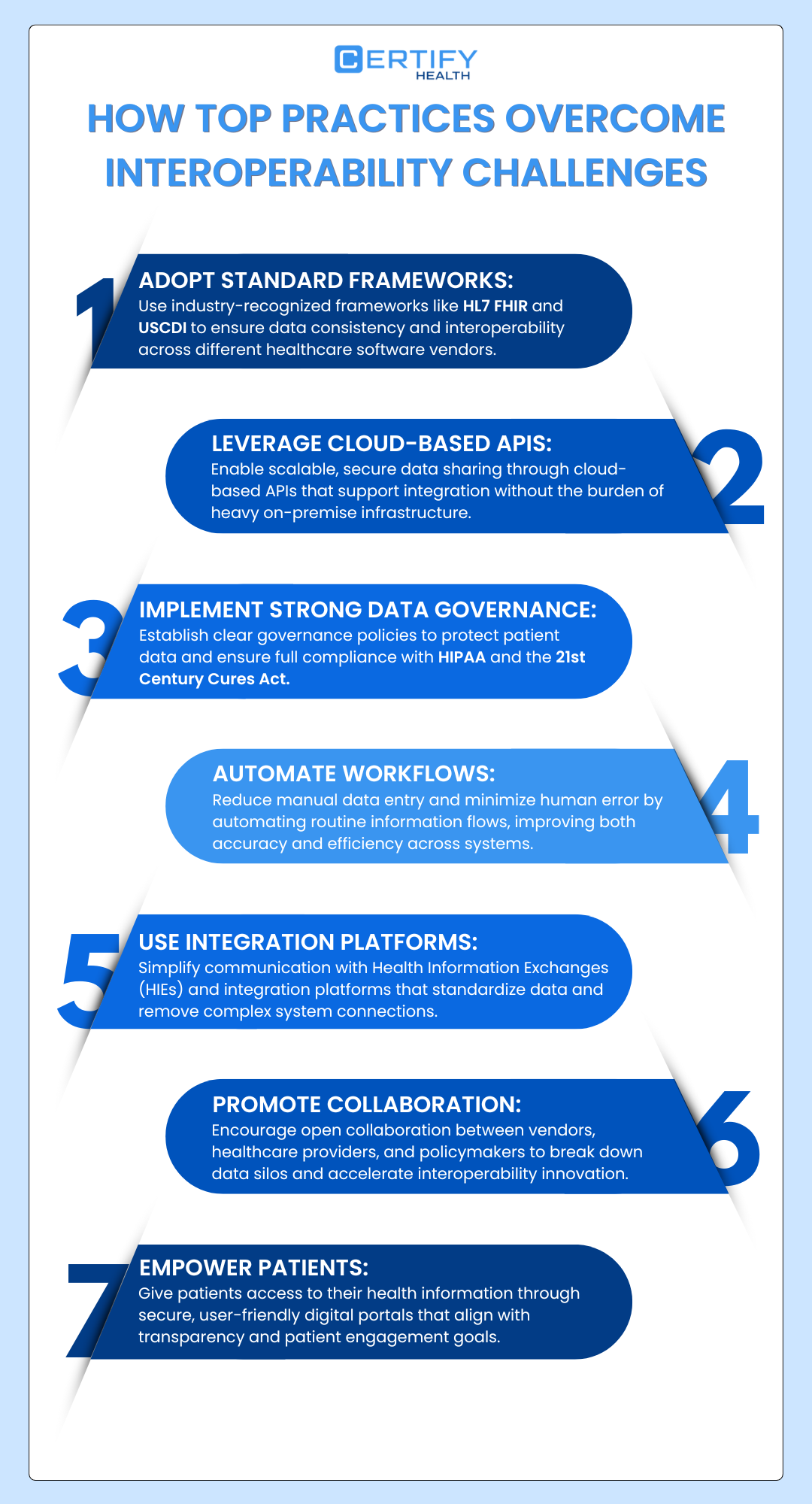
Interoperability Challenges and How Practices Overcome Them
Despite rapid innovation, interoperability challenges persist across U.S. healthcare. Top barriers include:
Lack of Standardization
Every healthcare organization speaks its own “data language.” Different formats and systems make it hard for platforms to talk to each other — slowing down how information moves across providers.
Data Security & Privacy Issues
Protecting patient data is always a top priority. Any breach can mean heavy penalties and lost trust. On top of that, meeting HIPAA and other privacy regulations adds extra layers of responsibility for healthcare teams.
Fragmented Systems
Many hospitals and clinics still use separate or outdated Electronic Health Record (EHR) systems. This creates isolated data pockets, making it difficult to get a complete, connected view of a patient’s medical history.
High Financial & Technical Resources
Building and maintaining interoperable systems isn’t cheap. The financial, technical, and staffing investments required can be overwhelming, especially for smaller healthcare organizations.
Resistance to Change
Some organizations hesitate to share data, whether due to competition, control, or simply fear of the unknown. This slows down collaboration and keeps information locked in silos.
Technical Complexity
Blending new digital tools with older legacy systems is a technical juggling act. Managing multiple data layers and ensuring everything syncs smoothly remains a huge challenge.
What is Interoperability Software?
It is a set of technologies, protocols, and standards that enable different systems to connect and communicate with each other, allowing you to securely send, receive, and interpret various sets of data.
This interoperability allows healthcare providers to quickly access a patient’s medical history across different systems, reducing errors, and improving care.
Interoperability Software Benefits for Practices
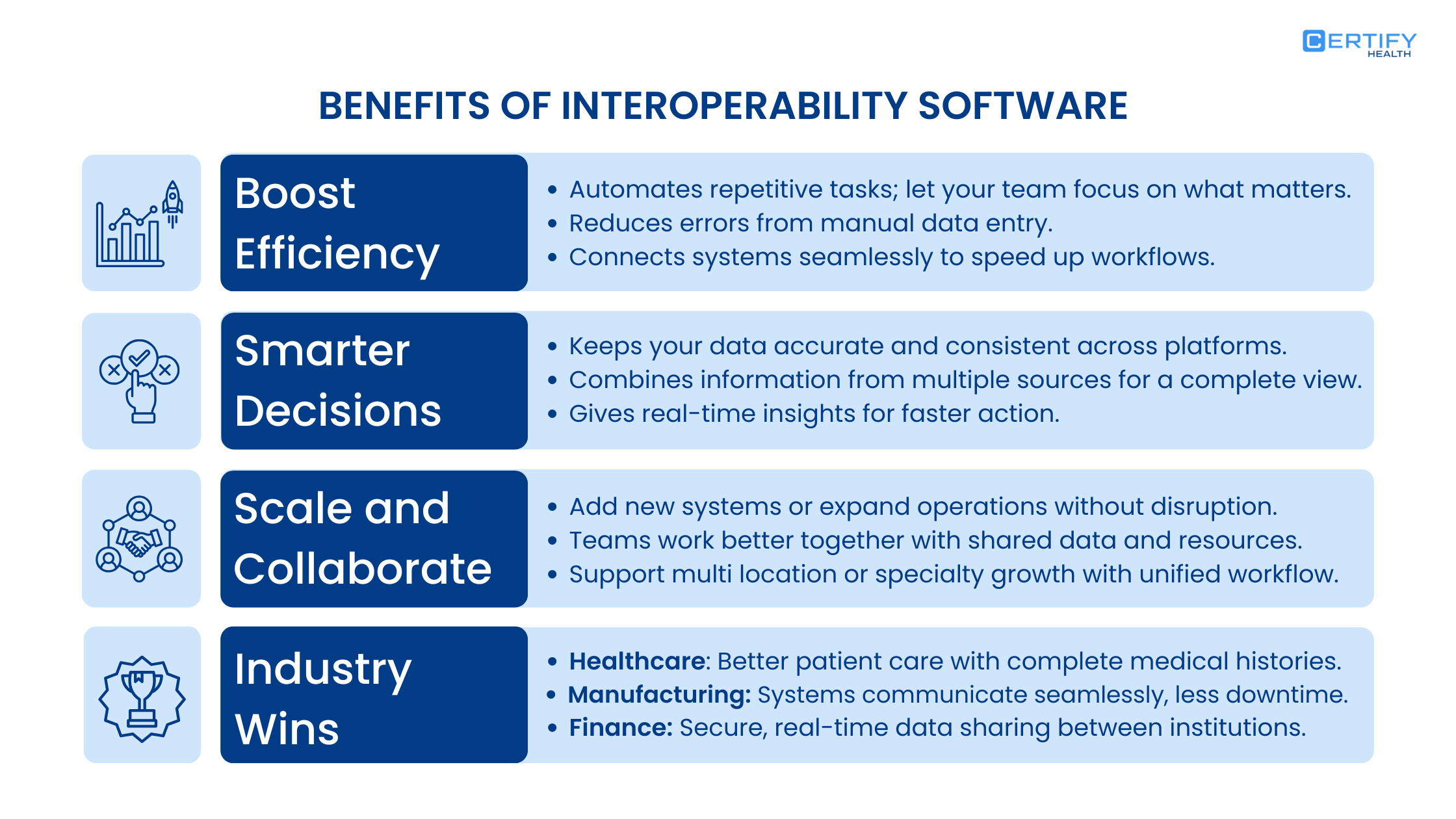
When practices define interoperability through the lens of both compliance and care quality, the ROI becomes clear: fewer errors, happier patients, and stronger financial performance.
As practices strengthen interoperability, unified financial data flow becomes just as critical.
CERTIFY Health’s CERTIFYPAY is an omnichannel payment gateway that integrates directly with EHR and practice management systems to ensure every patient payment, whether made in-clinic, online, via mobile, kiosk, QR, cards, ACH, or digital wallets, posts accurately and securely.
Payments are handled through PCI-DSS–compliant, HIPAA-aligned infrastructure with safeguards for sensitive patient and payment data, allowing CERTIFYPAY to connect payment events back into clinical and billing systems while improving collection success rates and delivering a consistent, interoperable payment experience across every touchpoint.
The Future of Healthcare Interoperability
The U.S. health data interoperability market reached USD 84.58 billion in 2025, projected to triple by 2032 at a 22.6% CAGR. This growth reflects widespread policy adoption, TEFCA expansion, and FHIR-enabled innovation.
AI-driven data harmonization is already being used by next-generation platforms to improve decision support, predictive analytics, and scalable connectivity between legacy systems. The infrastructure of contemporary medicine is being shaped at this rapid pace by healthcare interoperability, which is bringing disparate ecosystems together into a cohesive, data-driven continuum.
Conclusion
Interoperability in healthcare is essential to a connected care ecosystem and goes beyond simple compliance. The time to act proactively is now – find gaps, build relationships, and ensure your practice is future-proof with seamless data exchange, schedule an interoperability assessment.