

Table of Contents
Introduction: The Patient Journey Starts Before They Walk Through Your Door
A recent survey revealed that 60% of Americans reported experiencing poor healthcare service within the last two years. Most of those frustrations were not related to the actual medical care. They were about patient access, communication, scheduling, billing, and delays.
That’s how the healthcare patient experience works today. It’s not just the 12 minutes in the exam room. From the first online search to the final statement, every click, delay, and unanswered question leaves an impression.
Many resources approach this issue as if it only relates to patient surveys. Get better scores. Send a follow-up email. That’s not enough.
Real patient experience improvement is about how your practice runs. It’s about digital tools. It unfolds across every touchpoint of the patient experience.
This guide lays out a straightforward, actionable path you can follow. It covers patient experience in healthcare from the first search to the last payment — and maps each step to digital tools your team can use today.
What Is Patient Experience, Really?
Three terms often get mixed up. Let’s clear them up fast.
Patient experience includes every interaction and touchpoint a person encounters while receiving care. Booking. Forms. The waiting room. The bill. Every interaction with your team, technology, and physical environment shapes the experience.
Patient satisfaction is how patients feel about those steps. A patient in pain can still rate a visit highly — if a nurse was kind and things were clear.
Patient experience vs patient satisfaction is a key difference. Experience reflects what patients went through. Satisfaction measures the impression patients are left with after the experience ends.
Clinical outcomes measure whether the treatment worked. A patient can have a poor experience and a good result. Patients who feel heard are more likely to follow their care plan, which can support better outcomes.
When we talk about patient experience in healthcare, we’re looking at three things at once.
- The worried patient navigating an uncertain health concern.
- The patient going through treatment.
- It also includes the person interacting with your website, reception staff, and billing department.
Why Patient Experience Is a Business Priority Now
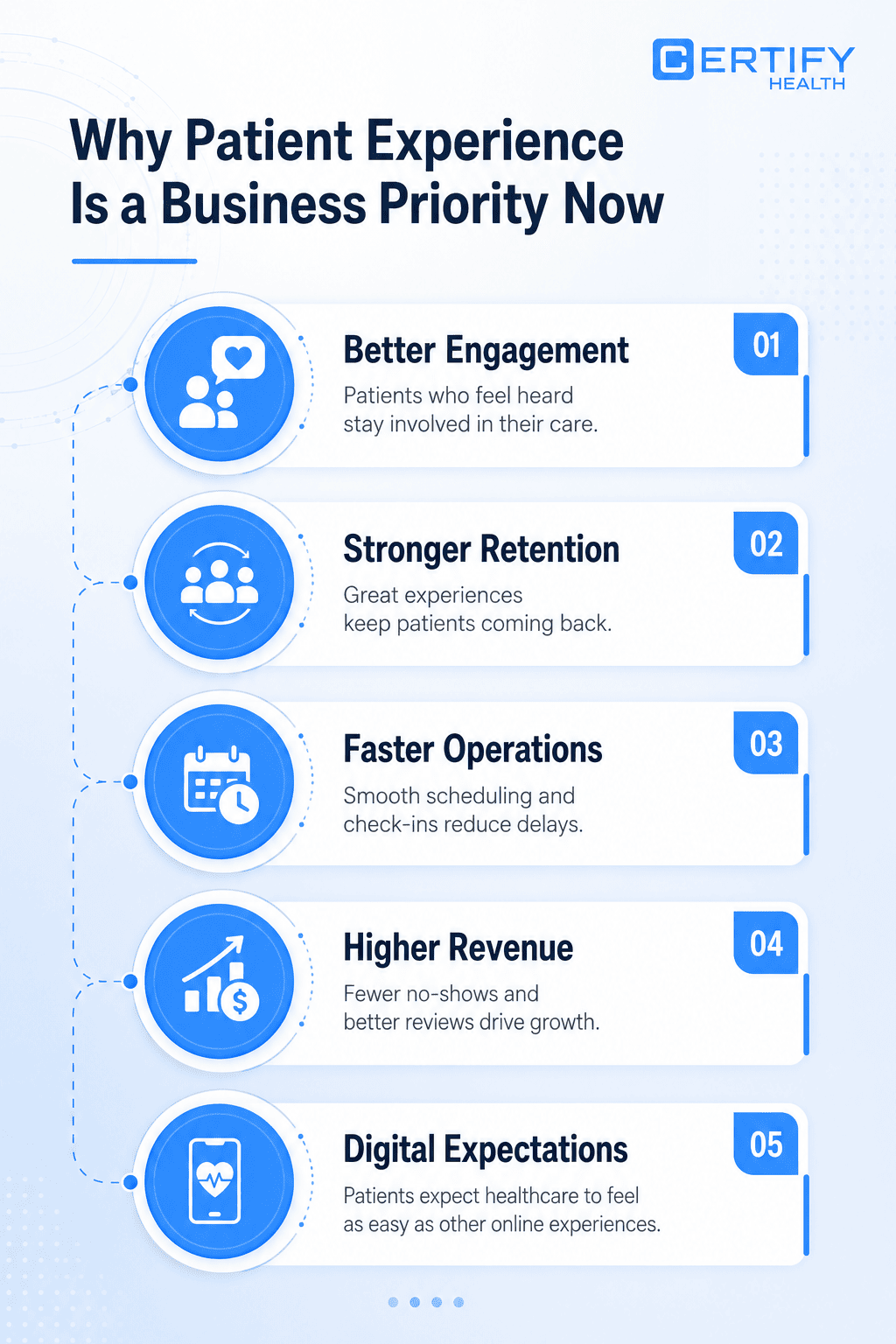
Patient-centered care is more than a philosophy. It directly influences how your practice performs. And it’s become a key driver of healthcare digital change across the industry.
Clinically, patients who feel heard follow their care plans more closely. They come back for follow-up visits. They catch problems early. Better patient engagement can improve follow-up adherence, care continuity, and early issue detection.
Financially, poor experience drives quiet loss. Patients don’t complain, they just go elsewhere. Negative encounters can hurt a practice’s reputation through public reviews and personal recommendations. In many value-based care models, patient experience scores like HCAHPS can affect reimbursement levels.
In day-to-day operations, every friction point creates a cost. High no-show rates. Slow check-ins. A flooded call center. These lose revenue, burn out staff, and slow your whole day.
Patients now expect booking a doctor’s visit to feel as easy as booking a flight. If your booking process falls short, you lose patients before they ever meet your team.
Did You Know?
- A broad healthcare analysis showed an average patient no-show rate of 18.8%, with every missed appointment resulting in an estimated $196 loss for providers.
- Research shows patient no-shows reduce provider productivity, limit access to care, disrupt scheduling workflows, and increase operational costs across healthcare systems.
- Since 2013, CMS value-based purchasing programs have put nearly $1 billion in hospital reimbursement at stake through HCAHPS patient experience measures.
The SEE–CARE–CLOSE Framework
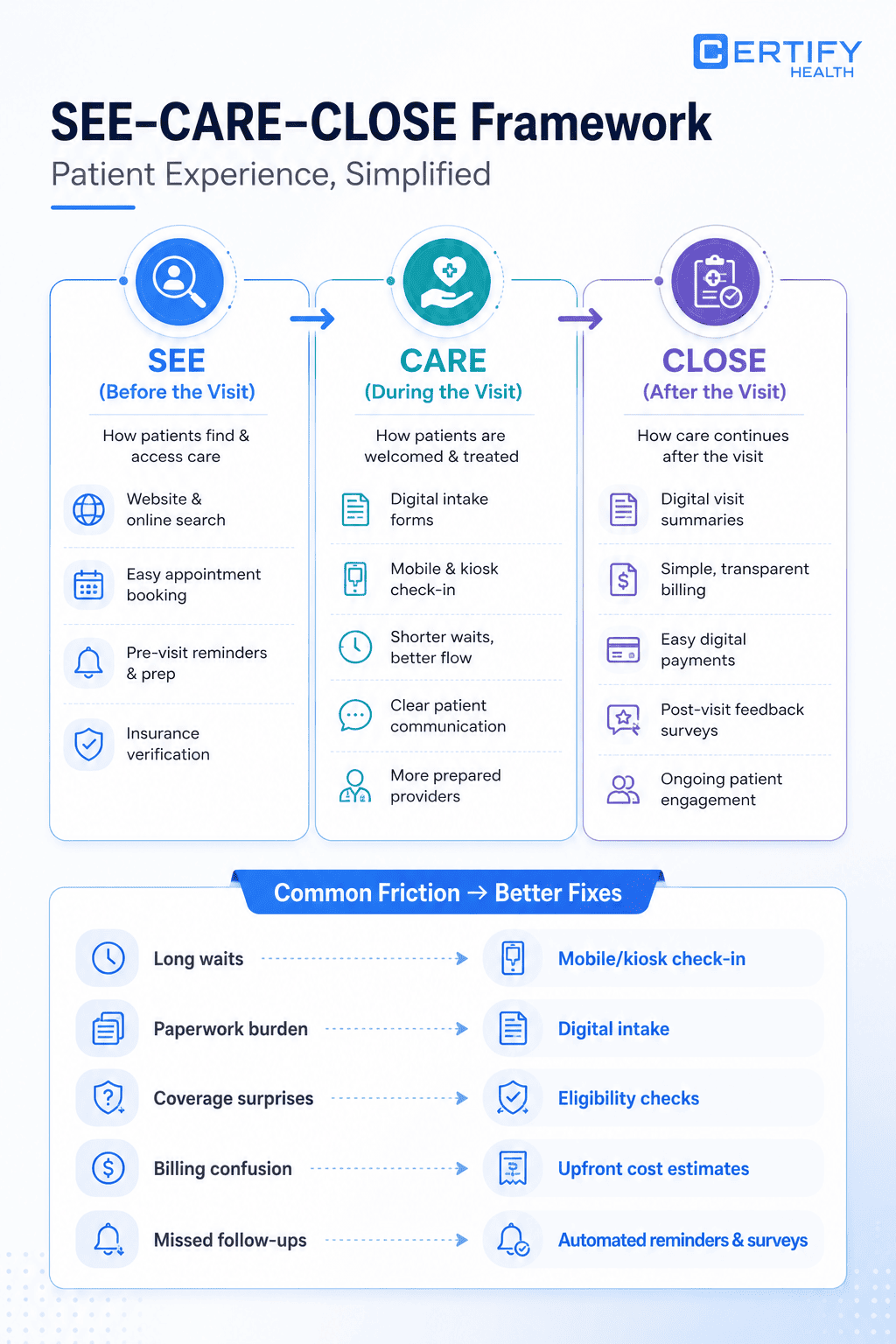
A simple way to think about patient experience improvement is to break each care episode into three phases.
SEE: How Patients Discover and Reach Your Practice
This phase is everything before the visit. It is the start of the patient journey in healthcare. It covers search. Your website, which is your digital front door in healthcare. Booking. Pre-visit prep.
Appointment access is where most practices lose patients first. If someone can’t find an open slot online, or if booking takes too long, they leave. Online self-scheduling through healthcare scheduling software cuts inbound calls. Automated reminders help patients remember visits, finish check-in tasks, and arrive on schedule.
Checking insurance before the visit removes one of the most common problems on arrival day — surprise coverage issues that hold up care.
CARE: How Patients Are Welcomed and Treated
This stage covers check-in, registration, waiting, the appointment, and follow-up care transitions.
Digital intake is one of the most impactful improvements a healthcare organization can implement. When patients complete paperwork such as medical history, consent documents, insurance information, and ID verification from their mobile device before the visit, it creates three immediate benefits. Teams save time by reducing the need for manual data entry. Patients feel ready. Doctors are more likely to begin visits with more complete patient information.
Mobile check-in and kiosk check-in cut front-desk lines. Providing wait-time visibility can reduce patient frustration and uncertainty.
Communication during the visit matters just as much. Communication delivered in a patient’s preferred language helps create confidence and stronger connections. When patients know what’s happening and why, it reduces anxiety and confusion. Patients are more likely to stick with the recommended next steps.
CLOSE: How the Appointment Ends — and the Patient Relationship Continues
This phase covers discharge, post-visit experience, billing, feedback, and re-engagement.
Discharge is often where things go wrong. Patients often leave with printed instructions they never look at again. Sending a digital visit summary through a Patient Portal — with clear next steps — helps patients act on what they learned.
Billing is often the most emotionally sensitive stage of the entire patient journey. Even a good visit can feel frustrating if the bill is confusing. Clear pricing, online payments, and upfront estimates make costs easier to understand.
Automated post-visit surveys sent by text within a few hours capture feedback while the visit is fresh. They also give your team a chance to fix a bad experience before it becomes a bad review.
Points of Friction — and Practical Ways to Solve Them
Here’s a quick view of where patient experience in healthcare most often breaks down, and what high-performing teams do instead. Improving patient experience starts with finding these gaps.
| Touchpoint | Common Problem | High-Impact Fix |
|---|---|---|
| Finding a provider | Poor search results, old listings | Strong digital front door healthcare, updated profiles |
| Booking | Phone-only, long hold times | Online self-scheduling, healthcare scheduling software |
| Pre-visit | No reminders, no prep info | Automated reminders & nudges, digital intake |
| Arrival/check-in | Paper forms, long lines | Mobile check-in, kiosk check-in |
| Waiting | No updates at all | Queue messages, wait time alerts |
| Clinical visit | Rushed or unclear talks | Short, clear language, multilingual tools |
| Discharge | Dense paperwork | Digital visit summaries via patient portal |
| Billing | Surprise bills, confusing terms | Upfront cost estimates, digital payments |
| Feedback | Annual surveys, low response | Real-time SMS surveys post-visit |
How to Measure Patient Experience the Right Way
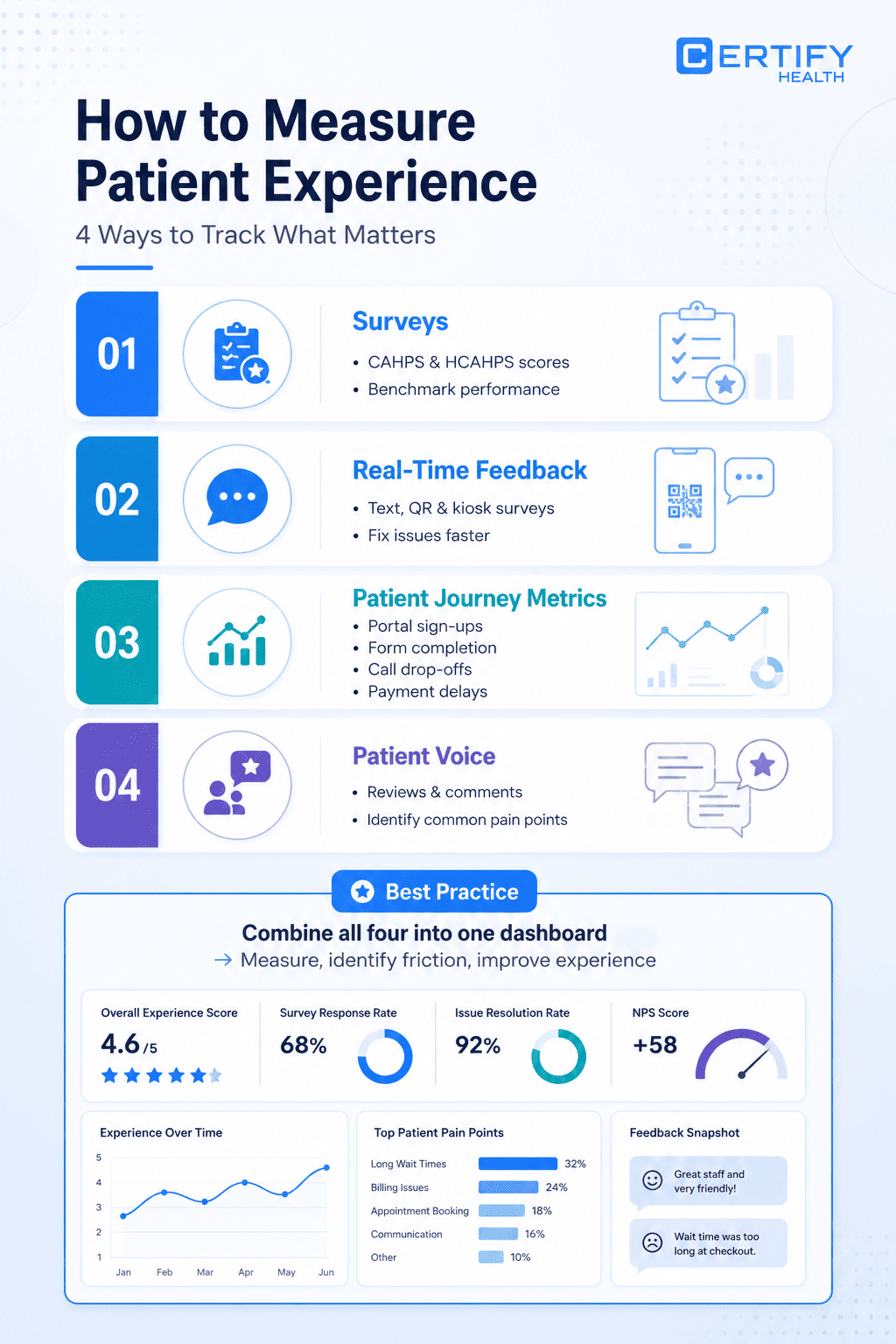
Most teams answer the question “how to measure patient experience” too narrowly. They check one survey score and stop there.
Strong measurement tracks the full digital patient journey — not just one moment in it. Use four layers.
Standard surveys like CAHPS programs and HCAHPS let you compare your scores with other practices. But they’re slow — results can take months to come back.
Real-time feedback via text, QR code, or kiosk tells you what’s happening right now. You can still fix a bad experience before it spreads.
Your own data holds patient experience metrics most teams overlook. Portal sign-up rates. Form completion rates. Call drop rates. Payment delays. These all point to where friction lives in your patient journey in healthcare.
Patient comments — from surveys, online reviews, and direct talks — tell you the “why” behind your scores. Build a short list of common themes. That list becomes your roadmap.
A good patient experience dashboard brings all four layers into one view. It links experience data to your daily ops so your team can act, not just report.
8 Ways to Improve Patient Experience in Healthcare
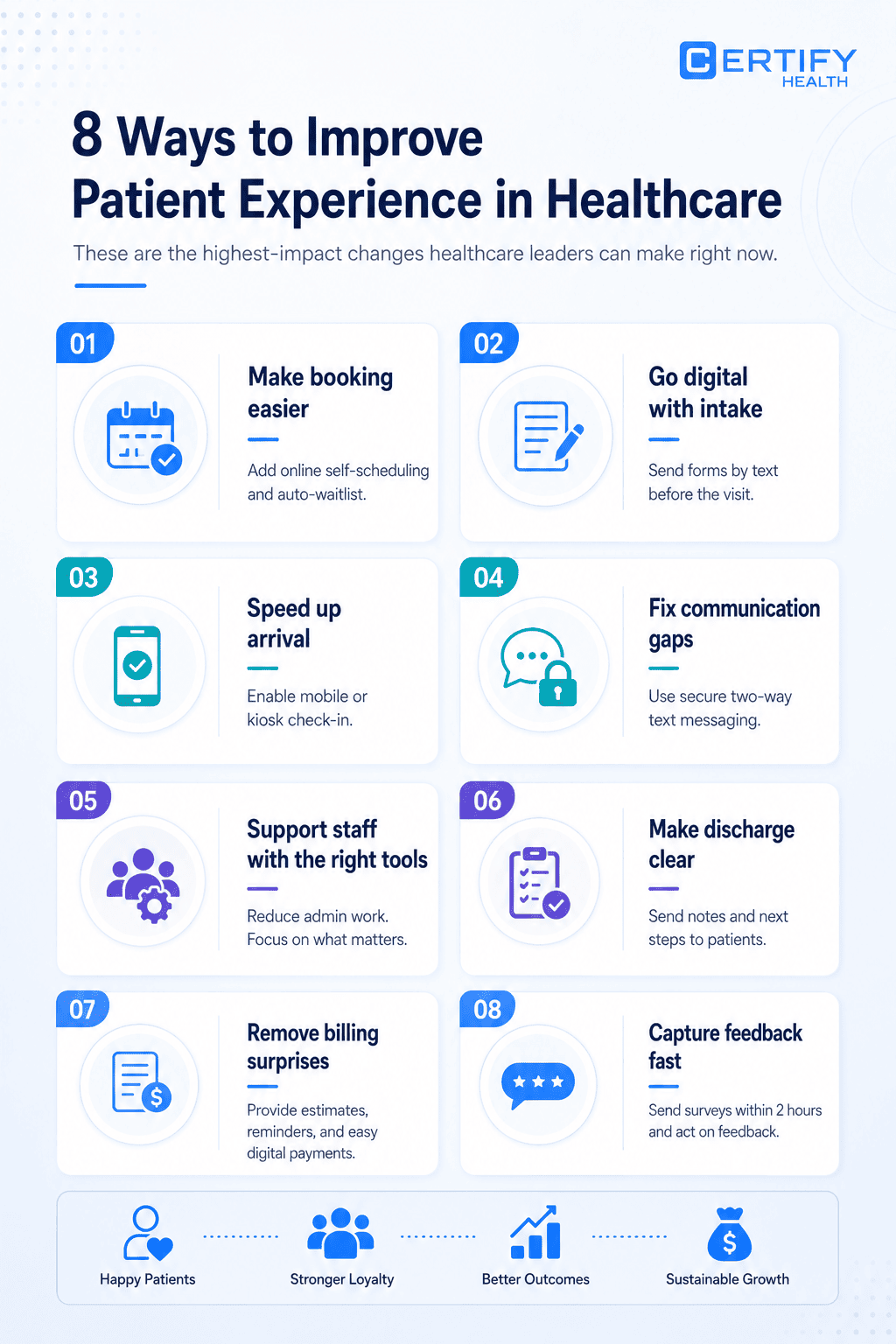
These are the highest-impact changes healthcare leaders can make right now.
- Make booking easier. Add online self-scheduling. Use an auto-waitlist so a canceled slot fills fast.
- Go digital with intake. Send forms by text before the visit. Less paper. Less desk work. Better data.
- Speed up arrival. Let patients check in on their phone or at a kiosk. Skip the line.
- Fix communication gaps. Use secure two-way text so patients can ask questions without calling.
- Support staff with the right tools. Less admin work means more time for the moments that really matter.
- Make discharge clear. Send visit notes and next steps to the patient’s phone. Link to the patient portal.
- Remove billing surprises. Give cost estimates upfront. Send payment reminders. Offer easy digital payment.
- Capture feedback fast. Send a short survey within two hours of a visit. Route bad feedback to a real person right away.
Make Patient Experience Everyone's Job
Patient experience improvement without a clear plan won’t last. The best teams treat patient experience in healthcare as a team sport — not just one person’s job.
Build a small group. Include clinical leads, front-office staff, IT, billing, and quality teams. Review a patient experience dashboard each month. Do a deeper dive each quarter. Set a clear path for urgent problems.
Tie PX goals to numbers your whole practice tracks — no-show rates, portal sign-up rates, and payment delays. When patient experience has a seat at the table, it gets the time and tools it needs.
How CERTIFY Health Brings This All Together
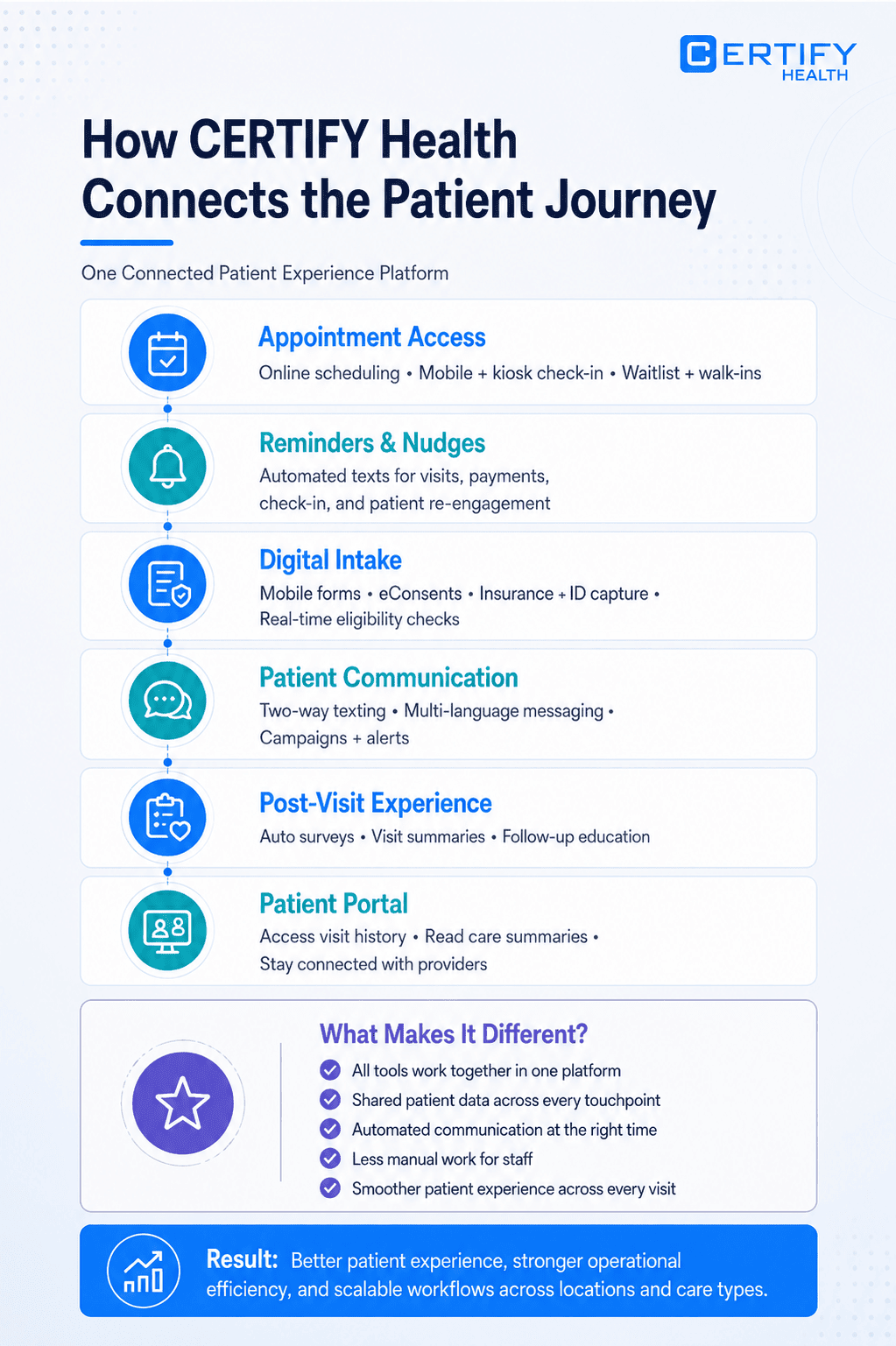
Running a strong digital patient experience across every step is hard when your tools don’t talk to each other.
CERTIFY Health’s Patient Experience Platform connects the whole journey in one place:
- Appointment Access — Online self-scheduling, mobile check-in, kiosk check-in, waitlist automation, and walk-in management.
- Reminders & Nudges — Auto texts for visits, check-in, payments, and re-engaging patients who haven’t been in.
- Digital Intake — Mobile forms, eConsents, insurance capture, photo ID, and real-time insurance checks — all done before the patient arrives.
- Communication — Secure two-way text, multi-language support, patient campaigns, and broadcast alerts.
- Post-Visit Experience — Auto feedback surveys, digital visit notes, and follow-up learning sent right after the visit.
- Patient Portal — One place where patients can see their visit history, read summaries, and stay in touch with their care team.
What makes CERTIFY Health different is that these tools work as one. They share data. They send the right message at the right time. That means less manual work for your staff and a smoother ride for your patients — every single visit.
For healthcare leaders who want to improve patient experience in healthcare across many locations or care types, a connected platform makes the difference between a one-time fix and a lasting change.
Getting Started: A 90-Day Action Plan
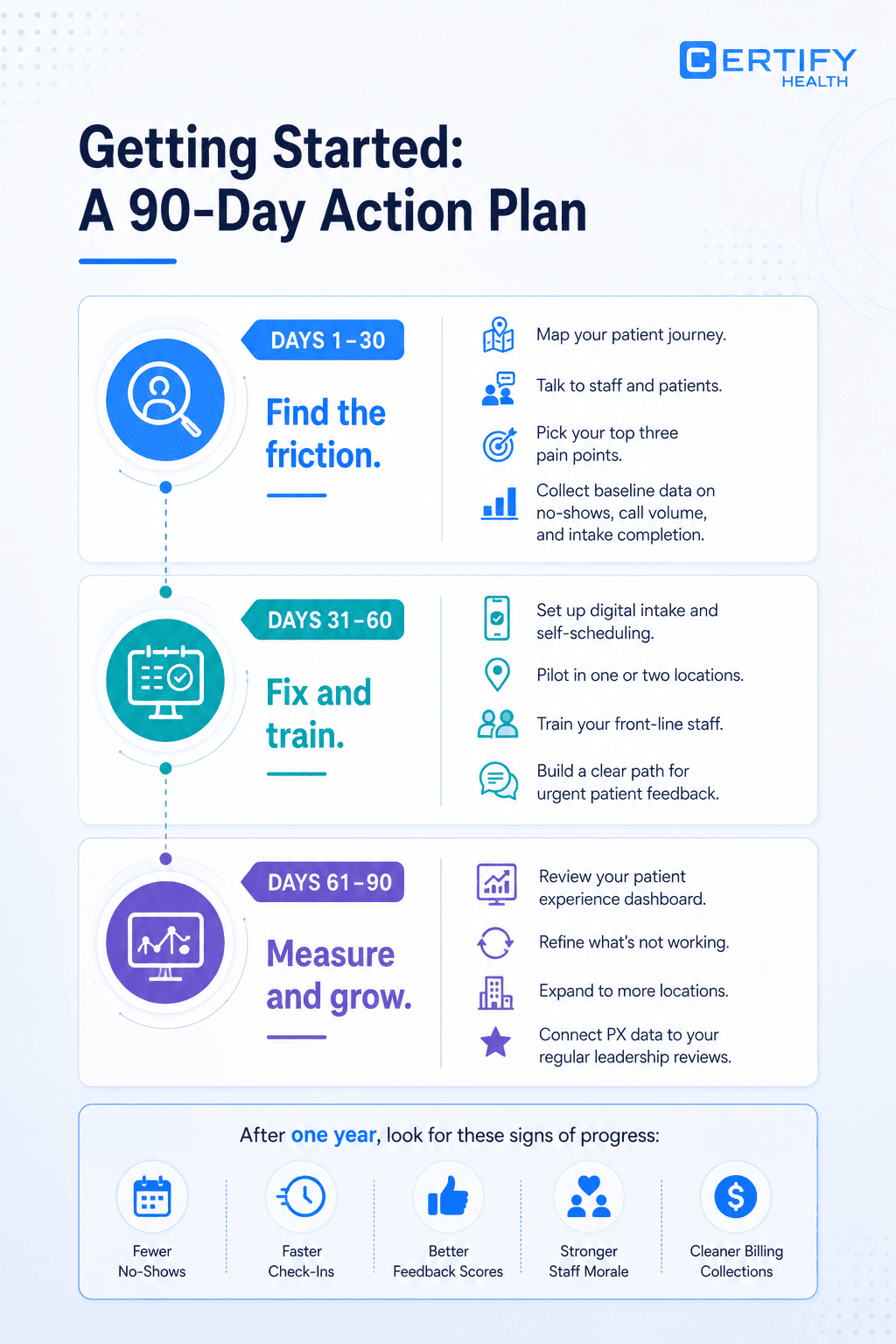
Days 1–30: Find the friction. Map your patient journey. Talk to staff and patients. Pick your top three pain points. Collect baseline data on no-shows, call volume, and intake completion.
Days 31–60: Fix and train. Set up digital intake and self-scheduling. Pilot in one or two locations. Train your front-line staff. Build a clear path for urgent patient feedback.
Days 61–90: Measure and grow. Review your patient experience dashboard. Refine what’s not working. Expand to more locations. Connect PX data to your regular leadership reviews.
After one year, look for these signs of progress: fewer no-shows, faster check-ins, better feedback scores, stronger staff morale, and cleaner billing collections.
Conclusion
Every confusing form. Every minute on hold. Every surprise bill. They add up. Patients use these moments to decide where to go, whether to return, and whether to recommend you.
Improving patient experience in healthcare isn’t about being perfect. It’s about finding where friction lives and fixing it — one step at a time. It’s about using the right digital tools. And it’s about building a team habit of measuring, learning, and getting better.
The healthcare leaders winning today stopped treating patient experience in healthcare as a survey score. They treat it as how their practice runs. They’ve mapped the journey, closed the gaps, and connected their tools — so every patient, from first click to final payment, feels the care they came for.
That’s the goal. And it’s closer than you think.
Want to see how a connected patient experience platform can cut friction across your whole patient journey? Explore CERTIFY Health’s Patient Experience Platform or Book A Workflow Review With Their Team.