

Connect appointment access, reminders, intake, consent, eligibility, and payment readiness across the recurring workflows women’s health teams manage every day.
Give patients a clearer path to the next visit while reducing the manual calls, repeated follow-up, and disconnected handoffs that add pressure to access teams.
12 visits · reminders on
Capacity recovered
Intake already complete
Women’s health and OB-GYN teams manage routine care, recurring visits, procedures, sensitive communication, and changing coverage needs. Booking alone does not keep that journey moving.
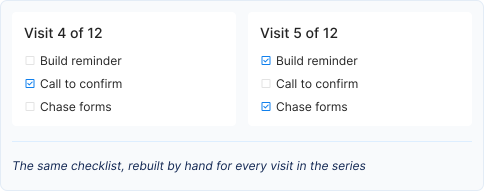
Staff repeatedly rebuild reminder and follow-up tasks around visit sequences.
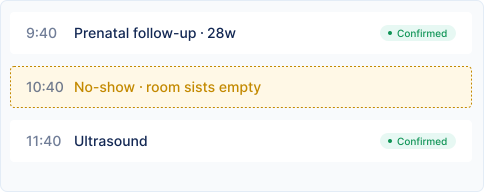
Missed visits leave capacity unused and can interrupt continuity.
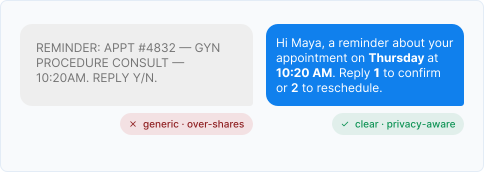
Generic reminder patterns do not always fit the context of women's health workflows.
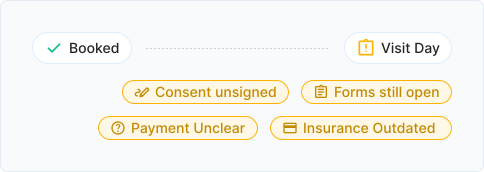
Forms, consent, insurance details, and payment questions still surface later.
CERTIFY Health links scheduling with reminders, two-way messaging, digital intake, eConsent, insurance capture, eligibility, check-in, and payment workflows so the next required action can follow the visit.
Offer eligible booking pathways online under configured rules.
Support repeat-visit scheduling patterns where configured.
Keep upcoming appointments visible without depending only on manual calls.
Give patients and staff a direct channel for operational questions.
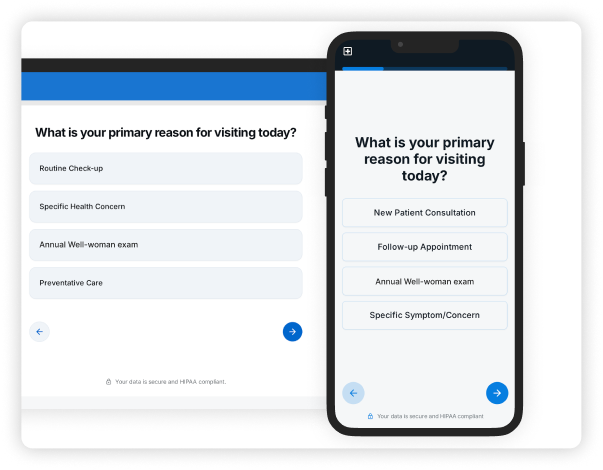
Move forms and signatures earlier in the journey.
Carry the appointment into coverage and payment readiness where configured.
Every appointment carries its own next steps, so the schedule, the patient, and the front desk stay in sync.
Patients or staff create the appointment under the practice's configured rules.
The pre-visit workflow can carry forms, consent, insurance updates, and instructions.
SMS and email communication can support confirmation and unfinished tasks.
Staff can see pre-registration progress and focus follow-up on exceptions.
Maria P.Annual exam · 7:00 AM
100%
ready
James T.Prenatal 28w · 7:40 AM
66%
consent pending
Anita K.Ultrasound · 8:15 AM
83%
insurance updated
Post-visit or recurring follow-up can continue through configured messaging workflows.
New patients booked online without staff intervention, showing how digital access can absorb real appointment demand at scale.
High-volume communication ran at scale with more than 50% open rates, supporting reminders, follow-up, and next-step completion.
Completion reached 88% for new patients, 87% for returning patients, and 73% among patients age 75+, showing adoption across age groups.
Open capacity was moved back into the schedule instead of being left empty; the same deployment estimated about $831K in recovered production.
Shift eligible booking and reminder work into digital channels.
Connect scheduling to forms, consent, and coverage steps.
Use configured messaging to move patients toward the next required action.
CERTIFY Health OB-GYN scheduling software connects patient-led scheduling, recurring visits, reminders, intake, consent, insurance capture, eligibility context, check-in, communication, and payment readiness around the appointment.
The EHR, clinical charting, pregnancy management, care-plan documentation, and medical decision-making stay in the clinical workflow. CERTIFY Health strengthens the access workflow so each booking can trigger the right next step before staff are forced to chase patients manually.
The workflow should support repeat visits, reminders, and next-step communication without making staff recreate the same process every time.
Scheduling should connect to clear, privacy-aware reminders and instructions instead of generic outreach.
Forms, consent, insurance capture, eligibility, and payment readiness should follow the booking while there is still time to act.
The workflow should support follow-up, recall, and available-capacity recovery instead of leaving every gap to manual phone work.
No. It works alongside existing clinical and practice systems.
Bring appointment types, recurring workflows, reminder cadence, current forms and consent needs, payer mix, systems in use, and the points where staff rely most on manual calls.