
CERTIFY Health Vs Rectangle Health
Which Payment and Patient Workflow Platform Fits Your Practice?
Rectangle Health and CERTIFY Health both support revenue-facing workflows, but they start from different places.
Rectangle Health
Rectangle Health is often evaluated for healthcare payments, payer payments, payment engagement, compliance, and A/R workflows. CERTIFY Health includes payment workflows, but it also addresses the upstream work that affects collection: scheduling gaps, incomplete intake, late eligibility checks, check-in friction, disconnected reminders, and patient responsibility prompts.
CERTIFY Health
So the real question is simple: is your biggest problem payment acceptance, or does payment friction start earlier in the patient journey?
A Simple Way
to Compare the Two
Look at
Rectangle Health when
Rectangle Health is worth a closer look when the main need is payment processing, payer payments, compliance automation, payment posting, and reducing A/R around payments.
Look at
CERTIFY Health when
Look at CERTIFY Health when payment leakage starts before collection, with incomplete intake, missing insurance data, late eligibility checks, check-in delays, weak payment prompts, or disconnected patient responsibility workflows.
That difference matters. Better payment tools help at collection time, but they do not always fix the front-end gaps that create collection issues in the first place.
Key Differences at a Glance
Understand how each platform fits your outpatient or ambulatory workflow before you scope a project.
Buying Context

Often evaluated for patient payments, payer payments, payment engagement, compliance, integrations, and A/R workflows.

Often evaluated when practices want front-end revenue readiness through digital intake, insurance capture, eligibility checks, payment responsibility prompts, Text-to-Pay, payment plans, card-on-file, autopay, electronic statements, in-office payments, and reporting.
Core strength

Strong healthcare payments and compliance packaging, with payment-first workflow depth.

Moves payment readiness upstream by connecting intake, eligibility, check-in, communication, patient responsibility, Text-to-Pay, payment plans, card-on-file, autopay, and follow-up workflows.
EHR relationship

Usually complements the practice management or payment environment rather than replacing the EHR.

Works alongside existing EHR, EMR, and practice management systems without requiring rip-and-replace.
Patient access

Includes communication-heavy workflows, with public positioning around scheduling, check-in, intake, and eligibility to verify by scope.

Supports the patient access steps that affect collections: pre-registration, digital forms, ID and insurance capture, eligibility review, check-in, reminders, payment prompts, and staff-assisted follow-up.
Payments

Core focus: patient payments, payer payments, payment posting, payment engagement, compliance, and related workflows.

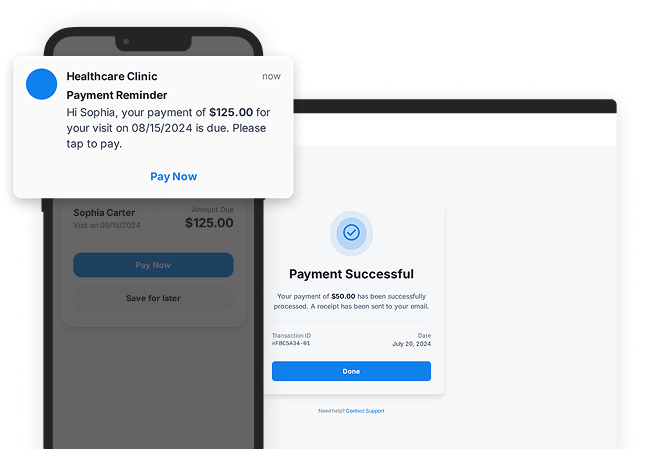
Supports patient payments through CERTIFYPAY, including Text-to-Pay, online payments, in-office payments, payment plans, card-on-file, and reminders where configured.
Who should look closer

Practices focused mainly on payments, payer payments, compliance automation, and A/R collection workflows.

Practices where payment leakage begins earlier in scheduling, intake, eligibility, check-in, and patient responsibility workflows.

The Workflow Difference Most Practices Miss
On a feature checklist, both platforms can appear to support payment and engagement workflows. The practical difference is where the revenue problem starts.
If balances are delayed because payment methods are limited, payment posting is manual, or payer payment workflows are inefficient, Rectangle Health deserves a close look. But if balances are delayed because patients arrive with incomplete forms, coverage is checked late, staff does not have readiness visibility, or payment prompts are disconnected from check-in, the problem starts earlier.
CERTIFY Health is built for that upstream layer. It connects intake, eligibility, check-in, communication, and payment workflows so staff can act before the balance becomes harder to collect.
CERTIFY Health Capabilities That Matter in This Comparison
CERTIFY Health’s strongest fit is the outpatient workflow between the first patient action and the final payment. The capabilities that matter most in this comparison are:
Multi-channel intake
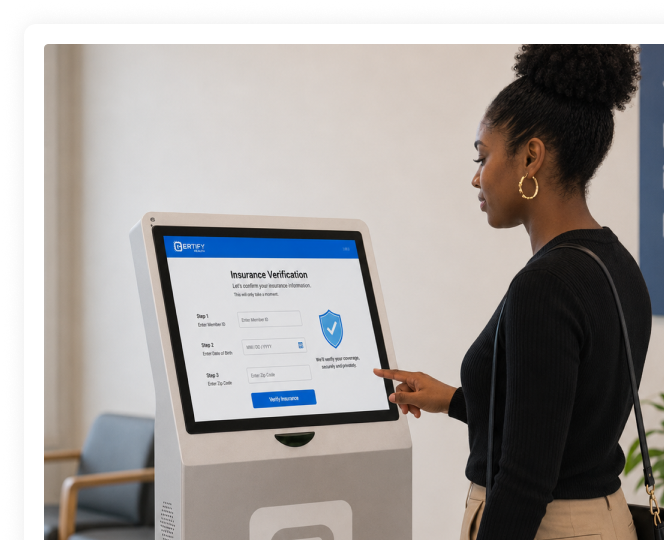
Patients can complete intake through a secure web portal, mobile link, kiosk, tablet, patient portal, or staff-assisted workflow. Intake can include demographics, insurance, medical history, digital forms, and eConsents.
EHR-connected intake
Submitted information can be routed into connected practice systems based on the integration and workflow configuration.
Insurance capture and eligibility review
Patients or staff can capture insurance card images, and coverage can be checked during scheduling, pre-registration, or check-in when the workflow is configured for it.
Check-in nudges
Automated reminders can prompt patients to finish forms, confirm arrival steps, complete mobile check-in, make payments, or use kiosk and staff-assisted options when needed.
Patient payments
CERTIFYPAY supports payment links, Text-to-Pay, card-on-file, payment plans, payment reminders, online payments, and in-office payment options where configured.
Identity verification
Photo ID capture can be part of intake and check-in. FaceCheck can be used as an optional identity assurance layer where the practice needs added control.
Interoperability
CERTIFY Health is built to work with existing healthcare systems through scoped EHR/PM integrations, HL7, FHIR, EDI, payment gateway connections, identity tools, and communication services.
Practice Scenarios Where the Difference Becomes Clear
- Revenue leaders should map whether payment delays come from the payment tool itself or from upstream readiness issues.
- Practices with high patient balances should compare how each platform handles pre-visit readiness, eligibility, check-in prompts, and post-visit payment reminders.
- DSOs, specialty groups, PT, vision, and ASC teams should decide whether they need a payment-first system or a patient access workflow that also supports payment collection.
How to Decide
Choose the evaluation path based on the problem you are trying to solve.
Evaluate Rectangle Health more closely if:
- You are primarily solving payment acceptance, payer payments, compliance, payment posting, or A/R collection.
- The practice already has intake, eligibility, and check-in workflows under control.
- You want a payment-first platform with engagement around payments.
- The buyer is in finance, revenue cycle, or payment operations.
Evaluate CERTIFY Health more closely if:
- Payment delays are tied to incomplete intake, late eligibility, missed reminders, or check-in friction.
- You need payment workflows connected to scheduling, intake, check-in, and communication.
- You want patient responsibility prompts before, during, and after the visit.
- You want to improve revenue workflow without treating payments as an isolated problem.
Where CERTIFY Health Extends Beyond Payment Collection
CERTIFY Health does not need to replace Rectangle Health as a payment-first or payer-payment platform. The stronger distinction is where the payment problem begins. Rectangle Health may make sense when the core issue is payment processing, payer payments, compliance, A/R, EOPs, posting, or finance-led collections. CERTIFY Health makes more sense when payment friction starts earlier in the visit journey: missing intake, unclear eligibility, incomplete insurance capture, delayed patient responsibility conversations, check-in friction, missed reminders, or disconnected follow-up. CERTIFY Health helps prepare the patient and staff for the financial conversation before the balance becomes harder to collect.
See How CERTIFY Health Would Fit Your Workflow
Bring your current scheduling, intake, check-in, eligibility, communication, and payment process into the demo. We’ll walk through where work breaks down today and where CERTIFY Health can help connect the patient journey without replacing the systems that already run your practice.
Questions to Ask Before You Choose
Four questions that separate a quick communication fix from a real workflow decision. Step through them and tick off the ones you’ve thought about.
QUESTION 01/04
Are balances delayed because patients cannot pay easily, or because the workflow did not prepare them earlier?
QUESTION 02/04
When do we check eligibility and patient responsibility today?
QUESTION 03/04
Do payment reminders connect to intake, check-in, and communication workflows?
QUESTION 04/04
Does finance need only payment tools, or does operations need a cleaner patient journey too?
Frequently Asked Questions
Is CERTIFY Health a payment processor like Rectangle Health?
CERTIFY Health includes patient payment workflows through CERTIFYPAY, but it should be positioned more broadly: scheduling, intake, check-in, eligibility, communication, identity, and payments around the visit.
Which platform may make more sense for payment operations?
Rectangle Health may make more sense when the main issue is payments, payer payments, compliance, or A/R payment workflows. CERTIFY Health may make more sense when payment leakage starts earlier in the patient journey.