Connect Without Replacing
CERTIFY Health’s healthcare interoperability software integrates with 234+ EHRs and EMRs worldwide—from Epic and Cerner to custom in-house builds—so your workflows stay unified, automated, and compliant.
Why Healthcare Interoperability Matters
CERTIFY Health’s healthcare interoperability platform solves this by being your operations & engagement layer around the EHR. We don’t replace your system—we make it work harder for you with automated scheduling, intake, billing, payments, and communication, all fully integrated.
Revenue leakage
Claim denials rise when eligibility, notes, or billing don’t sync.
Staff inefficiency
Double entry and fragmented systems waste hours every week.
Patient experience
Patients notice when care feels disconnected.
Find Your System
Supported Integrations
CERTIFY Health’s healthcare interoperability software offers seamless integration with EHR and EMR systems, connecting effortlessly with all major vendors across hospital, ambulatory, dental, behavioral health, and international markets.
Major US Hospital EHRs
Ambulatory & Outpatient EHRs
Behavioral & Mental Health EHRs
Dental Systems
Global & EU EHRs
Legacy & On-Premise EHRs
Allscripts (Veradigm Sunrise, TouchWorks, Professional)
Medhost
VistA/CPRS (VA legacy)
MHS GENESIS (Cerner-based DoD/VA EHR)
eClinicalWorks – Cloud ambulatory – major market share in US
Practice Fusion (legacy, acquired by Allscripts)
Kareo (Tebra) – Ambulatory cloud for small practices
CureMD – Multi-specialty ambulatory
DrChrono – Cloud/mobile EHR for small practices
ChartLogic – Specialty-focused, voice-based charting
e-MDs – Long-standing ambulatory vendor
Netsmart Technologies – Behavioral, ID/DD, long-term care
Qualifacts (CareLogic) – Mental health, addiction
Valant – Mental health and psychotherapy practices
Credible – Therapy and behavioral health
Welligent – Community behavioral centers
Henry Schein One (Dentrix, Ascend) – Largest US dental EHR
Patterson Dental (Eaglesoft) – Widely used, now part of Henry Schein
Carestream Dental (SoftDent, CS Ortho) – Dental and orthodontic specialties
Curve Dental (PracticeWorks) – Cloud-based dental EHR
Open Dental (open source) – Popular open-source dental EHR
InterSystems (TrakCare) – Multi-country EU deployments
Dedalus Group (Orbis, Agfa HealthCare legacy) – Large European footprint
CompuGroup Medical (CGM) – EU outpatient, labs, multi-specialty
Allscripts/Veradigm – EU limited presence
HL7® and FHIR® APIs
EMPI/ID systems (IBM Initiate, Oracle, etc.)
Direct database connections and middleware
Why CERTIFY Health is the Preferred Choice for Interoperability in Healthcare
EHR-agnostic by design
no rip-and-replace needed
FHIR/HL7 compliance
real-time, bidirectional data exchange
Secure & compliant
HIPAA, HITRUST r2, SOC 2, PCI DSS, GDPR
Proven scalability
from solo clinics to large IDNs & DSOs
Custom-ready
tailored integrations for unique workflows
Compliance & Security
Our healthcare interoperability software are built to integrate with every system securely and compliantly:
Audit trails, data residency alignment, and real-time monitoring ensure trust at scale.
Ready to Connect Your EHR Without Replacing It
CERTIFY Health’s healthcare interoperability software integrates with Epic, Cerner, MEDITECH, Dentrix—and 200+ more EHRs/EMRs. We also support custom and proprietary systems.
Frequently Asked Questions
How long does implementation of CERTIFY Health’s healthcare interoperability software take with an existing EHR?
Is CERTIFY Health’s healthcare interoperability software future-ready?
Yes. Our interoperability solution in healthcare is built to continuously align with FHIR v5, TEFCA frameworks, and emerging interoperability mandates so your organization stays compliant and scalable, no matter how fast healthcare regulations evolve.
Does CERTIFY Health support interoperability beyond the EHR like labs, imaging, or pharmacies?
Yes. CERTIFY Health’s healthcare interoperability platform connects with labs (LIS), imaging centers (RIS/PACS), and pharmacy systems to enable a 360° data view. Orders, reports, and results can flow seamlessly between systems without duplicate entry or manual uploads.
How customizable are CERTIFY Health’s interoperability workflows?
Which EHR and EMR systems does CERTIFY Health integrate with?
CERTIFY Health stands out as comprehensive EHR integration software, connecting with 234+ EHR and EMR systems globally.
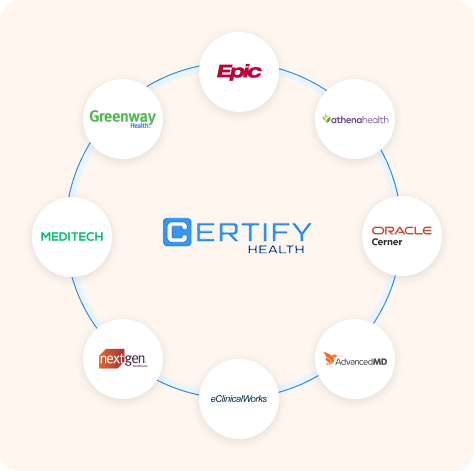
The platform integrates with leading U.S. hospital EHR systems such as Epic, Oracle Health (Cerner), and MEDITECH, along with widely used ambulatory and practice management platforms including athenahealth, eClinicalWorks, NextGen Healthcare, AdvancedMD, Greenway Health, DrChrono, Practice Fusion, and Kareo/Tebra.
It also connects with dental systems such as Dentrix, Open Dental, Eaglesoft, and Curve Dental; and behavioral health platforms including Netsmart, Qualifacts, Valant, Credible, and Welligent.
As flexible EHR integration software, CERTIFY Health also supports custom connectivity for proprietary or in-house systems. Most integrations go live within four to eight weeks, with CERTIFY Health’s team managing all configuration and data mapping.
How does CERTIFY Health achieve interoperability with Epic, Oracle Health (Cerner), and other major EHR providers?
CERTIFY Health functions as a true healthcare interoperability platform, using industry-standard data exchange protocols — primarily FHIR and HL7 — to enable secure, bidirectional communication between systems.
For Epic, it connects through Epic’s published app and data exchange frameworks.
For Oracle Health (Cerner), the platform integrates through Cerner’s REST-based API framework.
These connections provide both systems with real-time access to shared data including patient demographics, scheduling records, and encounter information.
CERTIFY Health operates alongside existing EHR systems as an interoperability and workflow platform, helping automate scheduling, intake, billing, and payment processes while continuously syncing patient data with the clinical record. Staff no longer have to re-enter or move patient information between disconnected systems.
What is the difference between an EHR system and an interoperability platform like CERTIFY Health?
An EHR is a clinical database where physicians document visits, record diagnoses, manage prescriptions, and store patient medical histories.
Unlike traditional platforms, CERTIFY Health functions as a connected workflow and patient engagement solution built to unify interoperability across healthcare systems. It handles everything surrounding the clinical encounter — online scheduling, digital intake, insurance verification, billing, and patient payments — and exchanges data with the EHR automatically via FHIR and HL7.
With EHR system interoperability, information entered in one platform automatically syncs across connected systems without the need for manual data entry.
The EHR stores the clinical record; CERTIFY Health manages everything that gets the patient to the appointment and settles the bill — making both tools necessary parts of a modern practice.
How many EHR and practice management systems does CERTIFY Health support through its integrations?
CERTIFY Health integrates with 234+ EHR and practice management systems worldwide, including hospital, ambulatory, dental, behavioral health, and international healthcare platforms.
On the practice management side, the platform integrates with major systems such as athenahealth, NextGen Healthcare, and AdvancedMD to support two-way data exchange across scheduling, billing, insurance eligibility, and patient intake workflows.
Custom integration support is available for proprietary or legacy systems.
Beyond EHR and PMS integrations, CERTIFY Health also connects with lab and diagnostic systems including LIS and RIS/PACS platforms, eliminating data silos. Most integrations go live within four to eight weeks, with CERTIFY Health’s team managing FHIR configuration, data mapping, and workflow setup throughout the process.
Can CERTIFY Health integrate with ambulatory EHR systems like athenahealth, NextGen, and AdvancedMD?
Yes — CERTIFY Health supports ambulatory EHR integration with all three systems directly.
For athenahealth, it syncs patient records, streamlines check-in, and connects billing and payment workflows.
With NextGen Healthcare, it combines clinical and administrative data, enables digital intake, and automates scheduling.
For AdvancedMD, bidirectional data exchange supports patient authentication, automated insurance verification, and streamlined intake.
Across all deployments, CERTIFY Health works alongside the existing ambulatory EHR as a workflow and patient engagement platform, extending current capabilities instead of requiring a full system replacement. This approach to ambulatory EHR integration means practices can improve patient experience and front-office efficiency without overhauling their current clinical systems.