
Table of Contents
Key Takeaways:
- Front-end issues drive nearly half of all denials, and registration/eligibility errors are the single largest piece, the part real-time verification is built to catch.
- Urgent care centers face a harder denial problem than most specialties because walk-in patients leave no pre-visit window to spot lapsed coverage, plan changes, or incorrect policy IDs.
- When insurance eligibility verification is built into the check-in workflow, claims go out clean the first time, shortening A/R cycles, reducing billing rework, and eliminating the surprise bills that drive patients away.
A recent JUCM report found that many urgent care centers face problems because of mistakes made at the front desk. These errors commonly happen when staff register patients, verify insurance, or enter billing information.
This results in delayed reimbursement, repetitive tasks leading to staff burnout, and poor patient experience, all of which hit your bottom line.
Proper insurance eligibility verification at check-in is the one fix that sits right at the source. It detects the incorrect data in real time, before the patient even enters the exam room, and prevents it from turning into a rejected claim, a billing dispute, or a write-off.
Revenue cycle teams are increasingly shifting their focus from recovering denied claims to preventing denials before claims are ever submitted. Insurance eligibility verification remains one of the most effective first-line defenses in that shift, but it delivers the greatest impact when combined with accurate documentation, coding, prior authorization, and payer-specific workflows.
The impact can be big. HFMA research shows that most claim denials can be avoided. Many of them happen because of mistakes made when patient or insurance information is entered at the start of the visit.
Urgent care centers are not just dealing with the same denial problem as everyone else. They are dealing with a harder version of it, and the fix is hiding in the first two minutes of every patient visit.
Denial Prevention Starts Before Claim Submission
Eligibility verification is the front door, but it isn’t the whole house. Clean claims depend on a chain of upstream processes working together: insurance eligibility verification, prior authorization, accurate patient demographics, complete clinical documentation, correct coding, and adherence to payer-specific requirements. Miss any one link, and the claim can still come back denied, even if coverage was verified correctly at check-in.
For urgent care centers specifically, eligibility verification is the highest-leverage piece because it happens first and catches the largest share of front-end errors. But treating it as the entire denial prevention strategy leaves gaps that show up later in the billing cycle.
Why Urgent Care Is More Vulnerable Than Most Specialties
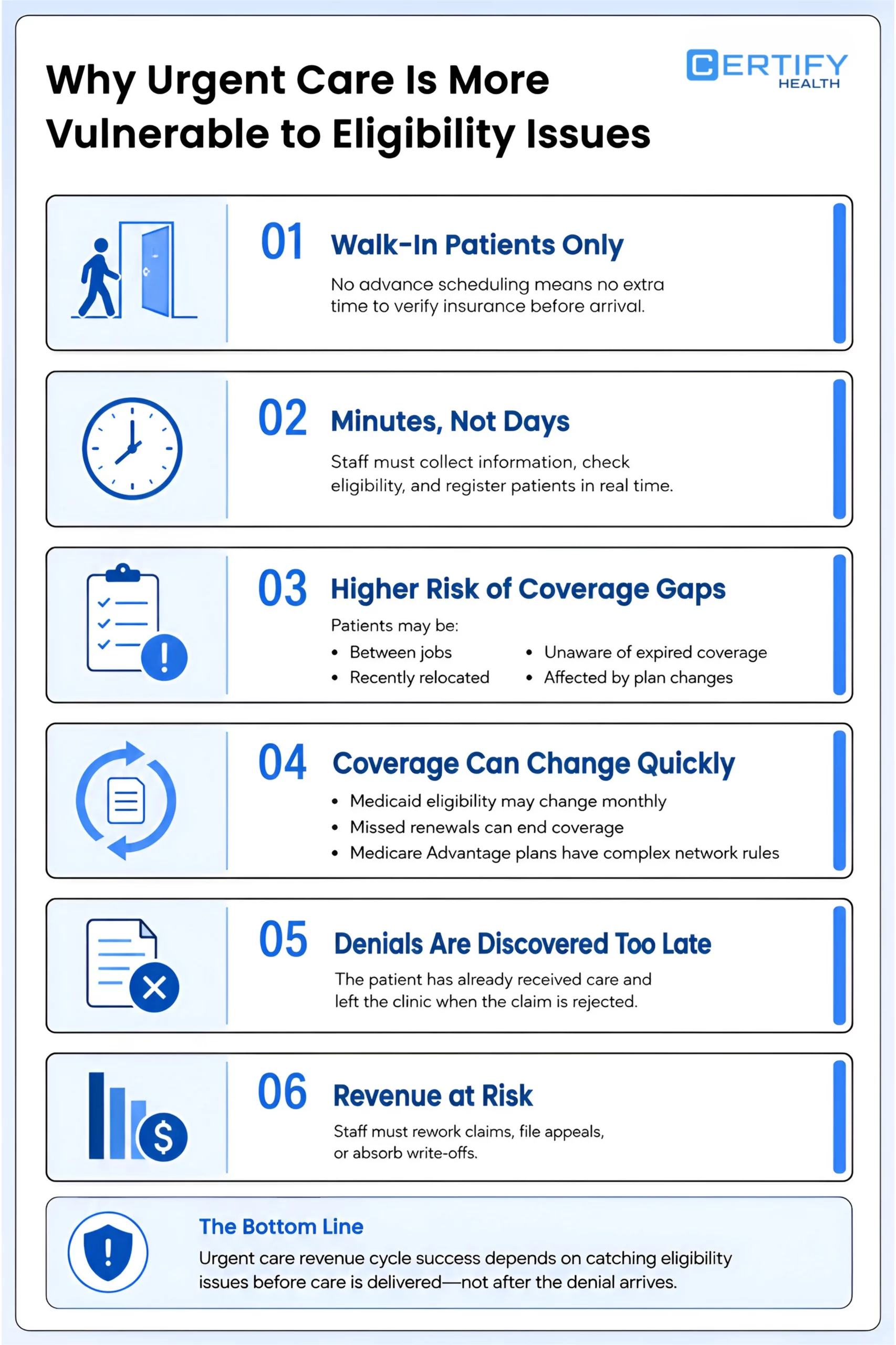
Most doctors’ offices schedule appointments in advance. That gives staff an extra day to verify insurance eligibility, spot any mismatches, and fix problems before the patient walks in.
Urgent care doesn’t have that advantage. You know it very well: your patient walks in unannounced, and the staff member has very little time to collect information, verify insurance, and get the patient moving.
No pre-visit scheduling window, no time to chase an insurance card photo, and no chance to call the payer before care is delivered.
That creates a unique vulnerability. Urgent care patients are also more likely to have coverage gaps than people visiting a primary care doctor.
Think about who comes to an urgent care clinic, people between jobs, people who recently moved, people who haven’t checked their coverage in months. Insurance lapses from job transitions, missed premium payments, or plan changes are common. The patient believes they are covered. The front desk assumes they are covered. Nevertheless, the claim is rejected.
Coverage gaps are only part of the challenge. Medicaid can change from month to month. If a patient misses a renewal or their income changes, they may lose coverage. A patient who had insurance last week may not be covered today. Medicare Advantage can also be difficult because each plan has different networks and covered services. Front desk staff often do not have enough time to check these details when patients walk in.
And by the time that denial comes back from the payer, the patient is long gone. You can’t go back and ask them to update their information at the time of service. You are stuck reworking the claim, appealing the denial, or absorbing the loss.
Urgent care revenue cycle management depends on catching these issues before care is delivered, not afterwards.
The Front-End Denial Chain: How One Small Error Becomes a Big Problem
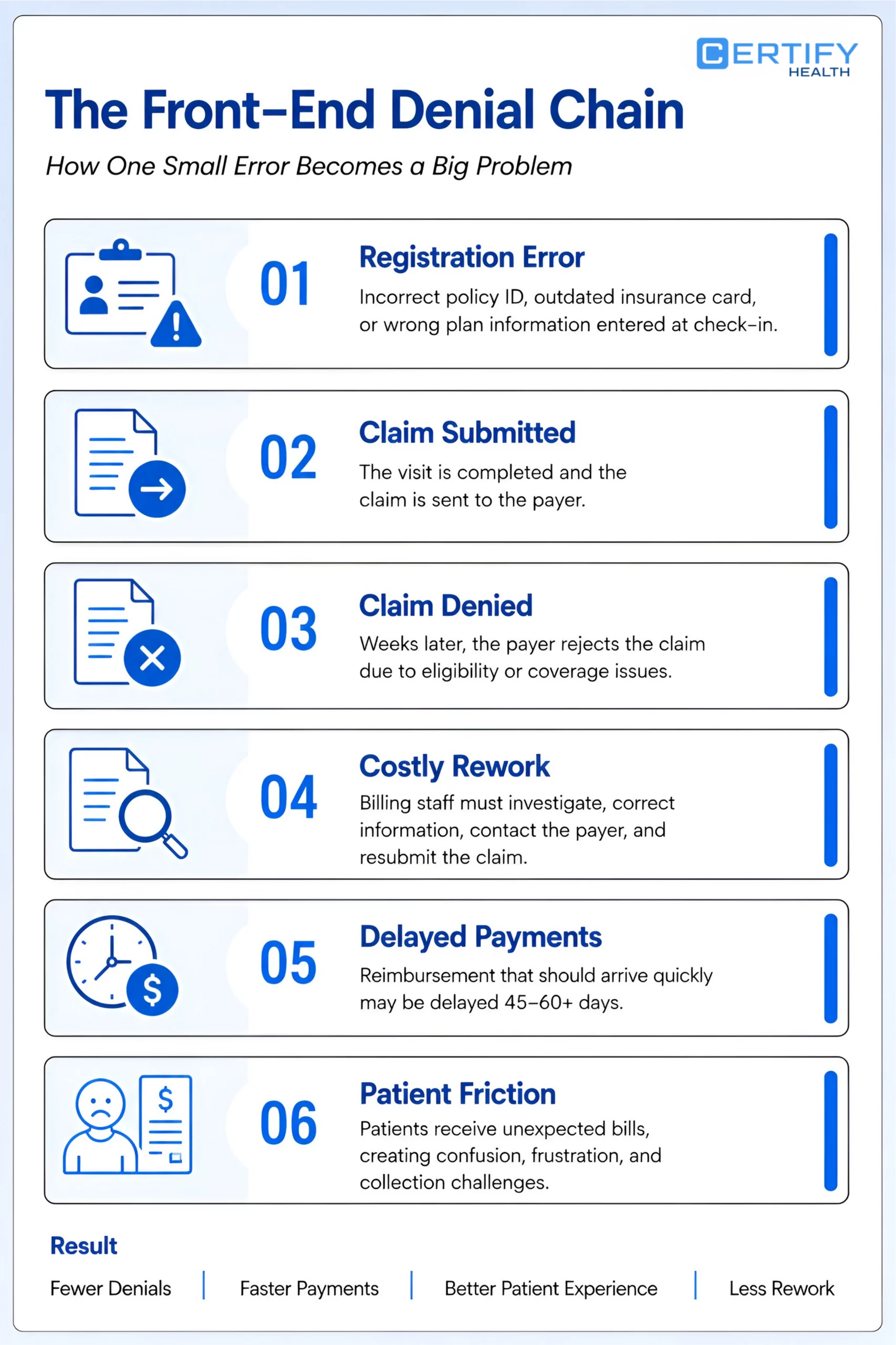
Let’s understand what happens when eligibility verification is done manually or skipped altogether.
A patient walks in. The front desk collects their insurance card. Staff type the policy ID into the system, but one digit is wrong, or the plan has changed since the card was printed. The visit happens. The claim goes out.
Three weeks later, the payer rejects the claim. Maybe the policy was terminated two months ago. Maybe the plan ID was wrong. Maybe the patient switched employers, and their new insurance requires a different billing code.
Now your billing team has to investigate. They pull the claim, contact the payer, research what happened, correct the information, and resubmit it. That process costs time.
According to research, the administrative cost to rework a single denied claim is nearly $25 for practices and $181 for hospitals. Now, multiply across dozens of denials a month.
If an urgent care center has to fix 100 denied claims every month, even a small drop in denials can save a lot of time and money. Staff can spend less time fixing mistakes and more time helping patients.
Meanwhile, your accounts receivable clock is running. That reimbursement that should have arrived in two weeks is now 45 to 60 days out, if it comes at all.
The second problem is that most urgent care operators don’t think about: the patient experience. After a few weeks, patients receive unexpected expenses. They believed it was covered by their insurance.
Now they are confused, and even angry. Collecting from patients after the fact is harder, slower, and damages the relationship you rely on to bring them back.
The entire chain: the rework, the delay, the billing friction, starts from a registration error that could have been caught in 10 seconds at check-in.
A 10-second insurance check can save weeks of payment delays.
Checking insurance before the visit helps catch problems early. CERTIFY Health verifies coverage in real time, helping urgent care teams reduce claim denials, get paid faster, and avoid surprise bills for patients.
What Real-Time Insurance Eligibility Verification Changes for Urgent Care
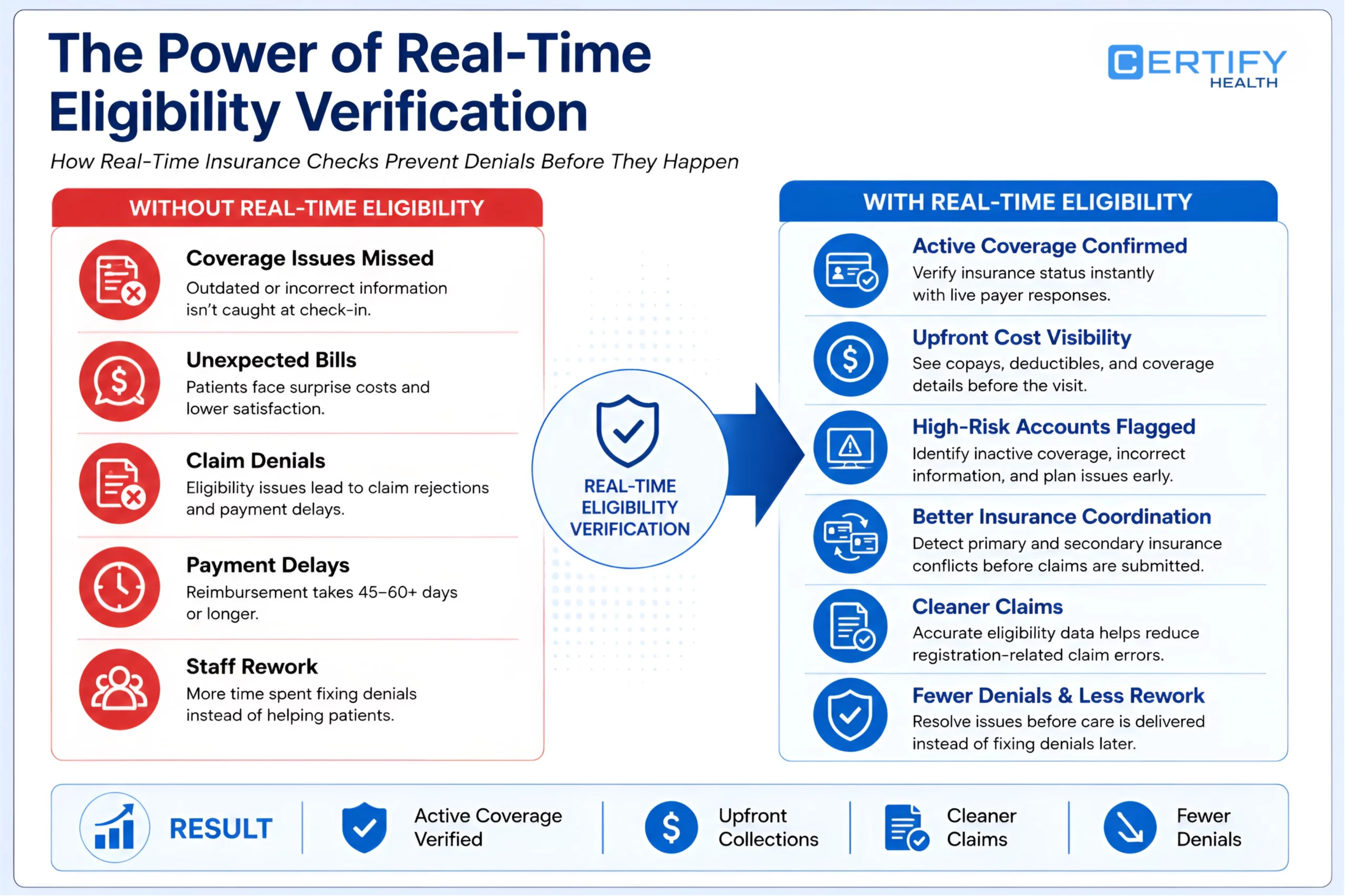
Checking insurance in real time is not a new idea. But many healthcare practices still do not use it as part of their daily workflow.
An HFMA survey found that only about 4 out of 10 healthcare practices use automated insurance checks. With more claims being denied, practices need better tools to find problems early, save staff time, and help patients avoid billing surprises.
Here is what changes when you run real-time eligibility verification at check-in instead of relying on manual checks or batch processes run overnight:
- Staff know immediately whether coverage is active. Not active as of last month, active right now. The system pings the payer directly and returns a live status.
- Copays, deductibles, and exclusions are visible before the patient sees a provider. The front desk can tell a patient exactly what they owe before care starts. That means collections at the time of service, which is far more effective than billing after the fact.
- High-risk registrations get flagged before the visit happens. The system helps staff find insurance problems before the patient arrives. Insurance may no longer be active, information may be wrong, or the plan may not cover the visit. Staff can talk with the patient early, update the information, and explain any costs ahead of time.
- Correct Insurance Order Matters. Real-time verification also finds coordination of benefits issues that manual checks often miss. When a patient has two insurance plans, billing the wrong primary plan can cause a denial, just like an expired policy.
- The claim goes out clean. Because the data used to build the claim is accurate from the start.
It’s worth being precise about what eligibility verification actually fixes. Real-time checks are highly effective at catching inactive coverage, incorrect payer information, coordination of benefits issues, and coverage limitations, the errors that originate at the front desk. They are not designed to catch authorization denials, medical necessity denials, coding denials, or documentation deficiencies, which depend on separate workflows further down the revenue cycle. Knowing the difference helps practices invest in the right fix for the right problem, rather than expecting one tool to solve every category of denial.
CERTIFY Health helps urgent care staff check a patient’s insurance during check-in. Staff can see if the insurance is active and what the plan covers before the visit starts. This helps catch problems early and reduces the chance of denied claims later.
This is the difference between reactive urgent care billing and denial prevention that actually works.
Clean Claims Begin at Patient Intake
Real-time eligibility checks work best when they’re part of a broader intake process, not a standalone step bolted onto check-in. Front-office teams contribute to denial prevention well beyond the insurance check itself, by confirming patient demographics, collecting referrals when a visit requires one, validating that prior authorizations are on file, and capturing complete, accurate patient information at the first point of contact.
When digital intake handles these tasks together, rather than as separate manual steps, the data feeding into the claim is consistent from the moment the patient walks in. That consistency is what actually produces a clean claim, eligibility verification alone can flag a coverage problem, but it can’t fix a missing referral or an incomplete demographic field. Those need to be caught in the same intake workflow.
What Changes for Your Team Once Verification Runs Smoothly
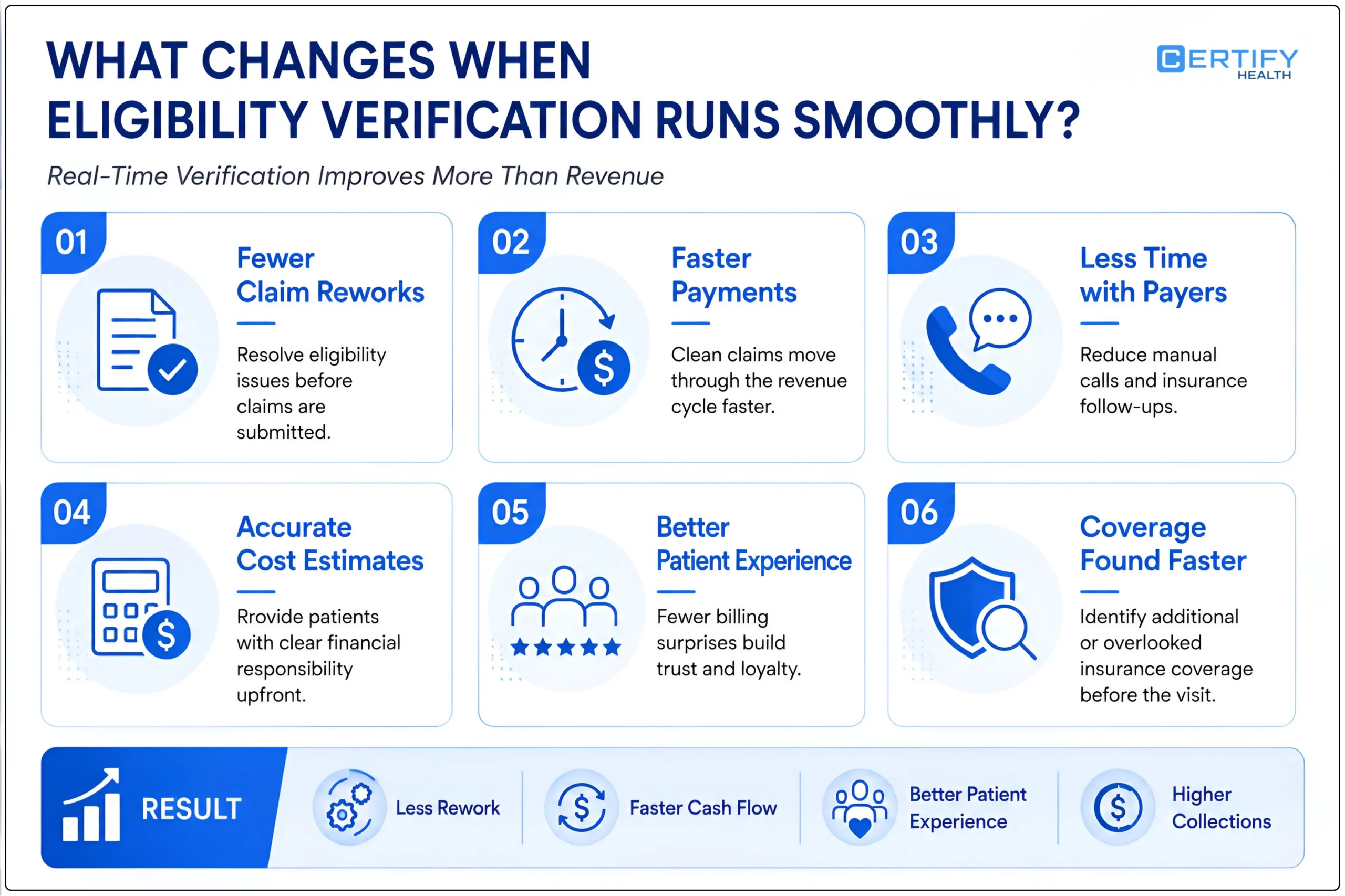
The benefits of accurate insurance eligibility verification go beyond revenue. It also improves how your team operates every day.
Fewer Claim Reworks
The billing team no longer has to call the payer and resubmit the claim when they get information right on the first go. Instead, staff members may use that time to assist patients.
Shorter A/R Cycles
Clean claims get paid faster. When your denial rate drops, your cash flow becomes more predictable. You are not waiting 60 days on claims that should have cleared in two weeks.
Less Time on Hold with Payers
Manual insurance eligibility verification in urgent care looks like this – staff calling payers and waiting on hold. Real-time eligibility verification software eliminates the need to make those calls entirely as it directly connects with the payer’s portal.
Patients Leave with Accurate Cost Estimates
When patients know their financial responsibilities upfront, they are more likely to pay their bills. And they are less likely to dispute a bill they already agreed to at the desk.
There is another advantage that often gets overlooked: patient experience. Patients are more likely to seek care elsewhere after receiving an unexpected bill. When patients know their costs before the visit, there are fewer surprises later. Patients become comfortable and loyal to a practice when they are given clear information about copays and coverage.
When the Check Returns No Active Coverage
Not every insurance check comes back with active coverage. When there is no active insurance, the front desk has two choices. They can make the visit self-pay and collect money before care is given, or they can run an insurance search to find other coverage the patient may have.
This can include a spouse’s work plan, an active Medicaid plan, or insurance from a recent job the patient forgot about. For patients between jobs or moving to a new area, this helps find coverage that would otherwise be missed and lost.
A common question from operations directors is whether insurance eligibility verification software needs to replace the existing PMS or sit alongside it.
The honest answer: it depends on what you are currently using. Tools that integrate directly into practice management software workflows create the least friction as staff don’t have to switch between systems or re-enter data. Standalone real-time eligibility software requires staff to enter information by hand from one system to another. This can not only slow them down but create errors.
Verification should occur seamlessly during intake and check-in workflows, eliminating the need for staff to remember a separate step.
CERTIFY Health works with the tools your practice already uses. When patient information is updated in one place, it updates everywhere. This saves time for your staff and helps prevent mistakes from typing the same information again.
What to Look for in an Insurance Eligibility Verification Solution
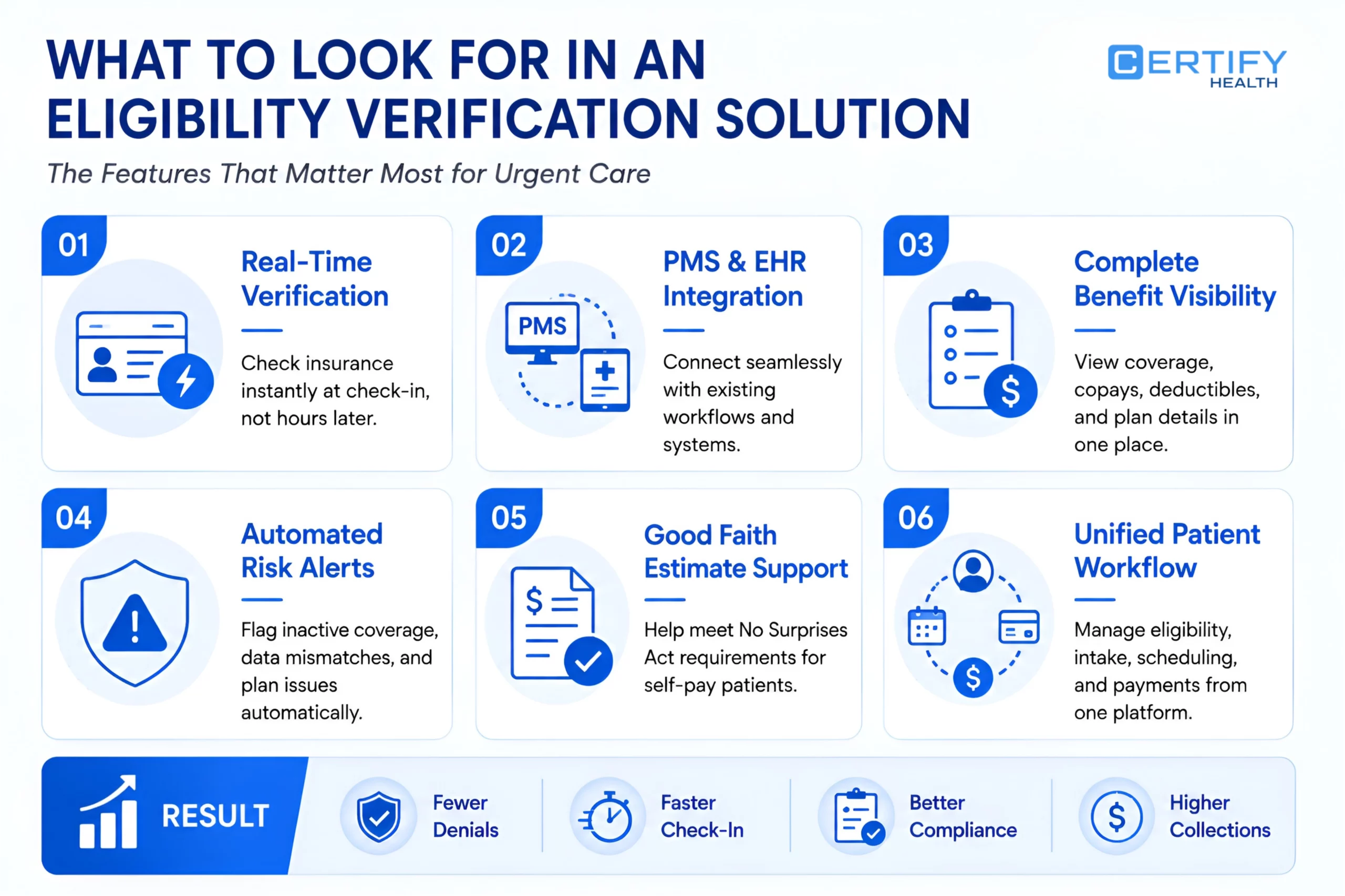
Not all insurance eligibility verification software works the same way. If you are choosing software for your urgent care center or walk-in clinic, these are the features that matter most:
Real-time Payer Connectivity, Not Batch Processing
Batch checks are done overnight or at off-peak times, meaning by the time a patient checks in, the data may be hours old. Real-time means the check runs at the check-in.
Easy Connection With Your Existing Software
If front desk staff have to open another system to check insurance, they may skip the step. Integration makes it automatic and frictionless.
Benefit Details, Not Just Active/Inactive Status
Making sure a patient’s insurance is active is the first thing to check. Staff must also be aware of the copay, the remaining deductible, and whether the visit is covered by the plan. When staff can see all this information in one place, they can work faster and make fewer mistakes.
Automated Flagging of Registration Risks
The system should tell staff when there is a problem. Problems like patient insurance may have ended; data mismatch, or the plan may not cover the service they need. Finding these issues before the visit can help avoid billing problems and denied claims later.
No Surprises Act / Good Faith Estimate Support
Under the No Surprises Act, doctors must give patients without insurance or self-pay patients an estimate of costs before care. When a check shows no active insurance, this estimate should be created right away.
Connecting insurance checks with cost estimates helps the center follow the rules and avoids penalties & extra work for staff.
CERTIFY Health brings insurance checks, patient payments, online intake forms, and scheduling together in one place.
The same platform also supports digital intake, prior authorization tracking, payer-specific workflow rules, and documentation consistency, so eligibility verification works alongside the other pieces of denial prevention instead of standing in for them.
CERTIFY Health brings insurance checks, patient payments, online intake forms, and scheduling together in one place. This helps staff catch problems early and keep patient information accurate from start to finish.
Building a Proactive Denial Prevention Strategy
Insurance eligibility verification is the starting point, but a genuinely proactive denial prevention strategy extends further. Practices that consistently see lower denial rates tend to follow the same core checklist:
- Verify eligibility before every visit.
- Confirm prior authorization requirements.
- Capture complete patient demographics.
- Standardize clinical documentation.
- Apply payer-specific billing rules.
- Review coding before claim submission.
- Monitor denial trends for continuous improvement.
None of these steps replace eligibility verification, they build on it. Together, they shift the front office from reacting to denials after the fact to preventing them before a claim is ever submitted.
Frequently Asked Questions
What is insurance eligibility verification?
Why does eligibility verification matter for urgent care specifically?
Urgent care centers often see walk-in patients. Because there is no scheduled visit, staff have little time to find insurance problems. Without an insurance check at check-in, these problems may not be found until a claim is denied.
What causes most eligibility-related denials?
Common problems include wrong policy numbers, inactive insurance, changes to the insurance plan, or incorrect patient information. Most of these issues can be found during registration with a quick insurance check.
How can real-time insurance checks help prevent claim denials?
When insurance is checked before the visit, staff can fix problems early. This helps prevent claim denials and billing issues later.
What are batch and real-time insurance checks?
Batch verification checks insurance at a set time, often overnight. Real-time verification checks insurance when the patient arrives, so staff see the most current information.
Can eligibility verification software integrate with our PMS?
Yes. Most insurance verification tools work with practice management and EHR systems. This allows staff to check insurance without leaving their normal workflow.
Does eligibility verification improve the patient experience?
Yes. When patients know what they may owe before the visit, there are fewer billing surprises. This helps build trust and makes it easier to collect payments.
Does eligibility verification replace prior authorization?
No. An insurance check only shows if a patient’s insurance is active and what it will pay for. Some treatments need extra approval from the insurance company before care can be given. This approval is a separate step. Even if the insurance check is complete, your staff may still need to get approval before treatment.
Fix the Front Door, Fix the Denial Rate
Urgent care denial prevention is not something that happens in the back office. It happens the moment a patient steps up to your registration desk.
The good news is that many of the claim and billing issues affecting urgent care revenue cycle management can be reduced by improving eligibility verification at the front end. Small changes can improve your billing process without a major overhaul. You need accurate insurance data at the point of care, and the right insurance eligibility verification process to get it.
When you verify coverage in real time, clean claims go out the first time. Your A/R shortens. Your billing team can focus less on rework and more on getting claims paid. Instead of facing an unexpected charge after their visit, patients know exactly what they owe before they walk out the door.
Insurance eligibility verification done right is not just a revenue protection tool. It is a patient experience improvement hiding inside your billing workflow.
It’s most effective as part of a bigger picture. Eligibility verification is one of the earliest opportunities to prevent revenue loss, but it works best paired with accurate documentation, coding, authorization management, and standardized front-end workflows. Practices that invest in prevention rather than recovery reduce administrative burden, improve first-pass claim acceptance, and get reimbursed faster.
Reduce your denial rate and clean up your front-end registration process.
See how CERTIFY Health’s Eligibility & Coverage feature can help your urgent care center verify coverage in seconds, before the patient ever reaches the exam room.