

Table of Contents
Key takeaways:
- Payment readiness begins with accurate eligibility, coding, and streamlined billing workflows.
- Small workflow gaps increase denials, aging A/R, and revenue leakage over time.
- Payment-ready practices use automation, visibility, and transparency to improve collections efficiently.
- Modern patient payment options and clear, compliant cost estimates are just as much a part of payment readiness as back-office billing accuracy.
One in five privately insured Americans experienced an insurance denial for doctor-recommended care in the past year. For healthcare organizations, that denial is not just a patient experience problem; it can become a revenue problem, creating delays, administrative work, and unexpected payment challenges.
In 2026, denials are still rising, prior authorization requirements are becoming more complex, and payment pressure is not slowing down. A missed eligibility check, incomplete authorization, inaccurate patient information, or delayed payment conversation can quickly turn into lost revenue.
Healthcare payment readiness means your practice collects the right amount, from the right payer or patient, at the right time, with as little friction as possible. This is the foundation of payment-ready healthcare systems in 2026. And this guide gives you a practical way to identify where your workflows stand today.
This isn’t a sales pitch; it’s a clear checklist of warning signs that can help you uncover revenue leaks before they grow. This guide is built for teams focused on revenue cycle management, medical billing services, claim denial management, and healthcare billing automation.
What Payment-Ready Actually Means for Practices
Payment-ready is not just about sending claims. It means your full medical billing workflow works smoothly from check-in to final payment. It also means your team can keep up with eligibility verification, prior authorization, medical coding updates, and patient payment collection without a pileup of delays.
In 2026, that matters more than ever because payer rules keep changing. Practices also have to deal with payment integrity healthcare checks, stricter prior authorization rules, and more pressure to improve revenue cycle optimization. If the process breaks in one place, the whole payment path slows down.
That is why being payment-ready is really about control. It means your team can move claims, collect faster, and reduce avoidable errors before they hurt cash flow. It also means your practice can respond faster when healthcare payments get delayed or denied.
The 11 Signs Your Practice is Not Payment-Ready
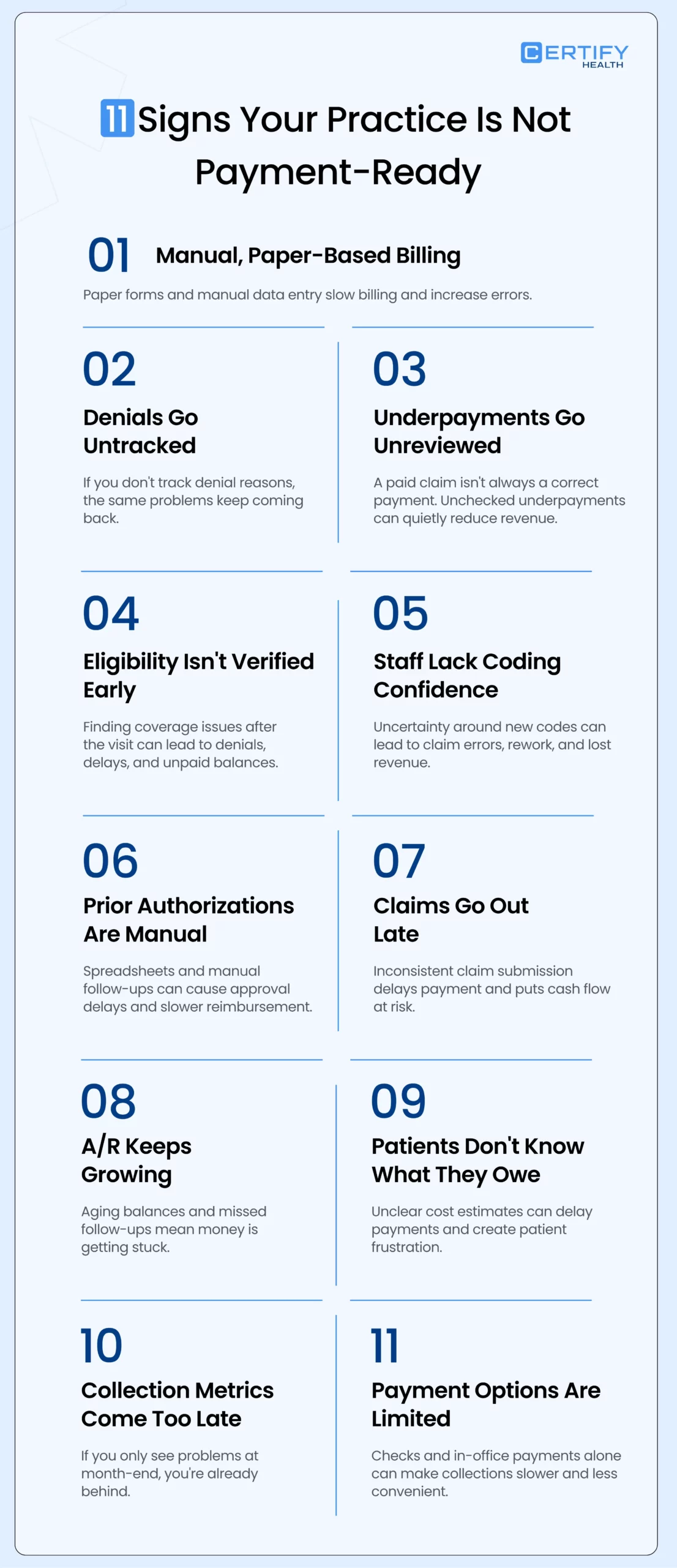
1. You Are Still Running Manual, Paper-Based Billing Workflows
If your team still depends on paper forms, faxing, or a lot of hand entry, that is a major warning sign. Manual work slows down every step of the medical billing workflow and makes it easier for errors to slip through.
This kind of setup also makes healthcare billing automation harder to use later. When staff members have to copy the same information more than once, delays and mistakes become normal. That can lead to missed claims, slower collections, and weaker payment integrity healthcare performance.
Manual systems also make it harder to keep up with prior authorization and eligibility verification. In 2026, that can leave your practice behind while faster offices keep moving. If your process still leans on paper, your practice is probably not payment-ready.
Pro Tip:
CERTIFY Health helps practices replace disconnected manual processes with digital registration, intake, scheduling, and insurance workflows that reduce administrative burden and improve data accuracy before billing begins.
2. Denials Go Untracked and Unreviewed
If claims are denied and the team just works them without looking for patterns, you are missing the real problem. Claim denial management only works when you know the reason behind each denial and what caused it in the first place.
That is where medical claims denial data becomes useful. Without it, your staff may fix the same issue over and over again without stopping it at the source. Denial management in healthcare should help your team learn, not just react.
When no one tracks denial reasons, the practice loses both time and money. It also becomes harder to improve revenue cycle optimization because the same errors keep coming back. Healthcare payment-ready processes always include clear denial tracking.
Pro Tip:
CERTIFY Health helps practices improve upstream data quality by capturing accurate patient insurance, and demographic information earlier in the workflow, reducing preventable issues that contribute to claim delays.
3. Underpayments and Downcoding Go Unreviewed
Some practices stop there and forget that a claim can be paid and still be paid wrong. If underpayments and downcoding go unreviewed, money can quietly leak out of the practice, especially as medical coding updates change how services should be billed. Those small losses may not look big at first, but over time they add up and hurt accounts receivable healthcare results.
A strong review process is an essential part of payment integrity healthcare. It helps your team identify errors, correct them, and protect revenue. Without regular reviews, healthcare payment issues can remain hidden for months.
Pro Tip:
CERTIFY Health brings billing, claims, and financial reporting into one workflow, giving practices better visibility into reimbursement trends so they can spot underpayments, investigate payment discrepancies, and protect revenue.
4. Eligibility Is Not Verified Before the Visit
If the team finds out about coverage problems after the visit, the practice is already behind. Eligibility verification should happen early, before services are delivered. That helps reduce surprises and keeps patient payment collection more predictable.
When eligibility is skipped, the practice may end up with denied claims, unpaid balances, or confused patients. It also creates extra work for staff, who then have to chase down missing insurance details later. That is not a healthy medical billing workflow.
Strong eligibility verification supports better healthcare payments from the start. It also helps the practice feel more payment-ready because fewer claims get delayed for preventable reasons. This one step can save time, reduce stress, and improve collection rates.
Pro Tip:
CERTIFY Health supports digital registration and eligibility workflows that help practices verify insurance information earlier and reduce avoidable billing issues.
5. Staff Cannot Confidently Apply New Codes
If your team is unsure about new or changing codes, that is a sign of risk. Medical coding updates affect how claims are built, and even small mistakes can lead to denials or slower payment. In 2026, this is especially important because coding rules keep shifting.
When staff are not trained well, they may avoid using the right code or use the wrong one out of caution. That hurts healthcare payment performance and may lead to underbilling or rework. It also puts more pressure on denial management in healthcare.
Your practice should not depend on guesswork. Coding confidence is part of being payment-ready, because accurate coding helps claims move faster and supports better revenue cycle management medical billing services.
Pro Tip:
Accurate coding is only one part of clean claim submission. CERTIFY Health helps practices streamline billing workflows by connecting patient and billing data, applying payer-specific rules, and identifying potential claim issues before submission, helping teams reduce avoidable rejections and delays.
6. Prior Authorizations Are Tracked Manually or Reactively
Prior authorization is one of the biggest bottlenecks in healthcare billing. If your practice tracks it on sticky notes, spreadsheets, or memory, you are at risk of delays. Prior authorization automation can help, but only if the process is watched closely.
A reactive process means the team follows up only after something goes wrong. That often leads to late approvals, postponed care, and slower reimbursement. In turn, this makes healthcare payment more unpredictable.
If your team is not watching turnaround times, it becomes harder to meet payer timelines. Prior authorization should be part of the daily workflow, not something checked only when a patient calls. This is one of the clearest signs a practice is not payment-ready.
Pro Tip:
With prior authorization capabilities built into its workflow, CERTIFY Health helps practices track authorization requests, monitor status updates, and reduce delays caused by manual follow-ups and disconnected processes.
7. Claims Are Submitted Late or Inconsistently
Late claims create an easy problem that turns into a bigger one. If claims are not sent on time, the practice waits longer for payment and may miss follow-up windows. That hurts cash flow and makes accounts receivable healthcare harder to manage.
Inconsistent claim submission also makes the process harder to trust. One day the claims go out fast, and the next day they sit unfinished. That kind of pattern usually signals a weak medical billing workflow.
A payment-ready practice keeps claims moving in a steady way. That supports healthcare payments, improves follow-up speed, and reduces the chance of avoidable delays. It is a simple habit, but it has a big revenue impact.
Pro Tip:
CERTIFY Health supports faster, more consistent claims submission by automating claim generation, validating claim data, and flagging errors before claims are sent to payers.
8. Outstanding A/R Continues to Grow While Follow-ups Fall Behind
When accounts receivable keep aging, it usually means the practice is losing control somewhere. Maybe claims were denied, maybe they were never followed up on, or maybe the team is just too busy. Either way, accounts receivable healthcare should not keep growing without a clear reason.
Late follow-up is costly because the longer a claim sits, the harder it can be to collect. Some balances become harder to recover, especially if the team does not act quickly. That slows down healthcare payment and can hurt revenue cycle optimization.
A strong practice reviews A/R often and acts on it fast. It knows where money is stuck and what needs attention first. That is one of the most important signs of being payment-ready.
Pro Tip:
CERTIFY Health helps practices reduce aged A/R with Text-to-Pay, automated payment reminders, and digital payment links that make it easier for patients to pay outstanding balances promptly.
9. Patients Don't Get Clear, Compliant Cost Estimates
If patients do not understand what they owe, collections become harder. Confusion around estimates, copays, and final balances can lead to frustration and delayed patient payment collection. It can also hurt trust, which matters a lot in healthcare.
This is where better healthcare payments communication makes a real difference, and where compliance comes in. Under the No Surprises Act, most uninsured and self-pay patients are entitled to a Good Faith Estimate of expected charges before a scheduled service.
If your practice cannot reliably produce a compliant, itemized estimate before care, that is a payment-readiness gap, not just a communication one.
Pro Tip:
CERTIFY Health gives practices real-time insurance verification tools to discuss expected patient costs, including Good Faith Estimate-ready figures, before care begins, helping patients know what to expect financially instead of being surprised after the visit.
10. Your Collection Metrics Are Always a Step Behind
If your team has to wait until the end of the month to see what happened, that is too late. A practice that is payment-ready needs visibility now, not later. Real-time data helps leaders see whether healthcare payment is on track or slipping.
Without real-time reporting, revenue issues like denials, delayed payments, and collection gaps often go unnoticed until they impact cash flow.
This is where revenue cycle optimization makes a real difference. A clear dashboard helps your team make better choices every day. If you cannot see the numbers in real time, it is hard to stay payment-ready.
Pro Tip:
CERTIFY Health brings billing and revenue cycle data into one dashboard, so practice leaders can see key metrics in real time instead of waiting for month-end reports.
11. Your Practice Doesn't Offer Modern Patient Payment Options
Back-office accuracy only gets you halfway to being payment-ready. If patients can only pay by mailed check or an in-office card swipe, the practice is leaving money on the table. In 2026, patients expect card-on-file, digital wallets, text-to-pay links, online payment portals, and manageable payment plans for larger balances.
Without these options, upfront and point-of-service collection suffers: staff have fewer ways to collect copays and patient responsibility at the time of service, and post-visit balances are more likely to age into the A/R problem described above.
Manual payment methods, such as paper records or manually entering card details, can increase PCI compliance and data security risks. Using secure digital payment tools helps protect sensitive payment information while streamlining the payment process.
A practice that offers flexible, secure, self-service payment options collects faster, reduces staff workload, and gives patients a better experience.
Pro Tip:
CERTIFY Pay lets patients pay how they prefer. Collect payments securely with card-on-file, digital wallets, or Text-to-Pay using a PCI-compliant platform that streamlines upfront collections and payment plans.
Why This Adds Up to Bigger Losses in 2026
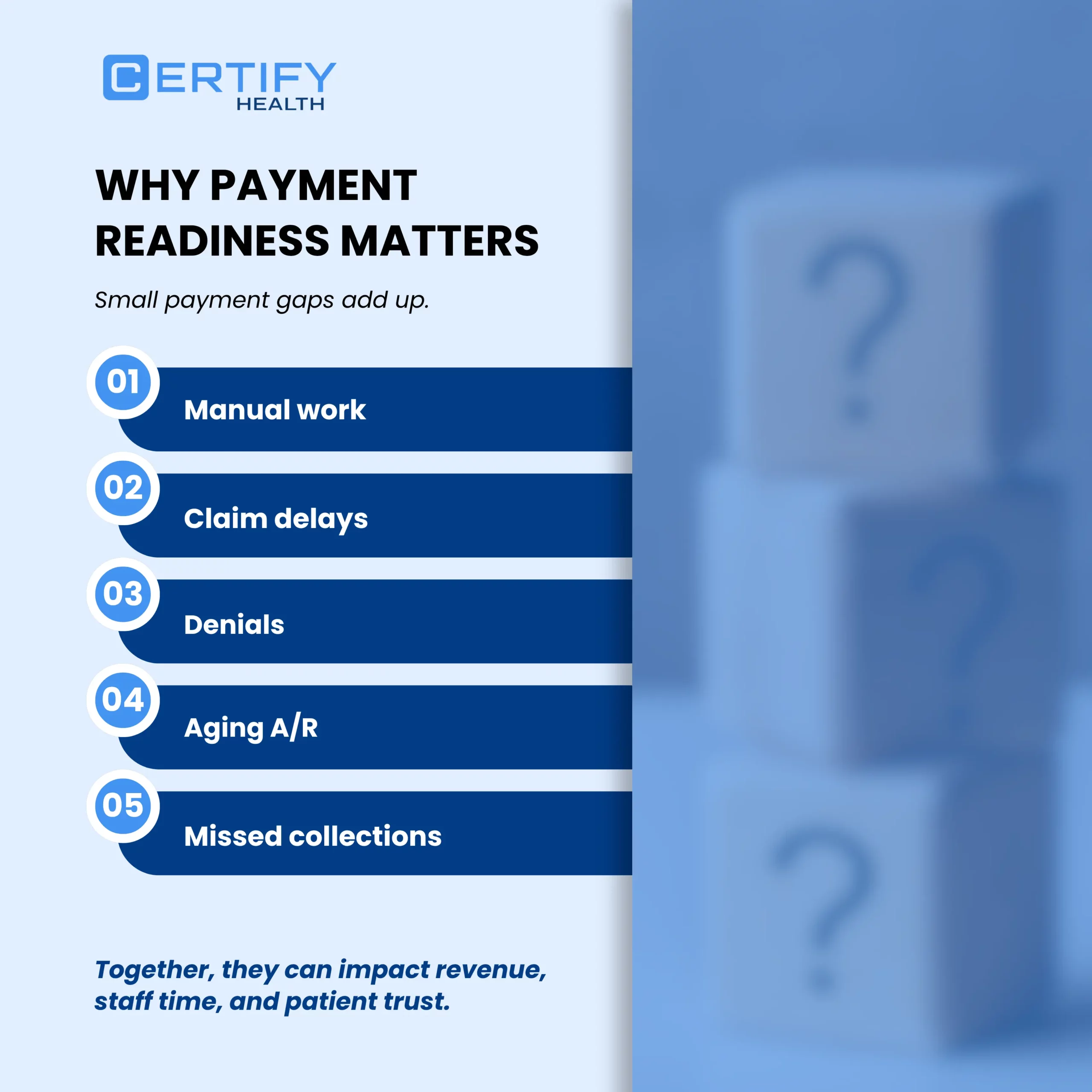
These signs do not stay small for long. One delay leads to another, and soon the whole process starts to drag. With tighter payer scrutiny, rising denial volumes, more prior authorization pressure, and changing healthcare payment rules, the old way of managing revenue cycle work is no longer enough.
A practice may think one missed verification or one late claim is not a big deal. But in 2026, small issues stack up fast. Add in medical coding updates, payment integrity healthcare reviews, and growing use of healthcare billing automation across the industry, and the gap between strong and weak performers gets wider.
That is why this is not just a billing problem. It is a business problem. If your team waits too long to fix the process, the losses can spread across collections, staff time, and patient trust.
Self-Check, Is Your Practice Payment-Ready?
Use this quick check. Answer yes or no.
- Do you still rely on paper or manual billing steps?
- Do denials and underpayments go untracked or unreviewed?
- Is eligibility often skipped or verified late, after the visit instead of before it?
- Is your staff unsure how to confidently apply new or updated codes?
- Are prior authorizations tracked manually or only after a problem comes up?
- Are claims submitted late or inconsistently?
- Is your aged A/R growing without regular, timely follow-up?
- Are patients often confused about estimates or balances, or do you lack Good Faith Estimates?
- Are your collection metrics always a step behind, instead of visible in real time?
- Does your practice lack modern patient payment options like card-on-file, digital wallets, or Text-to-Pay?
- Do patients still have limited ways to pay, such as only by check or in-office card payments?
If your practice answered “yes” to at least three questions, now is a good time to assess your payment readiness strategy. If you answered “yes” to five or more questions, you may have revenue cycle problems that need attention.
What Payment-Ready Practices Do Differently
Payment-ready practices do not wait for problems to pile up. They use eligibility verification early, track denial management in healthcare with clear reasons, and keep a close eye on prior authorization. They also use healthcare billing automation where it helps most, especially in high-volume steps.
They do not rely on hope. They use revenue cycle optimization to find weak spots, then fix them with better training and better systems. They also pay attention to accounts receivable healthcare, patient payment collection, and medical billing workflow issues before they become bigger losses.
Most of all, they treat healthcare payment like a system, not a surprise, with the patient-facing side incorporating flexible payment methods and compliant, upfront estimates just as much as clean claims. This is what helps practices stay financially stable, even as payer rules change. A truly payment-ready practice works with more confidence and less chaos.
FAQ
What does payment-ready mean for a medical practice?
What are the most common reasons medical claims get denied in 2026?
The most common problems usually include missing eligibility verification, prior authorization issues, coding errors, and incomplete claim details. Weak claim denial management can also make the same mistakes happen again.
How does the 2026 CMS prior authorization rule affect billing timelines?
The CMS Interoperability and Prior Authorization Final Rule (CMS-0057-F) took effect on January 1, 2026, for most non-technical requirements. Impacted payers, such as Medicare Advantage plans, state Medicaid and CHIP programs, Medicaid managed care plans, and QHP issuers on the federal exchanges (with some exceptions), must now send prior authorization decisions within 72 hours for expedited requests and 7 calendar days for standard requests, and must provide a specific reason for any denial.
How often should a practice audit its revenue cycle?
A practice should review revenue cycle performance often, not just once a year. Monthly checks are helpful, and high-volume practices may need even more frequent review to stay payment-ready.
As a next step, book a free billing or RCM assessment to see where your practice may be losing time or money.