

Table of Contents
Every fall, dental practices pull lists of patients with unused dental benefits and start sending reminders. The intent is good, and the underlying reason is real: unused benefits are forfeited value for the patient and forfeited revenue for the practice. But the sequence practices default to is often backward.
A benefit reminder gets sent before anyone confirms the patient still has active coverage. It goes out before staff know what benefit information is actually available, whether the patient has remaining applicable benefits, or what plan year applies. It goes out before anyone checks whether the practice can even seat the patient before the year ends.
The result shows up in November and December: patients who call confused about what they actually owe, a front desk trying to explain why a text promised something the schedule cannot deliver, and staff estimating costs off information that is already out of date.
Outreach without verification can create more operational problems than it solves. This article lays out the operational sequence that comes before the reminder: segment, verify, check capacity, communicate accurately, estimate responsibility, prepare for payment, and handle the exceptions that come up along the way.
1. Why Late September Is the Planning Window
Verifying eligibility and benefits takes real staff time per patient, and that time does not shrink because the calendar gets tighter. Capacity review and list segmentation also take time, and unclear or outdated patient records need to be resolved before anyone contacts them. Starting this workflow in late September gives the front office room to work through that volume before outreach and scheduling pressure both peak at once.
2. Segment the Patient List and Open Treatment Plans
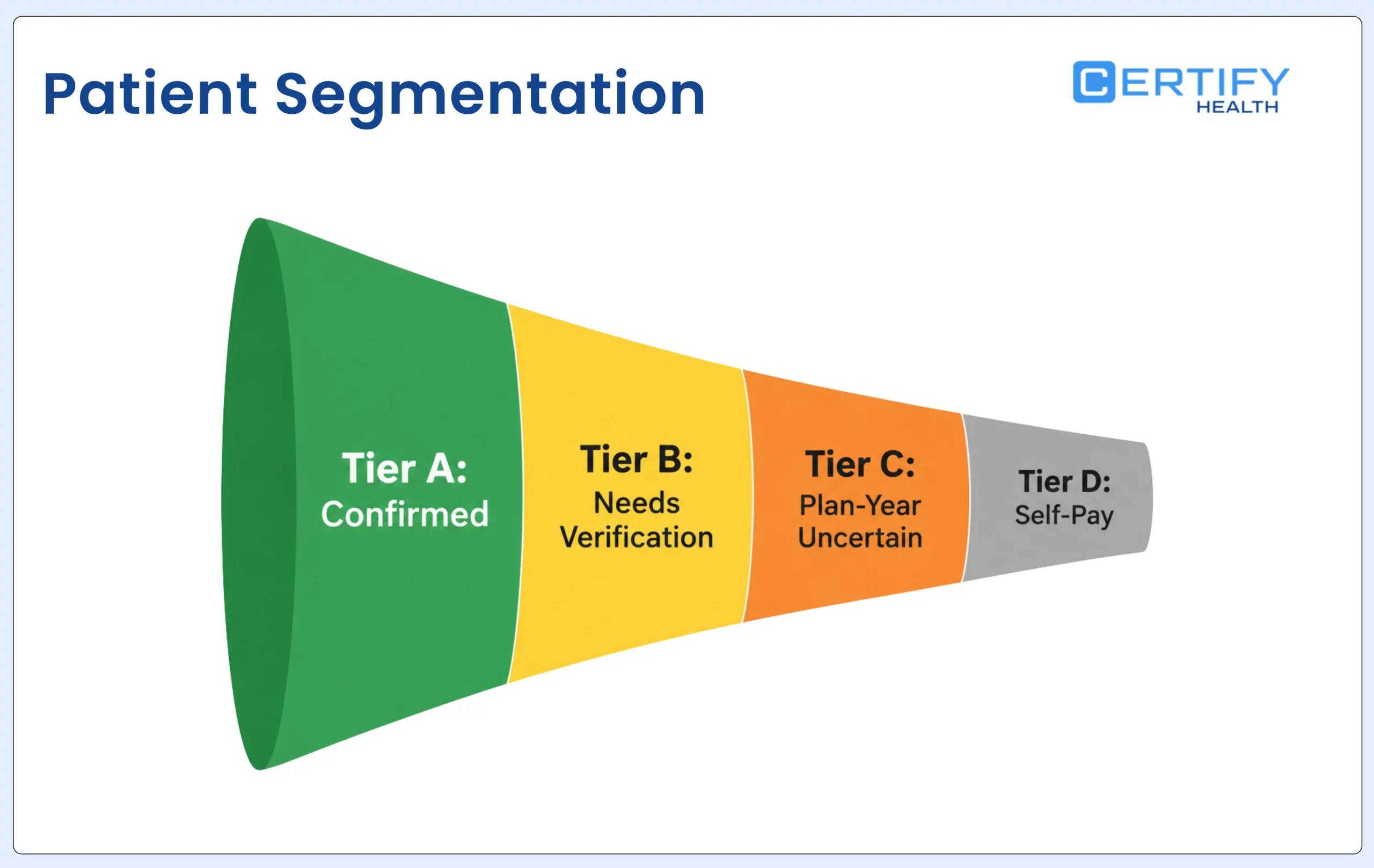
Before any patient receives a message about their dental benefits, the practice needs a patient list sorted by what is actually known, not just by who has an open treatment plan.
A simple three-tier structure works well for this.
Tier A: Confirmed Active Coverage
These are patients whose coverage has been checked and appears active as of a recent verification. They move forward to a benefit review, a check against treatment and capacity, and appropriately worded outreach.
Tier B: Unconfirmed, Needs Verification
Coverage or benefit information is incomplete or has not been checked recently enough to rely on. These patients need verification before they are added to the active outreach population. Nothing about their benefits should be represented as confirmed yet.
Tier C: Plan-Year Uncertain
The practice does not have a clear read on whether the patient’s plan follows a calendar year or a different plan year. These patients need that question answered before anyone assumes a January reset or a December deadline applies to them.
Tier D: Self-Pay or Uninsured
These patients do not have active dental insurance coverage identified, but they should not be excluded from the year-end treatment workflow. They may still have open treatment plans or care that needs to be scheduled before year-end.
For these patients, the practice should focus on the treatment plan, expected patient responsibility, and available payment options rather than insurance benefits. When required, the practice should also provide a Good Faith Estimate (GFE) before services are provided.
| Patient tier | What is known | Next action |
|---|---|---|
| Tier A: Confirmed active coverage | Coverage status confirmed | Continue benefit and treatment review |
| Tier B: Needs verification | Coverage or benefit information incomplete | Verify before outreach |
| Tier C: Plan year uncertain | Benefit cycle unclear | Confirm plan type and year first |
| Tier D: Self-pay or uninsured | No active insurance coverage identified | Review treatment needs, confirm expected patient cost, and provide a GFE when required |
The gate that matters here is simple: a patient should not enter the confirmed outreach population until the required verification step is complete. This is what separates a working segmentation process from a list export sorted by unscheduled treatment plans. Segmentation logic like this also protects the practice from sending a dental benefit reminder to someone whose coverage lapsed months ago.
3. Benefit-Cycle and Date-of-Service Caveats
This is the section that determines whether the rest of the workflow (and the practice’s read on the dental benefit cycle) holds up.
Dental eligibility should be confirmed as of the actual date of service, not assumed from a past check. The ADA eligibility verification guidance states plainly that:
- It is essential for dental offices to verify eligibility on the date of service, since plans can apply eligibility changes retroactively and practices can otherwise face recoupment.
- The same guidance warns that information pulled from a payer portal or call center may not be current, because an employer may not yet have told the plan about an employment or coverage change.
That single point rules out a common shortcut: reusing a verification from earlier in the year for year-end outreach.
It also means “benefits reset January 1” is not a rule the practice can apply across its whole patient list. Some plans run on a calendar year. Others run on a contract year tied to when the employer’s plan renews. Employer-specific plan designs can differ in what carries over, what resets, and when. That plan variability means the practice cannot know which applies to a given patient without checking.
Never Assume
- The plan follows a calendar year
- A previous verification is still current
- Active coverage means the same benefit level still applies
- Remaining benefits are unchanged
- A patient has the same plan information as their last visit
- The patient will still be on the same plan after January 1; open enrollment can change coverage before the new year begins
Every one of these needs a fresh check before it goes into a patient conversation. This is also the point where “confirmed active coverage” should be defined precisely inside the practice: it means coverage appeared active as of the date it was checked, not that every benefit detail underneath that coverage is locked in.
The same ADA guidance also recommends documenting the verification itself, not just the resulting estimate: a time-stamped portal screenshot, or the date, time, and name of the representative contacted, gives the practice something to point to if a claim is later disputed.
Coordination of Benefits and Dual Coverage
When a patient has coverage under two plans, the birthday rule (the plan of the parent whose birthday falls earlier in the calendar year is primary for dependent children) determines which one pays first, and a non-duplication provision can mean the secondary plan pays nothing beyond what the primary plan already covered. Ask about a second policy as part of verification, not after the estimate has already gone to the patient, since which plan is primary changes both the estimate and the deductible math.
Predetermination and Pre-Authorization
For crowns, periodontal treatment, and orthodontics, a predetermination or pre-authorization submitted to the payer can take several weeks to return. Submitted in November, it may not come back before the year closes, which affects whether the treatment can still be seated and billed against this year’s benefits. Build the expected turnaround into the schedule for these cases rather than treating predetermination as a step that happens in parallel.
4. Remaining Maximums, Frequency Limitations, Deductibles, and Waiting Periods
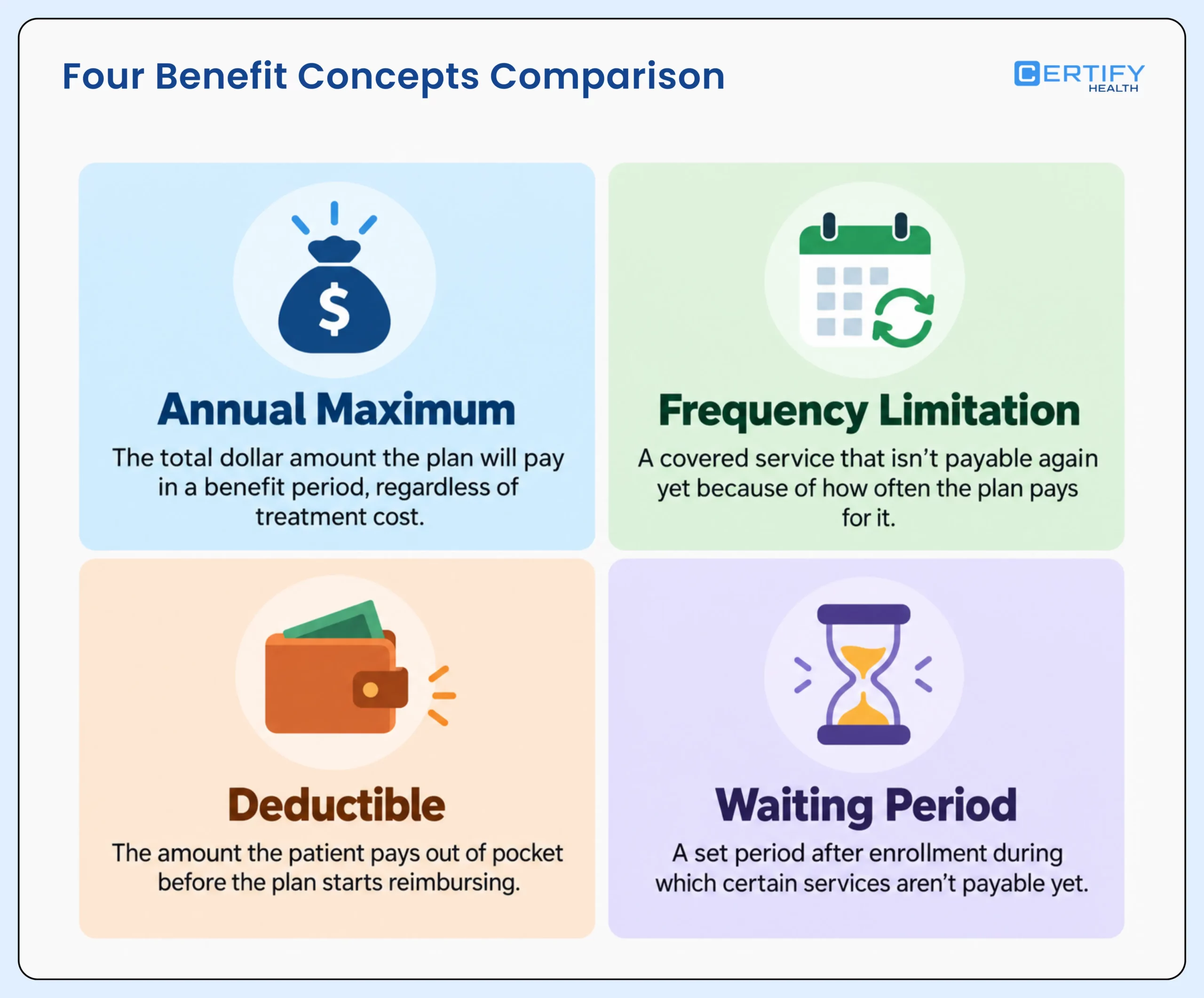
These four concepts get treated as one thing in a lot of front-office conversations. They are not the same, and mixing them up leads to inaccurate patient communication.
Annual Maximum
Many dental plans cap the dollar amount the plan will reimburse in a benefit period, regardless of what the total treatment cost is. The ADA describes this as a total annual maximum, which can be set on an individual or a family basis, and the plan will not reimburse beyond that amount even if the patient’s actual costs run higher. A practice should verify what remains of that maximum rather than assume the full amount is still available, since prior claims in the same benefit period reduce it. Orthodontic treatment usually runs against a separate lifetime maximum instead of the annual one, and that lifetime cap does not reset, a common source of patient confusion worth flagging separately.
Frequency Limitations
A service can be a covered benefit in concept and still not be payable on a given date because the plan limits how often it pays for that service. ADA guidance on noncovered services describes a “frequency limitation exceeded” outcome as one where the service is still a covered benefit in concept but is not payable again within the same period. Active coverage does not mean a specific service is payable today.
Deductibles
A deductible is the amount the patient pays out of pocket before the plan starts reimbursing, and it resets on whichever benefit-year date the plan runs on: for most plans that’s January 1, though not all. It is the single most common Q4 cost conversation there is. The same ADA guidance also lists “deductible not met” as a case where the plan would pay if the deductible were satisfied; the same diagnostic worth applying across all three: ask whether the service would be payable if the maximum hadn’t been hit, the waiting period were over, or the deductible were met. If yes, it’s covered but not currently payable, not truly noncovered. Many plans waive the deductible for preventive care, but not all, so confirm that per plan rather than assuming it.
Whether a patient with an unmet deductible should be treated now or encouraged to wait is patient-specific, not a general rule; it only makes sense to wait where a larger plan is already anticipated in the new year and nothing is clinically urgent. The verification data is what tells you which situation applies, and the FSA/HSA guidance in the payment section can point the same patient in the opposite direction, so lead with what’s actually been verified rather than a default answer.
Waiting Periods
Some plans hold back coverage for certain categories of service for a set period after enrollment, and this can apply to a new patient or someone who recently changed plans. The same ADA guidance describes a “waiting period in effect” outcome as one where the service category is covered but not payable until the waiting period ends.
Practices should also be clear about what a phone call or portal check can and cannot confirm. A front desk verification call may confirm that coverage appears active and may confirm some plan details, depending on payer and plan. Remaining maximum, deductible status, specific frequency history, and waiting period status may require the payer’s portal, benefit documents, or a look at prior claims and EOB history, and availability of that detail varies by payer. Staff should verify what a given payer’s portal or representative actually provides rather than assume every source gives the same level of detail.
Where does automation fit into this step?
The gap most practices hit here isn’t knowing that annual maximums, frequency limitations, deductibles, and waiting periods are four different things; it’s that pulling all four, per patient, per payer, for a whole Q4 outreach list is a lot of manual lookup for a front desk that is already stretched. This is the piece of the workflow that dental-specific eligibility verification tools are built to take on: real-time (or overnight batch) checks that return remaining annual maximum, deductible status, frequency history, waiting period status, and CDT coverage by category, tied to the patient record rather than a separate portal lookup.
CERTIFY Health’s dental insurance verification runs this check per patient, including primary and secondary coverage for patients with dual plans, so staff are working from current, payer-sourced detail rather than reconstructing it call by call. It doesn’t replace the segmentation or judgment calls this article walks through; it just removes the manual data-gathering underneath them.
See how CERTIFY Health’s dental insurance verification works
5. Capacity and Appointment Rules
A verified patient with real remaining benefits is still not ready for outreach until the practice confirms it actually has the capacity to seat them before the year ends.
The rule here is straightforward: do not promise a slot the practice does not have. Accurate scheduling means outreach volume needs to be matched against real provider availability, appointment types, operatory capacity, treatment duration, and location or provider constraints, alongside whatever the existing schedule already looks like for the rest of the quarter. Holiday closures, staff PTO, and the higher no-show rate practices typically see in late December all shrink real capacity below what the raw schedule shows, and are worth building into the plan explicitly rather than discovering in the moment.
This is where a patient waitlist system earns its place. Patients who clear verification but cannot be seated right away can move into a waitlist or short-notice list instead of getting a promised date the practice may not be able to keep. Cancellation recovery workflows can also help fill openings from this list as the quarter progresses.
The connection to segmentation matters more than the waitlist mechanics themselves. A patient should only move into the active outreach population once the practice has both a verified benefit picture and a realistic path to scheduling them. Sending accurate benefit information to a patient who then cannot get an appointment creates the same kind of frustration as sending inaccurate benefit information in the first place.
6. Communication Consent, Preferences, and Message Cadence
Outreach only works if it respects how a patient wants to be reached and what the practice actually confirmed about their coverage.
Before sending anything, confirm the patient’s communication preferences and get consent for the specific channel being used. A benefit reminder sent by text or autodialed call sits closer to marketing than to an appointment reminder under TCPA and the HIPAA marketing rules, so treat it with the same care as any other marketing message rather than folding it into routine appointment communication. Keep the cadence reasonable. Repeated messages across text, email, and phone can wear on a patient relationship if the content behind them has not changed.
The message should reflect what the practice actually confirmed. A generic line like “your benefits are expiring soon” applies to almost no one precisely, since plan years vary and remaining benefit amounts vary by patient. A message grounded in a real, current verification for that specific patient is more accurate and, in most cases, more effective.
7. Estimate and Patient-Responsibility Conversations
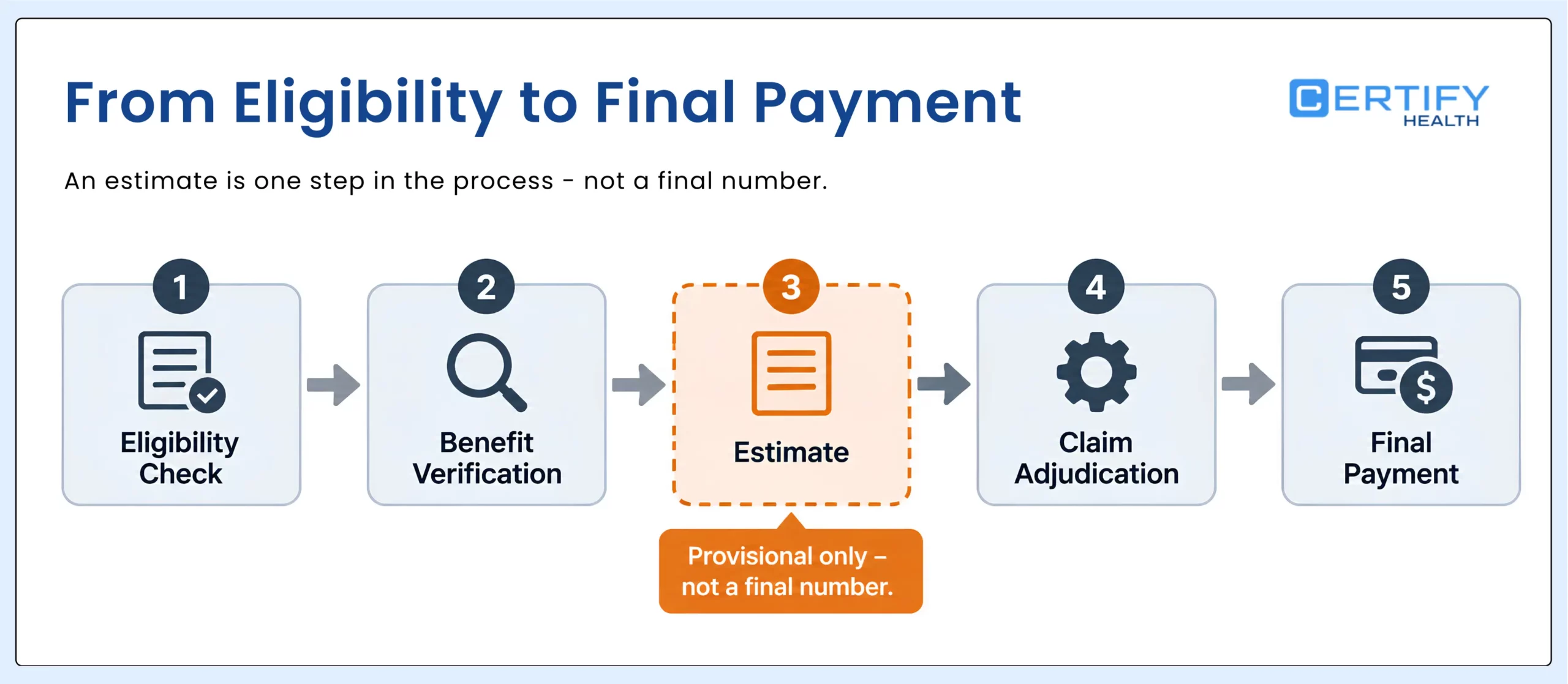
This is the part of the workflow where precise language matters most, because it is what the patient hears directly.
An estimate is an expected patient responsibility based on the treatment plan and the benefit information available at the time. A final payment is the amount actually determined after the payer processes and adjudicates the claim. These are not the same number, and they should never be presented as if they are.
Staff can speak with confidence about the estimate itself: “Based on the benefit information we have today, your estimated portion is $X.” That statement is accurate because it is scoped to what has actually been verified.
Staff should not say anything that implies a guaranteed outcome, such as “your insurance will definitely pay $X.” Eligibility verification confirms that coverage appeared active at the time it was checked. It does not guarantee that a specific claim will be paid at a specific amount; there is no guarantee of payment until the payer adjudicates the claim. Eligibility verification tells the practice coverage looks active, benefit verification adds detail about limitations and remaining amounts, an estimate applies that detail to a specific treatment plan, and adjudication is the payer’s final word once the claim is actually processed.
Estimates can and do change after that point. Claim processing can surface a frequency limit the practice did not have full history on, or apply an alternate benefit provision (downgrading a composite filling to the amalgam fee, or a posterior crown to a lower-cost alternative) that lowers the payable amount below what was estimated. A waiting period may apply that was not visible at verification. Plan coverage may have changed since the estimate was built, and a patient’s contracted fee changes if the practice, or the payer, changes network status between the estimate and the date of service. The payer may make a determination that differs from what the available information suggested. None of that means the original estimate was done carelessly: an estimate is, by definition, provisional until the payer adjudicates the claim.
Documenting the estimate, the date it was given, and the information it was based on protects both the practice and the patient if the final amount comes back different. If the adjudicated amount does come back different, a simple script travels well: “When we gave you that estimate, it was based on the best information we had at the time. Your plan came back with [detail], which changes the amount to $Y.”
8. Treatment That Spans Two Benefit Years
A crown started in December and seated in January, or a large treatment plan phased across two visits, can draw on two separate annual maximums instead of one, which changes the patient’s total out-of-pocket cost depending on how the work is split. Where the timeline allows it, walk the patient through both options and let them choose, rather than defaulting to whichever sequence is easier to schedule.
9. Payment Options and Collection Readiness
Once an estimate is in hand, the payment conversation should happen before treatment, not after.
Discuss the estimated responsibility with the patient ahead of the appointment. Where practice policy allows, collect an appropriate portion of that estimate at or before the visit. Offer the payment options the practice supports. Keep the distinction from Section 7 in the conversation the whole time: this is an estimate, and the final responsibility depends on how the claim adjudicates.
FSA and HSA Deadlines
Many patients are working against a use-it-or-lose-it FSA balance or an HSA they want to draw down before December 31, separately from whatever their dental plan’s own year-end deadline is: some FSAs offer a grace period or a small carryover instead of a hard cutoff, so the deadline that matters is the patient’s plan, not a general date. Asking whether a patient wants to use FSA or HSA funds before year-end is a natural part of this payment conversation and, for a patient who is otherwise ready to proceed, reinforces the case for treating soon (independent of, and sometimes in spite of, where their dental deductible stands).
10. Exceptions: When the Happy Path Breaks
Every Q4 workflow runs into cases that do not resolve cleanly. What separates a functioning front office from a struggling one is having a decision path ready for these, instead of improvising in front of the patient.
Scenario A: Benefit Details Cannot Be Confirmed Before the Appointment
Tell the patient plainly that coverage or benefit information could not be fully confirmed yet. Avoid promising a specific dollar amount. Whether the appointment proceeds depends on the practice’s own financial policy, since some practices will treat and estimate conservatively while others prefer to reschedule until verification clears. Flag the record clearly so front-desk and billing staff both know follow-up is still needed.
Scenario B: No Appointment Capacity Exists
Do not promise an appointment that does not exist yet. Place the patient into the practice’s waitlist or a follow-up queue instead, and keep their outreach status accurate so they are not treated as scheduled when they are not. Re-contact them if and when capacity opens up.
Scenario C: Coverage Changed Since the Previous Verification
Treat the earlier verification as no longer usable for decision-making. Reverify the patient’s current coverage and benefit information. Recalculate the estimate based on what is now confirmed. Update anything communicated to the patient before representing their benefits again, since the old numbers no longer apply.
11. Monthly Q4 Control List and KPI Dashboard
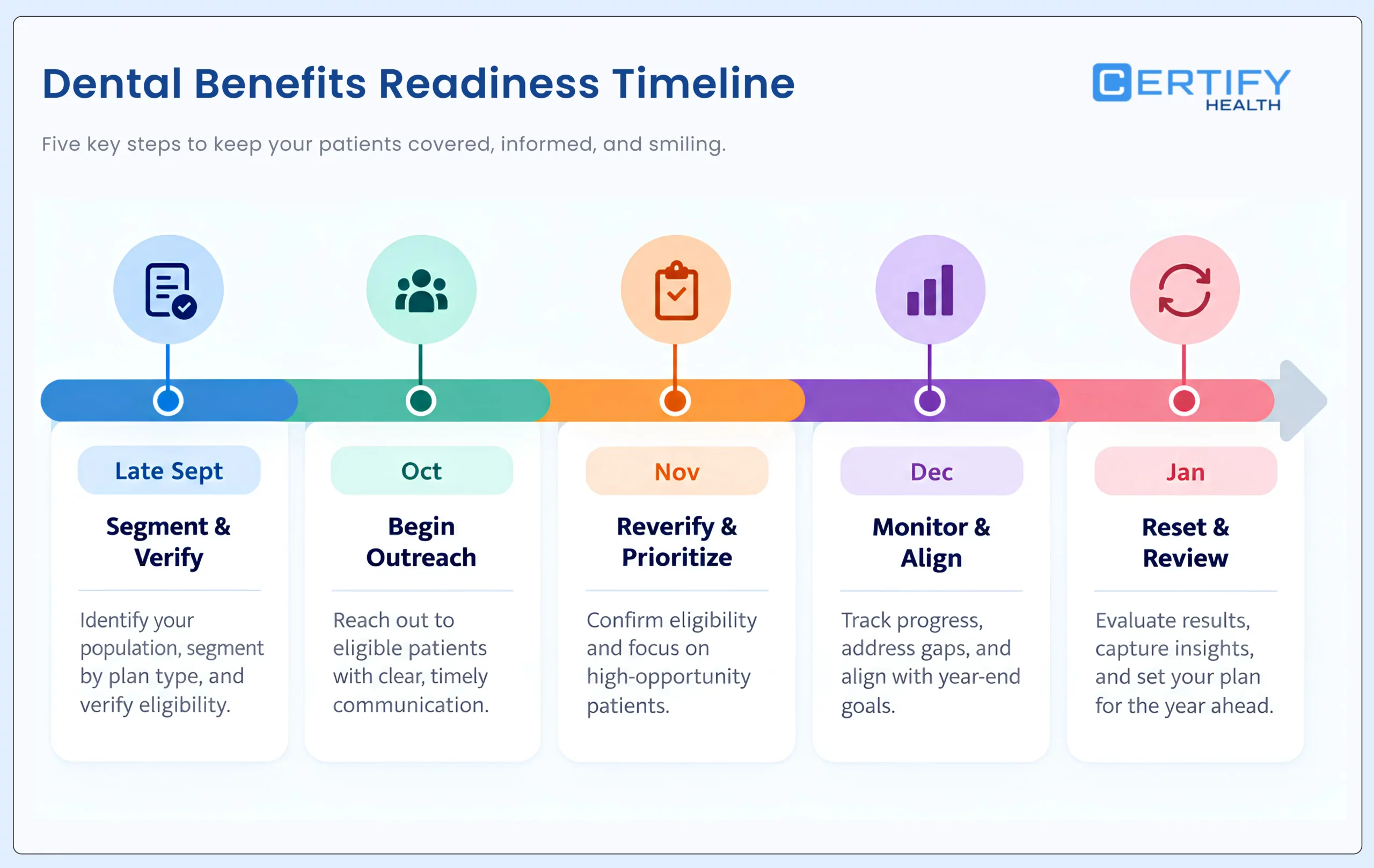
- Late September: Build the patient population, segment records into the four tiers, identify verification gaps, and review upcoming capacity by provider and location.
- October: Continue clearing the verification backlog, begin outreach to the confirmed tier, monitor responses and scheduling, and start resolving exceptions as they surface.
- November: Reverify anything that may have changed, manage capacity against demand, work the waitlist, and prioritize patients based on verified information and actual open appointment slots, not just urgency.
- December: Monitor remaining capacity closely, keep working exceptions, avoid over-promising as the calendar tightens, and keep every patient communication aligned with the most recent verification on file. Not every plan resets at year-end, so this is about closing out the quarter accurately, not chasing a universal deadline.
- January: Re-verify the confirmed population against new-year plan changes, reset tracking for the new benefit cycle, and run a short post-mortem on what worked and what didn’t in the quarter just closed.
Who Owns Each Step
Verification, outreach, estimates, and exception handling are usually different people in a practice, and naming that up front keeps records from stalling between steps. A common split: a front-desk or verification coordinator owns segmentation and verification, a scheduling coordinator owns outreach and capacity matching, clinical or financial coordinators own estimates, and a designated staff member (often the office manager or billing lead) owns exception follow-up so flagged records don’t sit untouched.
KPI Dashboard: Measuring Whether the Workflow Is Working
- Verification completion rate: percentage of the active outreach population with a current, documented verification
- Plan-year confirmation rate: percentage of patients with confirmed plan-year information on file
- Capacity-to-demand ratio: available appointment slots for the remaining weeks of the quarter compared to the confirmed outreach population size
- Exception rate: percentage of outreach records that required exception handling from Section 10
- Estimate-to-adjudicated variance: how far final claim payments land from the original estimate, on average
- Outreach-to-scheduled conversion rate: percentage of contacted patients who book an appointment
- Waitlist fill rate: percentage of waitlisted patients seated before quarter end
These measure whether the process itself is functioning, not whether the practice hit a revenue target. A high verification completion rate with a low exception rate is a sign the earlier steps in the sequence are doing their job. None of these metrics has a universal target: a practice’s own numbers from the previous one or two quarters make a more useful baseline than an industry figure, since payer mix and patient volume vary too much between practices for one target to fit all.
12. Q4 Dental Benefits Readiness Checklist
Download the Q4 Dental Benefits Readiness Checklist, a checklist your front desk can work from every week this quarter.
13. Compliance and Plan Caveats
Dental plan rules vary by payer, employer, and individual plan design, so nothing in this workflow should be treated as a universal rule for every patient. Eligibility verification confirms that coverage appeared active at the time it was checked. It does not guarantee that a claim will be paid. Estimates reflect the information available at the time and are not the same as a final, adjudicated amount. For self-pay and uninsured patients, a Good Faith Estimate under the No Surprises Act may also apply and should be handled under the practice’s own compliance guidance. This article is operational guidance for running a front-office workflow, not legal or insurance advice, and practices should confirm plan-specific details directly with each payer.
14. Review Your Q4 Patient-Access Workflow
The sequence in this article (verification, segmentation, capacity checking, accurate communication, and a real exception process) is what makes year-end outreach safe to send in the first place. If any one of those steps is missing or manual right now, that is a good place to start a workflow review before outreach volume increases.
A workflow like this runs on people, process, and the right tooling underneath it. If your team is doing the verification, segmentation, and capacity checks in this article largely by hand, CERTIFY Health’s patient access platform connects real-time dental eligibility verification, scheduling, and waitlist automation, so the sequence above happens inside your existing workflow instead of across separate manual steps.
Book a CERTIFY Health demo to see it against your own Q4 patient list.