
Table of Contents
Key Takeaways:
- Patient waitlist management software automatically recovers 6–10 last‑minute cancellations per week, turning gaps into revenue.
- ASAP lists use real‑time alerts and first‑come‑first‑served self‑scheduling to fill slots faster than manual phone‑down systems.
- Automated waitlist management boosts provider utilization, cuts staff time on calls, and improves patient access and satisfaction.
Introduction
Every day, healthcare practices lose money they will never get back, not from bad investments or poor staffing decisions, but from empty appointment slots.
In fact, no-shows quietly drain revenue. One study found an average 18.8% no-show rate, with losses reaching $14.58 million annually across clinics.
So how do practices recover that lost time and revenue?
Here’s what this blog covers: what an ASAP list is, how waitlist management software works, why it’s better than the old way of doing things, and how CERTIFY Health’s medical practice management platform handles it all, automatically.
The Hidden Cost of Appointment Cancellations
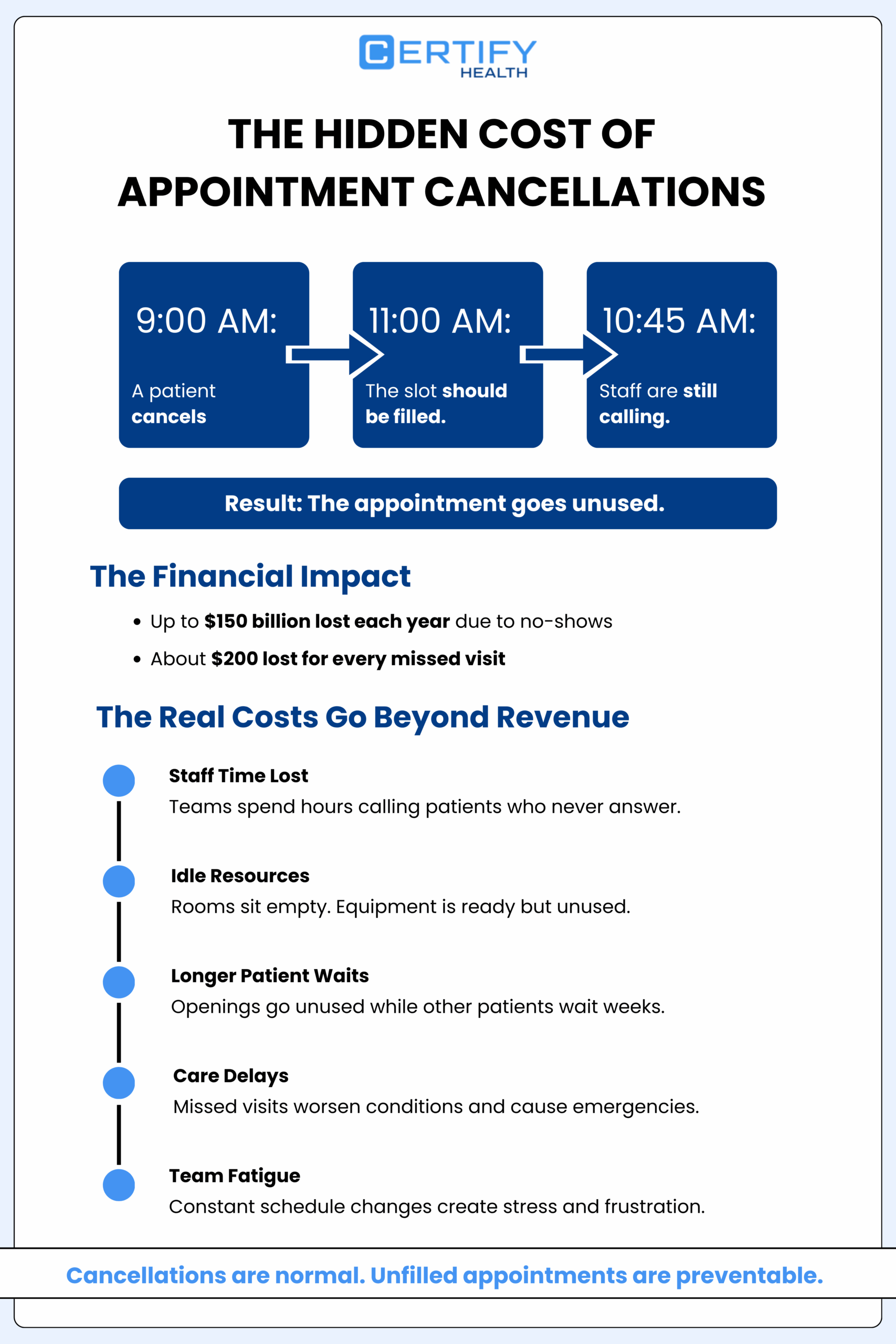
A patient calls at 9 AM and cancels their 11 AM slot. Your front desk team scrambles. They pull out the paper list, start dialing, leave voicemails, and wait. By the time someone confirms, it’s 10:45 AM. The slot is gone.
This happens dozens of times a week at busy practices. And while each cancellation feels minor in the moment, the financial damage is real.
Studies suggest that appointment cancellations and no-shows cost up to $150B annually. For individual providers, a single missed appointment can mean around $200 in lost revenue. High-volume clinics can lose up to $90,000 per year from gaps alone.
Financial loss isn’t the only consequence.
Here’s what appointment cancellations actually cost you:
- Wasted staff time. Your team spends hours making calls that go unanswered. That’s time not spent on patient care or front-desk efficiency.
- Unused resources. Exam rooms sit empty. Equipment is prepped but unused. The staff is ready but idle.
- Longer wait times for other patients. Ironically, while one slot sits empty, other patients are waiting weeks for an opening.
- Worse patient outcomes. Delayed care, especially in chronic disease management, leads to worse health results — and sometimes, unnecessary emergency visits.
- Staff burnout. Constant schedule disruptions wear your team down. It’s frustrating to prepare for a patient who never shows.
The problem isn’t that cancellations happen. They always will. The real problem is having no system to quickly recover those slots.
That’s where ASAP list software comes in.
What Is an ASAP Waitlist?
The term “ASAP” stands for “as soon as possible.” An ASAP list is a digital list of patients who’ve said: “If something open up sooner, I want it.”
It’s not a regular waitlist. A traditional waitlist is for patients waiting weeks or months for their first available slot.
An ASAP list is different, it’s built for speed. It’s designed to fill last-minute gaps created by cancellations, often the same day.
A patient is already scheduled for two weeks from now. But they’d love to come in sooner if a spot opens up. You put them on the ASAP list. When a cancellation happens, the system automatically alerts them. They book the open slot. Done.
No phone tag. No manual outreach. No scrambling.
The ASAP list concept is used in dental practices, primary care clinics, specialty care, hospital systems, and more. But it’s especially powerful in healthcare, where last-minute slot recovery directly impacts both revenue and patient booking rates.
Some common names for this concept: short-notice list, cancellation list, urgent appointment list, or “sooner if possible” list. Whatever you call it, the goal is the same, fill open slots fast, with the right patients, and with as little staff effort as possible.
How ASAP List Software Works
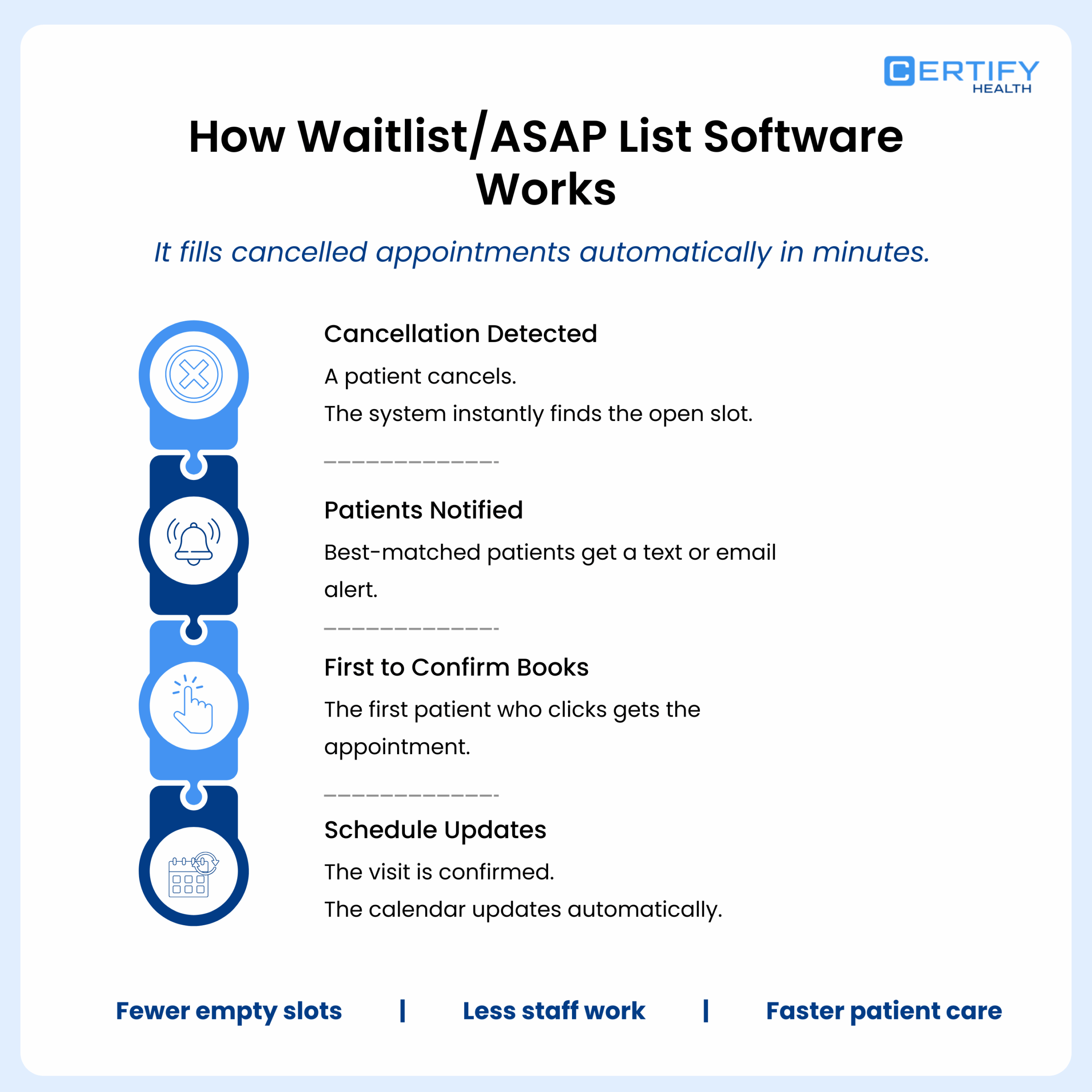
Modern waitlist management software doesn’t just maintain a list. It automates the entire process; from the moment a cancellation is detected to the moment a new patient is confirmed. Here’s a clear breakdown of how it works, one step at a time.
Cancellation Detection
The process starts the second a cancellation happens. In manual setups, a staff member has to notice the gap, log it, and then manually search for who to call. In automated setups, the software detects the open slot the moment it appears in the EHR or practice management system, no human trigger needed.
CERTIFY Health’s unified medical practice management software integrates directly with your existing EMR schedule. The moment a cancellation is logged, their ASAP list system recognizes the open slot and begins the process automatically.
Experience it Firsthand with a Demo
ASAP Patient Notification
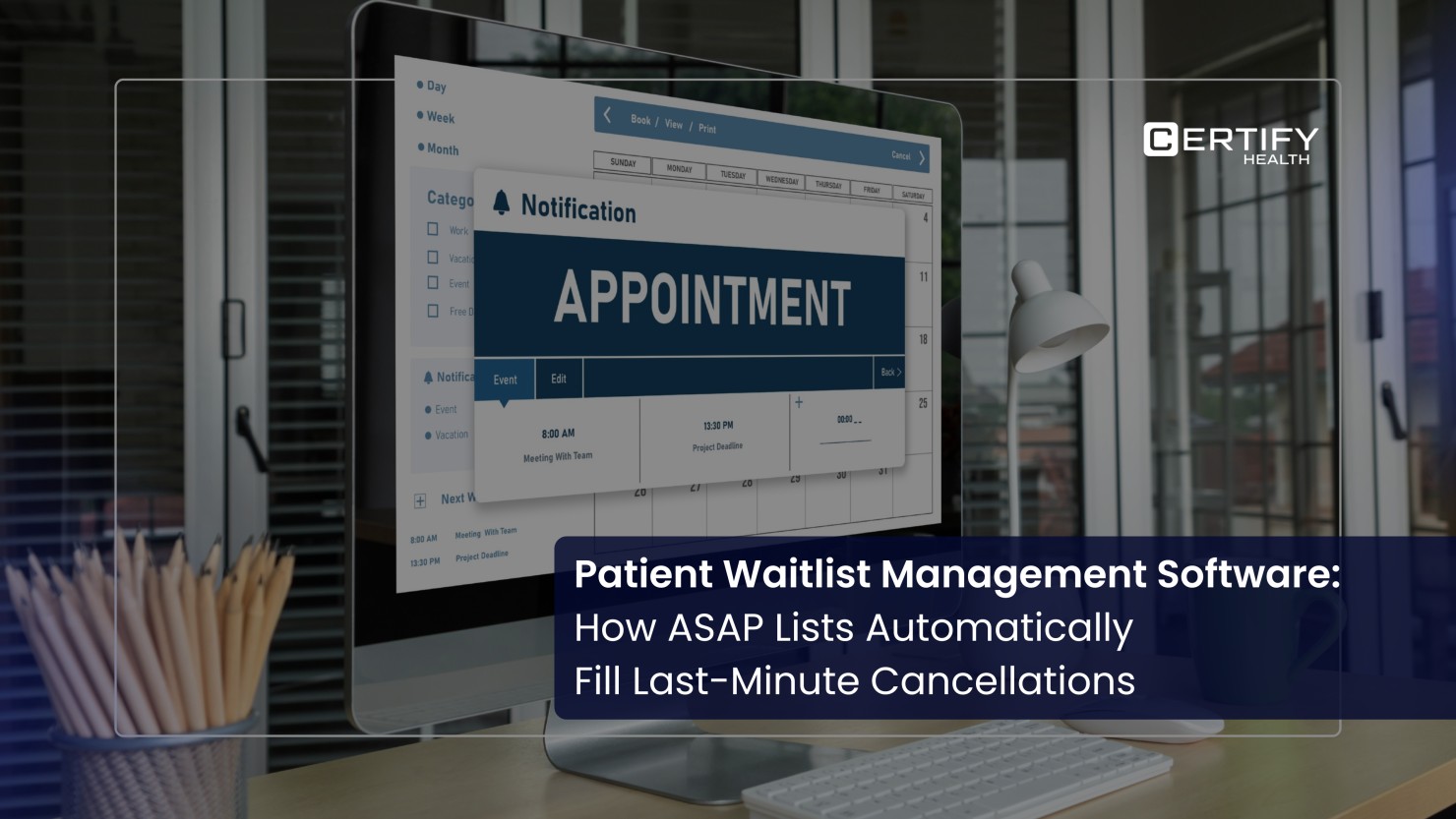
Once the gap is detected, the system scans the ASAP list for eligible patients. It looks at factors like: which provider the patient prefers, what procedure they need, and when they’re available. Then it sends automated alerts, via SMS or email, to the best-matched patients on the list.
This happens in under 2 minutes. Compare that to the 20–30 minutes your staff might spend calling down a paper list and leaving voicemails.
Good patient notification systems don’t just blast everyone. They send targeted, personalized messages that match the right patient to the right slot.
First-Come, First-Served Booking
This is where the magic of first come first served booking kicks in. The available slot is assigned to whoever confirms it first.
That’s it. No back-and-forth, no hold times, no waiting for a staff member to confirm manually.
Patients receive a link in their notification. They click it, confirm their availability, and the slot is theirs. The entire booking is self-serve. This first come first served model works because it’s fast and fair, patients who can make it on short notice get an earlier appointment, and the practice gets a full schedule.
Confirmation and Re-Scheduling
Once a patient books the newly opened slot, a few things happen automatically:
- The original, later appointment is held or cancelled — based on the patient’s preference.
- The new appointment is confirmed with automated reminders.
- The patient is removed from the ASAP list.
- The EHR schedule is updated in real time.
Re-scheduling has never been this clean. No paperwork, no manual updates, no follow-up calls. The system handles everything end-to-end.
ASAP List vs. Traditional Waitlist: Key Differences
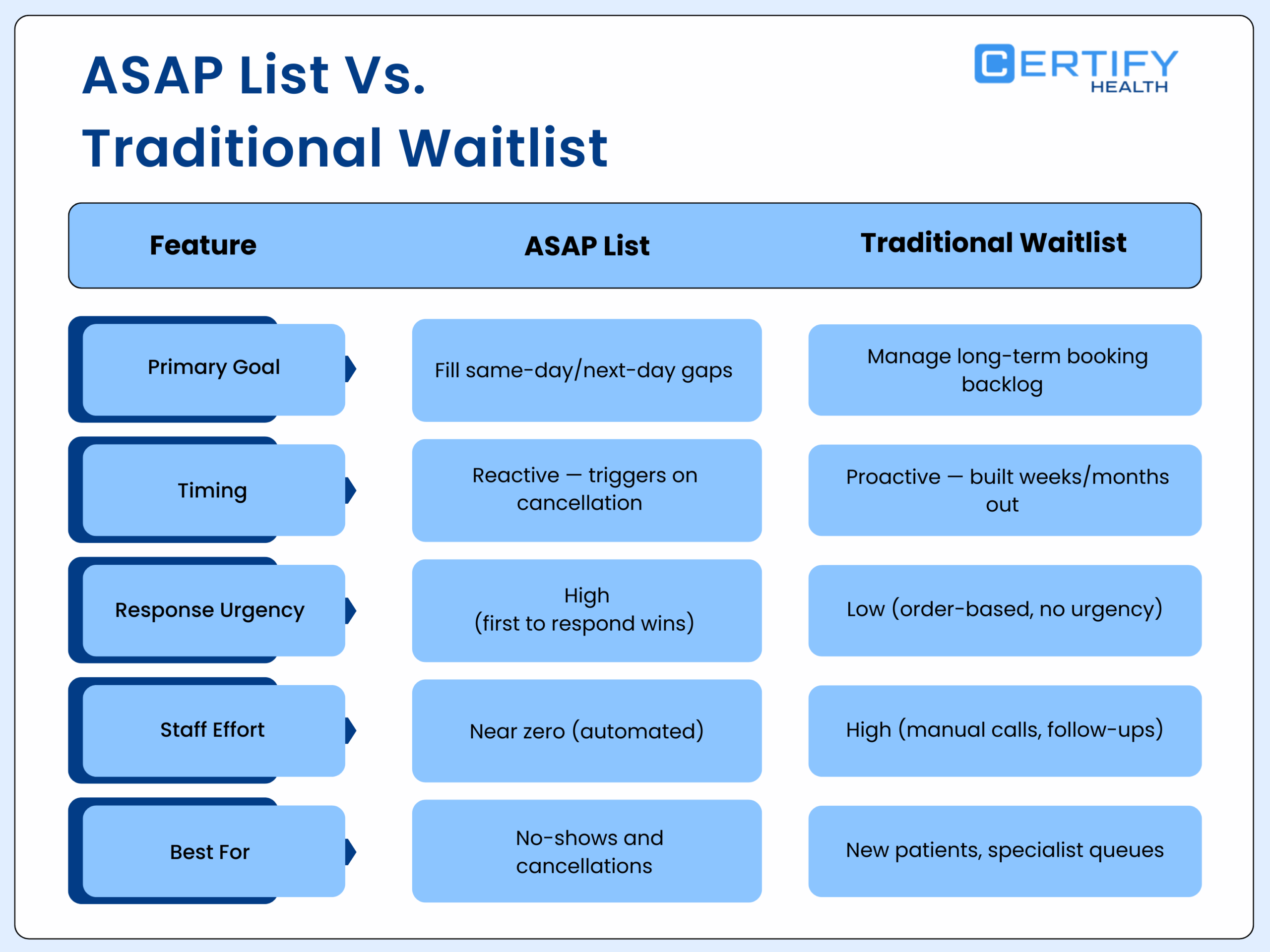
People often confuse ASAP lists with regular waitlists. But they are not same thing at all.
| Feature | ASAP List | Traditional Waitlist |
|---|---|---|
| Primary Goal | Fill same-day/next-day gaps | Manage long-term booking backlog |
| Timing | Reactive — triggers on cancellation | Proactive — built weeks/months out |
| Response Urgency | High (first to respond wins) | Low (order-based, no urgency) |
| Staff Effort | Near zero (automated) | High (manual calls, follow-ups) |
| Best For | No-shows and cancellations | New patients, specialist queues |
Traditional waitlists are valuable for long-term scheduling. But they’re not built for speed. They rely on staff to make calls, track responses, and manually update the schedule. In a fast-moving clinic, that’s just not fast enough.
Think about it this way: a traditional waitlist is like a physical line at a grocery store.
An ASAP list is like a digital queue that automatically calls the next person the second a register opens up.
The difference in speed and efficiency is enormous.
Benefits of Automated Waitlist Management
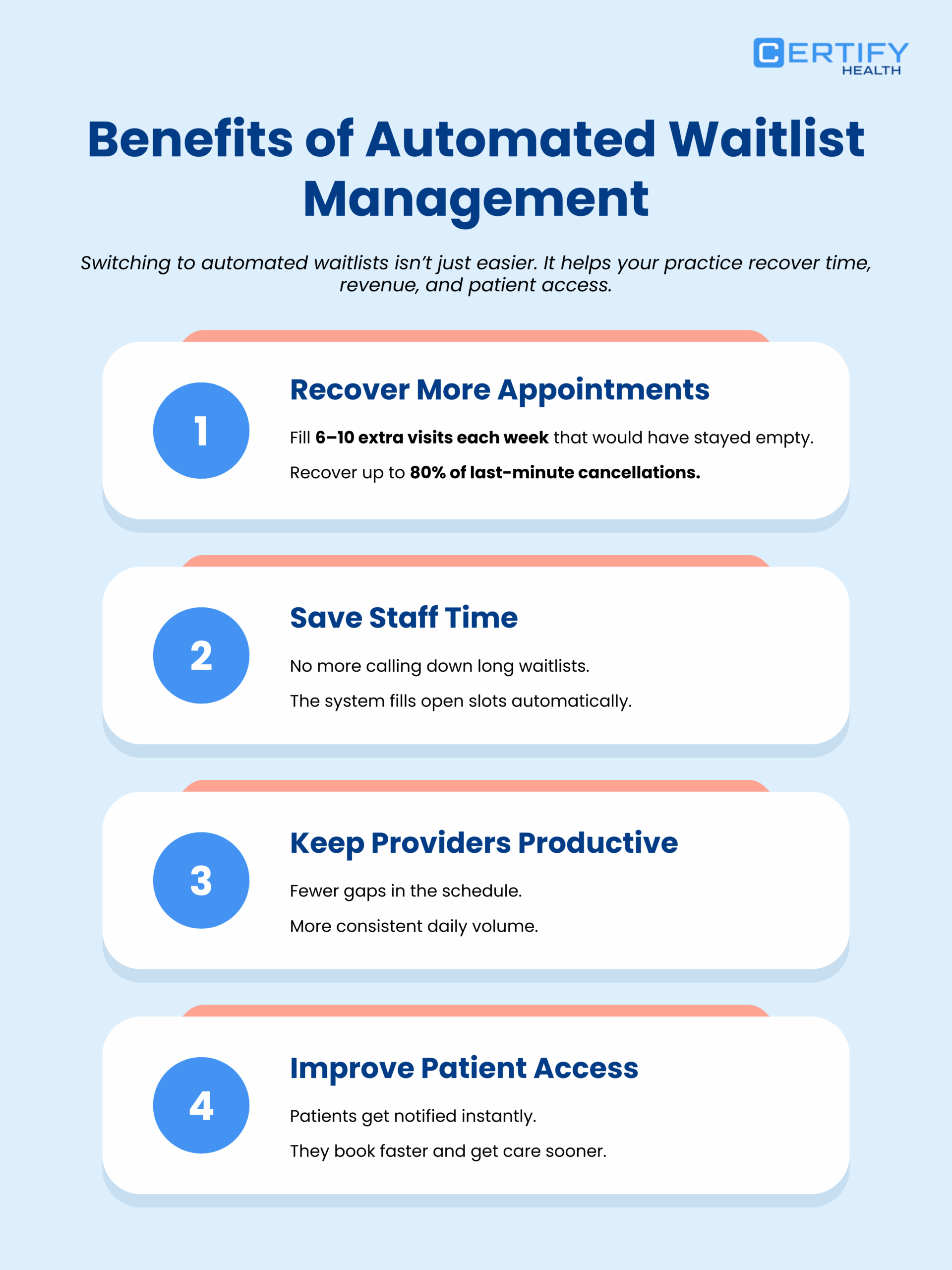
Switching from manual to automated waitlist management isn’t just a convenience upgrade. It’s a meaningful change to how your practice operates, and how much revenue you keep.
Recover 6–10 Appointments Per Week
Most practices using ASAP list software report recovering 6 to 10 appointments every week that would otherwise have gone unfilled. At $200+ per appointment, that’s $1,200 to $2,000 in recovered revenue, weekly.
ASAP list software can recover up to 80% of last-minute cancellations. That kind of fill rate is simply not possible with manual phone-based systems.
Eliminate Staff Time on Waitlist Management
The average front desk team spends 30–60 minutes per cancellation trying to fill a slot manually. That includes the initial call, voicemails, follow-up calls, and schedule updates.
With automated waitlist management software, that entire process runs without staff involvement. Your team gets that time back, time they can use for patient check-ins, care coordination, or other high-value tasks.
Improve Provider Utilization Rate
A better utilization rate means your providers are seeing more patients with less dead time in the schedule.
Automated ASAP lists close that gap. When every cancellation triggers an immediate, automated recovery effort, your utilization rate goes up. Providers stay productive. Revenue stays stable.
Better Patient Experience (Faster Access)
Patients who are on the ASAP list already want to come in sooner. When the system notifies them instantly, they feel heard. They get earlier access to care.
That’s a meaningfully better patient experience than waiting for a staff member to call them, maybe.
Automated patient booking systems also reduce the friction of scheduling. Patients can confirm in seconds from their phone, without navigating phone menus or waiting on hold.
Who Uses ASAP List Software?
ASAP list software is used across virtually every corner of healthcare.
- Dental Practices and DSOs: Dental teams deal with last-minute cancellations constantly. ASAP lists help hygienists and dentists maintain full schedules, keeping daily production goals on track.
- Primary Care Clinics: PCPs managing large patient panels use ASAP lists to ensure same-day and next-day availability — especially valuable for acute care needs.
- Specialty Practices: Dermatology, cardiology, oncology, ophthalmology — all high-demand specialties where a cancellation is expensive and a filled slot is critical.
- Hospital Systems: Larger health systems use ASAP waitlist tools for outpatient scheduling, care coordination, and managing complex multi-provider calendars.
- Urgent Care Clinics: Walk-in and urgent care centers benefit from real-time patient booking tools that adjust to demand spikes and schedule gaps dynamically.
CERTIFY Health ASAP Waitlist: How It Works
CERTIFY Health’s practice management platform includes a purpose-built Waitlist management software designed for modern healthcare practices. It’s not a bolt-on feature, it’s deeply integrated with how your schedule works.
- Step 1: Cancellation is detected automatically. When a patient cancels, CERTIFY Health’s system immediately identifies the open slot in your connected EHR. No staff input is required.
- Step 2: The ASAP list is scanned for eligible patients. The system filters your waitlisted patients by provider preference, procedure type, and availability. It finds the best matches, not just whoever is first on the list.
- Step 3: Automated SMS or email alerts go out instantly. Eligible patients receive a notification with the open slot details, including a direct link to confirm. All of this happens in under 2 minutes.
- Step 4: Patient self-schedule the new slot. The patient clicks the link, reviews the time, and confirms. The slot is booked. No staff involvement is needed. This is CERTIFY’s self-scheduling feature working in real time.
- Step 5: EHR schedule updates automatically. Once confirmed, the new appointment appears in your schedule; reminders are set, and the patient is removed from the ASAP list.
What makes CERTIFY’s approach stand out:
- Zero manual intervention required for the recovery process
- Works seamlessly with your existing EHR/EMR — no migration needed
- Patients can self-schedule from any device, 24/7
- Filters ensure the right patient gets the right slot
- Real-time schedule updates prevent double-booking or confusion
This is what true automated waitlist management looks like. Not a better spreadsheet or a smarter phone tree. A fully automated system that recovers revenue while your staff focuses on patient care.
Real Results: Practices Using ASAP List Software
The numbers tell the story.
- 30–40% reduction in revenue lost to cancellations. By quickly recovering open slots, practices cut the financial impact of gaps significantly. Even recovering just 3–4 extra appointments per week adds up to tens of thousands of dollars annually.
- Hours saved per week on manual scheduling tasks. Front desk teams report saving hours every week they used to spend calling down paper lists. That’s time redirected to higher-value patient interactions.
- Steadier, more predictable patient flow. Backfilling appointments means fewer dead hours in the schedule and more consistent daily production, even during high-demand periods.
- Improved patient satisfaction scores. Patients who get access to care earlier are happier. Practices using automated patient notification and self-scheduling tools consistently report higher satisfaction scores.
- Higher schedule utilization rates. Practices that actively manage their waitlist management process using automated tools see measurable improvements in their utilization rate. Sometimes 10–15 percentage points higher than those relying on manual processes.
The bottom line: ASAP list software doesn’t just fill slots. It changes how your practice operates. It turns a passive, reactive process, waiting for someone to answer a phone, into a proactive, automated system that works around the clock.
Conclusion
Appointment cancellations are unavoidable. But empty slots don’t have to be.
Every time a patient cancels, your practice has a choice: scramble manually and probably miss the window or let waitlist management software handle it automatically and recover that revenue in minutes.
CERTIFY Health’s ASAP list software is the answer most practices have been looking for. It removes the burden from your front desk, fills gaps before they cost you money, and delivers a better patient experience by getting people into care faster.
With real-time patient notification, first come first served self-scheduling, and seamless EHR integration; the recovery process becomes invisible, and effortless.
Our ASAP waitlist works within your existing practice management workflow, identifies the right patients for every open slot, and automates the entire re-scheduling process from start to finish.
Your providers are ready. Your rooms are ready. Your patients are ready.
The only question is: are you using the right waitlist management software to bring them together?