

How connected workflows, patient self-service and a hospitality-first approach help healthcare organizations create capacity, improve patient experiences and scale more effectively.
Healthcare organizations face mounting operational pressures. Rising administrative costs, persistent staffing challenges and fragmented technologies make it increasingly difficult to deliver consistent patient experiences while maintaining profitability. As practices expand, these challenges become more pronounced, particularly when organizations rely on manual processes and disconnected systems.
Automation offers an opportunity to address these challenges, but the conversation often starts in the wrong place. Rather than asking how technology can replace administrative employees, healthcare leaders should consider how it can increase the productive capacity of existing teams while supporting sustainable growth.
In a recent episode of the Thriving Practice Podcast, Jeremy Hummer, SVP of Strategic Partnerships and Growth at CERTIFY Health, joined host Tracy Cherpeski to discuss how automation can transform front-desk operations, improve staff retention and create more scalable healthcare organizations.
Breaking the Cycle of Administrative Burden and Staff Turnover
Front-desk teams spend considerable time managing patient registration, insurance information, paperwork, check-in and manual data entry. These repetitive responsibilities limit opportunities for employees to focus on patient engagement, appointment coordination and other higher-value activities.
Hummer described the recurring cycle of recruiting, training and replacing administrative employees. Practices invest weeks developing new staff, only to lose them to competing employers and repeat the process. Beyond recruitment expenses, turnover disrupts operations and places additional demands on remaining employees.
Automation helps organizations reduce their dependence on these manual processes. Digital pre-registration, self-service check-in and connected administrative workflows allow patients to complete routine tasks independently, creating additional capacity for existing teams while reducing the need to continually backfill positions.
In representative enterprise dental deployments, CERTIFY Health has demonstrated approximately 60 hours of additional administrative capacity per practice each week and reduced staffing backfill requirements by approximately 1.5 full-time equivalents per practice annually. These outcomes illustrate how organizations can increase productivity without proportionally expanding administrative staffing.
Bringing Hospitality Back to the Patient Experience
Hummer’s hospitality background shapes his perspective on healthcare automation. Technology should simplify routine interactions while allowing employees to deliver more personal service, particularly when patients need assistance.
Traditional check-in frequently involves repeated paperwork, insurance questions and manual data entry. Digital pre-registration, automated information verification and self-service kiosks can shift much of this work upstream, allowing patients to complete necessary tasks before arriving.
This approach also recognizes that patients have different preferences. Some welcome mobile-first interactions, while others prefer personal assistance. By automating predictable tasks, practices give employees more time to welcome patients, answer questions and manage situations requiring human judgment.
The objective isn’t to eliminate human interaction. It’s to make that interaction more meaningful and accessible.
Why Connected Workflows Matter More Than Individual Technologies
Many healthcare organizations already have technology supporting scheduling, forms, communications, eligibility, payments and reporting. The challenge often lies in connecting these functions rather than adding more applications.
Disconnected systems create duplicate data entry, manual handoffs and inconsistent processes. Patients experience unnecessary friction while staff spend time moving information between systems. Across multiple locations, these inefficiencies compound into greater operating costs and administrative complexity.
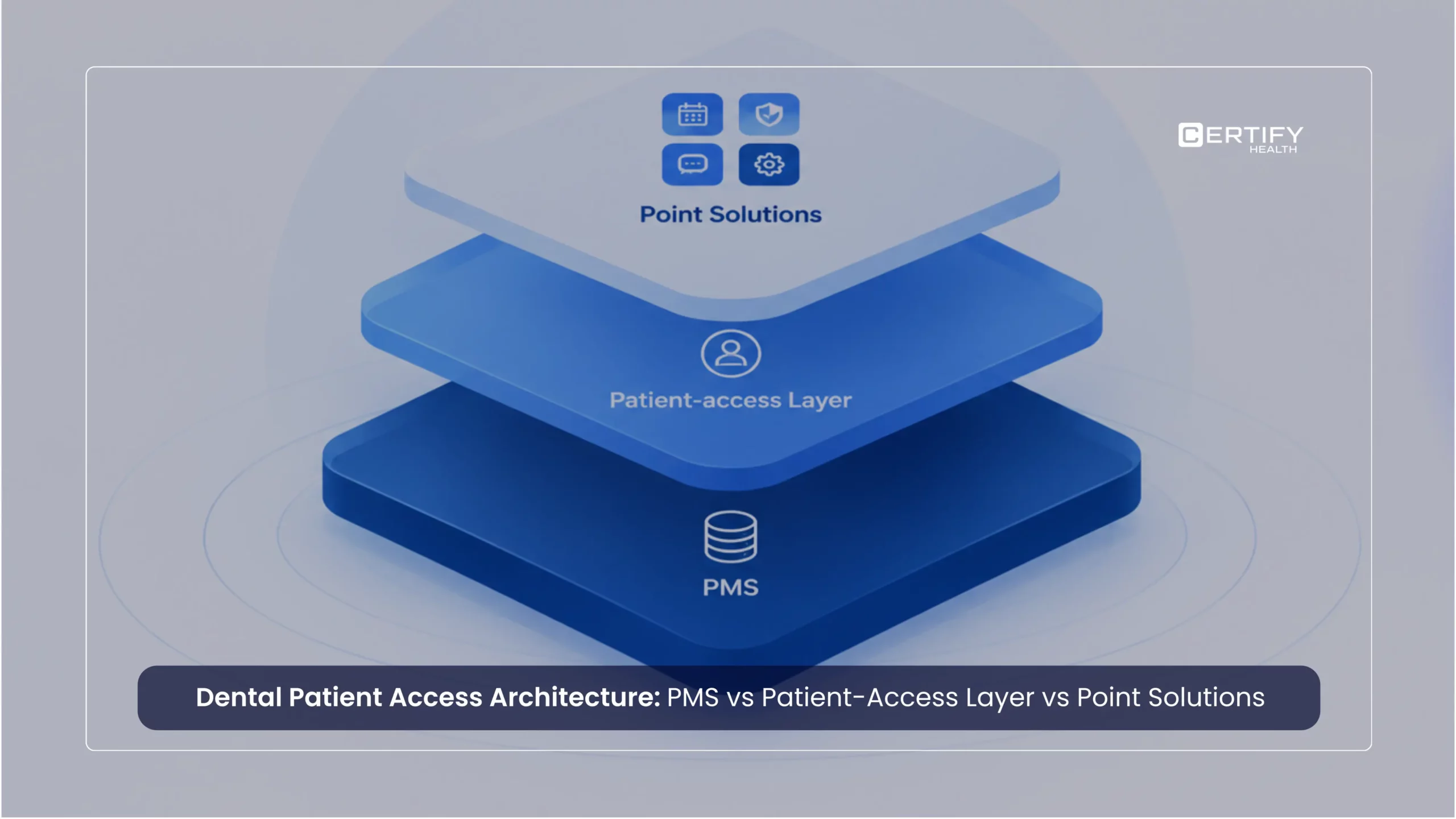
CERTIFY Health addresses this fragmentation through an enterprise operating platform connecting five administrative areas: Patient Intake, Patient Scheduling, Patient Communications, Payments & Revenue Cycle and Practice Performance.
Rather than replacing existing EHR or practice management systems, CERTIFY operates alongside them, connecting supported administrative workflows and reducing dependence on redundant technologies. This approach helps organizations establish more consistent operations while improving administrative capacity and visibility across locations.
Building a Scalable Operating Model
For multi-location healthcare organizations, particularly growing dental service organizations, acquisitions often introduce different practice management systems, administrative processes and patient experiences. Without a common operating framework, each additional location can increase complexity.
Hummer explained how CERTIFY helps organizations establish consistent patient-facing workflows across locations, even when different underlying systems remain in place. Patients encounter familiar registration and check-in experiences while employees benefit from standardized administrative processes.
This allows organizations to extend a common operating environment to newly acquired practices without requiring wholesale replacement of existing clinical technologies. Individual workflows can still accommodate differences among locations, specialties and operating requirements.
For emerging DSOs, establishing this foundation early can help prevent operational fragmentation from becoming a barrier to growth.
Measuring the Enterprise Value of Automation
The financial case for automation extends beyond direct labor savings. Connected workflows can improve patient access, reduce administrative errors, support collections and create additional capacity within existing teams.
These improvements become particularly valuable at enterprise scale, where even small workflow efficiencies can generate substantial cumulative benefits across dozens or hundreds of locations.
Leadership teams should evaluate how individual improvements translate into broader outcomes, including administrative productivity, financial performance, operational consistency and scalability.
Ultimately, successful automation connects measurable workflow improvements to meaningful enterprise economic value.
A More Human and Connected Future for Healthcare
The conversation between Hummer and Cherpeski reinforces an important principle: healthcare automation creates the greatest value when it improves how people work rather than simply replacing the work they perform.
For employees, this means fewer repetitive tasks and more opportunities to support patients. For patients, it means simpler interactions and greater access to personal assistance. For enterprise leadership, it means more consistent operations and a scalable foundation for growth.
As healthcare organizations expand, connected workflows and patient self-service can help them increase administrative capacity without proportionally increasing overhead.
The future of practice automation isn’t about replacing people. It’s about creating an operating environment where technology handles repetitive work and employees can focus on what matters most.
Listen to the Full Conversation
Hear Jeremy Hummer, SVP of Strategic Partnerships and Growth at CERTIFY Health, and Tracy Cherpeski discuss staffing challenges, patient experience and the role of automation in healthcare operations.
Thriving Practice Podcast, Episode 289: Practice Automation Isn’t About Replacing Staff. It’s About Keeping Them.