
Table of Contents
- Disconnected systems create costly inefficiencies. Data silos, duplicate testing, and billing errors drive billions in avoidable waste and slow clinical and revenue workflows.
- A healthcare data integration platform connects fragmented systems without rip-and-replace. CERTIFY Health integrates 234+ EHR and practice management systems using HL7 and FHIR APIs, creating a unified interoperability layer across clinical, billing, and patient-experience tools.
- Integrated data improves revenue, efficiency, and scalability. Clean data flows reduce claim denials, automate workflows, accelerate reimbursements, and typically deliver ROI within 6–12 months.
Introduction: Where $20M in Losses Actually Come From
Healthcare in the U.S. loses an estimated $1 trillion annually to inefficiency, with roughly ~25% of spending tied to waste that improved healthcare interoperability and shared electronic platforms could cut.
Data silos drive duplicate testing, delayed treatments, and avoidable readmissions, problems that hit smaller practices and multi‑specialty groups just as hard as large health systems.
Across the industry, billing and claims errors alone cost about $36 billion per year, largely fueled by poor data quality and disconnected workflows.
Introducing CERTIFY Health’s healthcare data integration software. Instead of forcing you to rip‑and‑replace legacy systems, our healthcare data integration platform auto‑integrates 234+ EHRs and EMRs (Epic, Cerner, MEDITECH, Dentrix, and others) through pre‑built HL7 integration software and FHIR v5‑ready APIs.
Whether you run a dental practice using Dentrix, an OB‑GYN group on athenahealth, or a multi‑specialty clinic on eClinicalWorks, CERTIFY Health’s healthcare interoperability platform connects your clinical, revenue, and patient‑experience systems in 4–8 weeks, with no custom development.
Healthcare Interoperability Challenges You Know Too Well
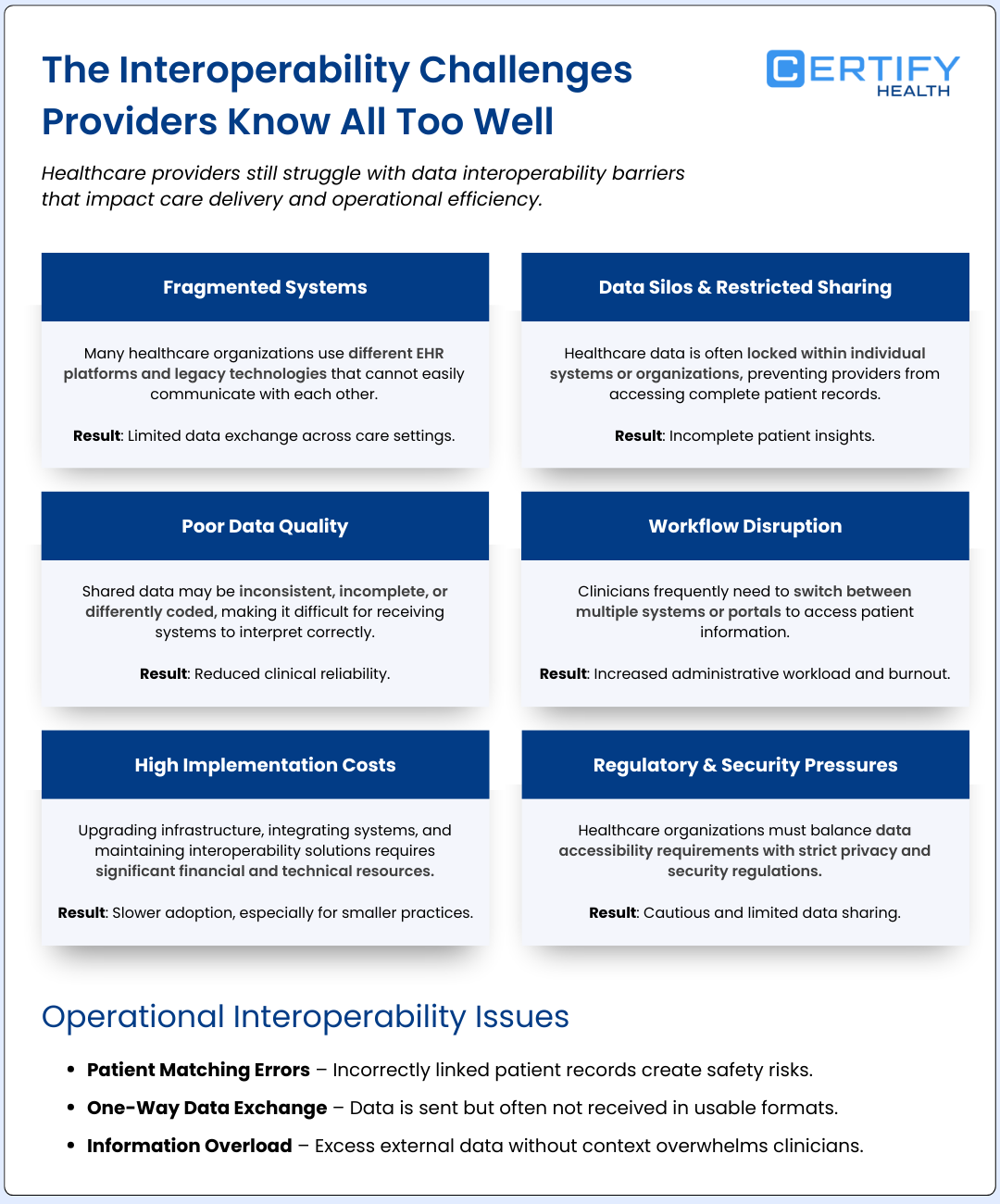
1. Fragmented Systems and Limited Communication
Many healthcare organizations run different EHR platforms that communicate with each other only through limited exchanges.
This fragmentation means that labs, imaging, and pharmacies often operate in isolation, forcing staff to chase results manually.
Solution:
CERTIFY Health’s healthcare interoperability platforms bridge these gaps via auto integrate capabilities, syncing data from Epic, Cerner, AdvancedMD, and eClinicalWorks without custom builds.
2. Data Silos and Restricted Sharing
Healthcare data is frequently locked within individual systems, resulting in incomplete patient records.
Without seamless sharing, clinicians miss critical context, leading to duplicate tests and delayed decisions.
Solution:
Our best interoperability platform for healthcare unifies these silos, providing a 360° view across legacy health systems and modern EHRs like Dentrix and DrChrono.
3. Poor Data Quality
Shared data is often inaccurate, incomplete, or formatted differently, making reliable clinical decisions difficult.
This directly risks patient safety and spikes claims denials.
Solution:
CERTIFY Health’s healthcare data integration software enforces semantic and structural standards through FHIR v5 and HL7 integration software, ensuring clean, actionable data flows.
4. Workflow Disruptions
Clinical workflows are disrupted between systems, multiplying administrative work and burnout.
Staff spend hours reconciling mismatched data instead of patient care.
Solution:
With CERTIFY Health, healthcare interoperability solution automates these handoffs, cutting redundancy and freeing teams.
5. Regulatory and Security Balances
Healthcare organizations must balance data accessibility with privacy and security regulations. Cautious sharing limits collaboration.
Solution:
CERTIFY Health’s top healthcare interoperability vendors platform includes audit trails, role‑based access, and full CMS/ONC compliance, so you scale securely.
6. Operational Interoperability Issues
Point‑to‑point data exchanges fail to capture full context after initial receipt in usable formats.
Information overload from external data overwhelms clinicians without proper context.
Solution:
CERTIFY Health resolves this with intelligent routing and enrichment via our healthcare data integration platform, turning raw exchanges into workflow accelerators.
To know the Interoperability Challenges in Depth, Read: Healthcare Interoperability Challenges: Why Data Still Doesn’t Flow Between Systems
CERTIFY Health’s Healthcare Data Integration Platform Saves You Real Dollars
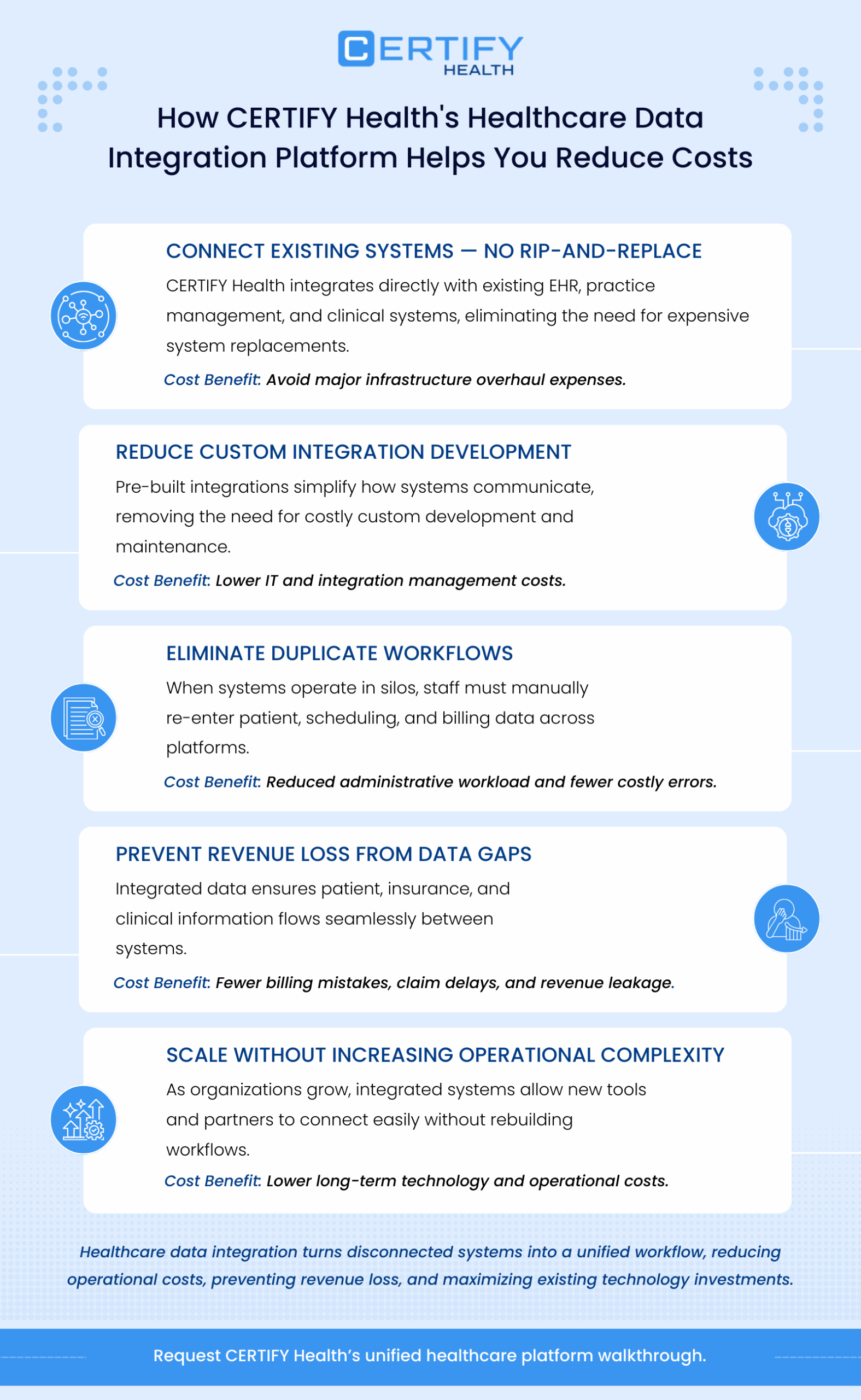
CERTIFY Health’s healthcare data integration platform delivers measurable cost savings by connecting your existing systems without rip‑and‑replace disruption. Check how we does that:
1. Connect Existing Systems: No Rip-and-Replace
CERTIFY Health integrates clinical, management, and billing systems, eliminating the need for expensive major system builds.
Our healthcare data integration software works with Epic FHIR integration, Cerner integration, Dentrix integration, and more, over 234 systems, without forcing you to overhaul your EHR stack.
2. Reduce Custom Integration and Infrastructure Overhead
Pre‑built integrations simplify how systems communicate, avoiding the $30K–$150K typical for custom HL7 integration software projects.
CERTIFY Health’s auto integrate deploys within few weeks, slashing IT labor and setup costs while maintaining uptime.
3. Lower Maintenance and Integration Management Costs
Ongoing maintenance on legacy interfaces often exceeds $50K annually, but CERTIFY Health includes it in the platform.
Updates for FHIR v5, TEFCA, and compliance are handled seamlessly, so your team focuses on care, not patching.
4. Eliminate Duplicates, Workflows, Staff Manually
When data silos force manual reconciliation, staff time vanishes into duplicates and errors.
CERTIFY Health’s healthcare interoperability platforms automate these, reducing administrative workloads and lowering error rates that contribute to $36 billion in annual claims losses.
5. Prevent Revenue Loss from Data Gaps
Integrated data flows securely between systems, closing gaps that leak reimbursements.
With clean data across AdvancedMD integration, athenahealth integration, DrChrono integration, and eClinicalWorks integration, denials drop from the 20–30% range, boosting cash flow.
6. Scale Without Billing, Claims, Revenue Complexity
Grow partnerships and integrated revenue tools easily with CERTIFY Health’s best interoperability platform for healthcare.
This cuts long‑term operational costs and protects integration investments, enabling scalable workflows that lift revenue by 10–25%.
Take a Next Step – Book a Personalized Demo to See it in Action!
Operational Wins from Connected Data
Studies show that administrative staff spend nearly 41% of their time on repetitive tasks, including data entry, form filling, and manual reconciliation. When your healthcare data integration platform auto‑syncs orders, results, and patient‑facing workflows, you sharply reduce duplication and redundancy.
Practices that replace fragmented, manual processes with a healthcare interoperability platform like CERTIFY Health’s see:
- Around 30% reduction in duplicate tests and redundant intake workflows, which directly lowers the per‑patient cost of care.
- Fewer claims denials: With clean, consistent data flowing from EHRs (Epic, Cerner, eClinicalWorks, etc.) to billing engines, denial rates drift toward the lower end of the 20–30% range commonly reported, effectively lifting revenue by 10–25%.
- Faster reimbursements: Automated, connected workflows shorten days in accounts receivable by minimizing follow‑up on rejected or incomplete claims.
Staff impact and ROI
Burnout among administrative and clinical staff is a top‑tier priority for healthcare executives. Research finds that overall burnout among healthcare workers nears 49%, with administrative staff often at or above those levels. Excessive data entry and manual reconciliation are consistently cited as key drivers.
CERTIFY Health’s healthcare interoperability platforms directly attack that driver. By automating intake, scheduling, billing, and clinical‑to‑revenue workflows through a single healthcare data integration platform, we cut the time staff spend on repetitive tasks and reduce cognitive load at the end of the day.
Typical returns for a practice deploying CERTIFY Health include:
- Integrations live in 4–8 weeks, with ongoing support and updates included in the platform subscription.
- ROI in approximately 6–12 months from a combination of lower integration spend, fewer denials, and higher throughput.
- Compliance and security built in: audit trails, data‑residency controls, and real‑time monitoring keep you aligned with CMS, ONC, and evolving interoperability mandates.
Build vs. Buy? Buy CERTIFY: Proven Strategy
Why custom HIEs underdeliver
Building an in‑house health information exchange (HIE) looks attractive on paper, but it quickly becomes a capital‑intensive, high‑maintenance endeavor.
Custom interfaces to Epic, Cerner, Dentrix, and other EHRs each require specialized resources, ongoing maintenance, and frequent security and compliance updates.
The aggregate cost and risk of that “build‑it‑yourself” path can easily total $20M+ across a health system’s footprint.
Instead, joining CERTIFY Health’s interoperability ecosystem lets you tap into a pre-built integration layer designed to connect seamlessly with EHRs like Epic and Cerner, dental systems like Dentrix, and leading practice-management platforms such as AdvancedMD, athenahealth, DrChrono, and eClinicalWorks. Connect with our Team to Know More.
Also, Read: Our Guide on Things to Consider Before Implementing Healthcare Interoperability Solutions
What The Roadmap Looks Like
For a practice or system, the path to lower interoperability costs with CERTIFY Health typically follows three stages:
1. Free audit and assessment
Audit to map your current interfaces, identify duplication, and quantify claims leakage and staff‑time waste. This step alone often reveals millions in recoverable margin.
2. Auto‑integrate in 4–8 weeks
Our auto integrate capability connects your existing EHRs (Epic, Cerner, Dentrix, etc.) through HL7 integration software and FHIR v5 APIs without requiring you to redesign core workflows.
You can selectively sync demographic, clinical, and billing data, adding role‑based access and triggers, so only the right people see the right information at the right time.
3. Secure scale and compliance
As regulations evolve, CERTIFY Health’s healthcare interoperability platform keeps pace with SMART on FHIR, TEFCA, and ONC‑style requirements so you’re never caught flat‑footed.
The result is about 40% lower total cost of ownership (TCO) versus building and maintaining a custom HIE, with no sacrifice to uptime or security.
Your Next Step
For most practice managers, the real question is no longer whether to integrate systems, but how quickly they can stop the interoperability cost leak. Disconnected EHRs still force staff to reconcile faxed records, manually re-enter data, and chase preventable denials, wasting hours of staff time while increasing duplicate testing and revenue loss.
CERTIFY Health’s healthcare data integration platform is built to close that gap. Through a single interoperability layer, it connects Epic, Cerner, Dentrix, AdvancedMD, athenahealth, DrChrono, eClinicalWorks, and hundreds of other systems using HL7 and FHIR-based integrations.
If you want to see the financial impact, start with an interoperability cost audit. Quantify claims leakage, staff-time waste, and duplicate-testing costs, then Book a Demo with CERTIFY Health to know how connected workflows can recover margin.